One of the most beautiful and overlooked themes in Scripture is the Breath of God.
From the opening pages of Genesis to the return of Christ, God’s breath appears again and again. Sometimes it gives life. Sometimes it restores what is dead. Sometimes it reveals truth. Sometimes it brings judgment. Yet in every case, the breath of God represents His active presence and power at work in creation.
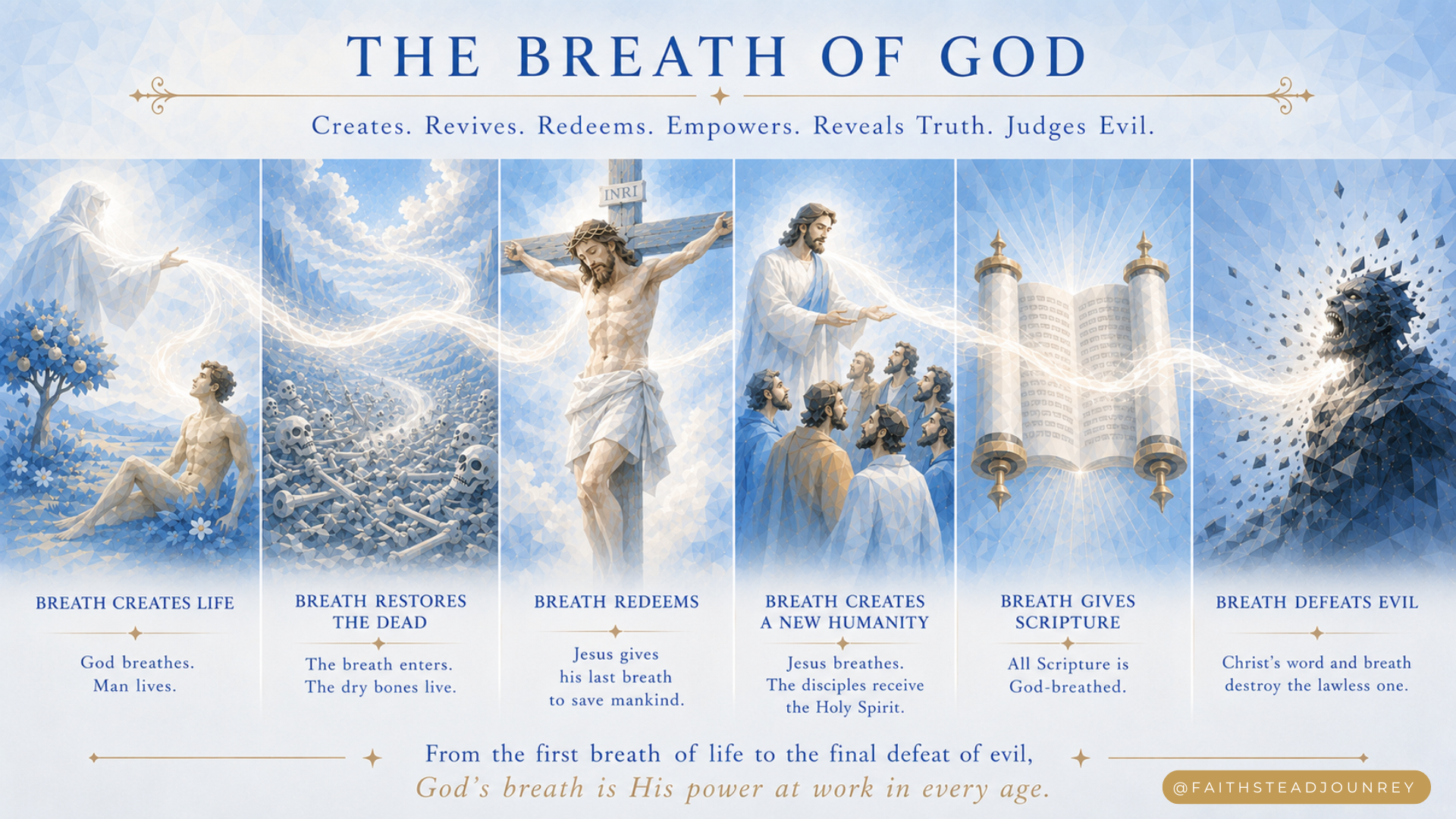
The Bible’s story begins with God’s breath entering man and ends with Christ’s breath destroying evil. Between those two moments lies a remarkable thread that unites creation, redemption, resurrection, the Holy Spirit, and the Word of God.
Breath, Wind, and Spirit
Part of what makes this theme so rich is the language Scripture uses.
In Hebrew, the word ruach can mean:
- Breath
- Wind
- Spirit
Likewise, the Greek word pneuma can mean:
- Breath
- Wind
- Spirit
The biblical authors intentionally use these overlapping meanings. Breath, wind, and Spirit all describe invisible realities whose presence is known through their effects.
You cannot see the wind, but you see trees move.
You cannot see breath, but you see life.
You cannot see the Spirit, but you see His work.
This connection forms the foundation of the biblical theology of God’s breath.
The Breath That Created Life
The first mention of God’s breath appears in Genesis 2:7:
“Then the Lord God formed the man of dust from the ground and breathed into his nostrils the breath of life”
Adam was fully formed before God breathed into him. But it wasn’t until God’s breath entered Adam that dust became a living soul.
The pattern is simple:
Dust + God’s Breath = Life
Life is not self-generated. Human existence begins as a gift flowing from the breath of God.
The Breath That Sustains Creation
The Bible teaches that God’s breath not only created life but continues to sustain it.
Job declares:
“The Spirit of God has made me, and the breath of the Almighty gives me life.”
The psalmist echoes the same truth:
“When you hide your face, they are dismayed; when you take away their breath, they die. and return to their dust.”
Creation is not independent of God. Every breath taken by every creature ultimately depends upon Him.
The God who breathed life into Adam continues to uphold all life by His power.
The Breath of God and the Name of God
Speaking about our dependance on God. Did you know some Jewish and Christian writers have noted that the divine name, YHWH, is composed largely of breath sounds.
While this is not explicitly taught in Scripture, some theologians have found symbolic significance in the idea that every breath reminds humanity of dependence on God. Meaning that every time you breath, you are whispering God’s name and every inhale and exhale becomes a quiet testimony to our dependence on our Creator. Whether awake or asleep, aware or unaware, we live by His breath. Every heartbeat, every breath, every moment is sustained by His grace.
The Breath That Creates the World
Psalm 33 expands the theme beyond humanity:
“By the word of the Lord the heavens were made, and by the breath of his mouth all their host.”
Notice the pairing:
- The Word of God
- The Breath of God
Creation comes through God’s speaking.
Throughout Scripture, God’s breath and God’s word are closely connected. God’s breath carries His word, and His word accomplishes His will.
The universe itself exists because God spoke.
The Breath That Restores the Dead
Perhaps nowhere is the imagery more vivid than Ezekiel 37.
The prophet is carried into a valley filled with dry bones. The bones are scattered, lifeless, and hopeless.
God commands Ezekiel to prophesy. The bones come together, flesh appears, and bodies are formed. Yet there is still no life.
Then God says:
“Come from the four winds, O breath, and breathe on these slain, that they may live.”
When God’s breath enters them, the dead stand up and a vast army lives again.
The vision teaches that God’s breath can accomplish what human effort cannot. What is dead, hopeless, and beyond recovery can live again through the power of God.
The Breath That Redeems
At creation:
“The LORD God… breathed into his nostrils the breath of life.”
At the cross:
“He bowed his head, and gave up his spirit.” (John 19:30)
Many theologians saw a profound symmetry here. As human history begins with God breathing life into man, so redemption reaches its climax when the Son of God breathes out His life for man. Then after the resurrection, He breathes life back into His disciples.
Creation → Fall → Redemption → New Creation
All marked by the breath of God.
The Breath That Begins a New Creation
After His resurrection, Jesus appeared to His disciples and did something extraordinary.
“He breathed on them and said to them, ‘Receive the Holy Spirit.'”
This action is no accident.
John intentionally echoes Genesis. In Genesis, God breathes into Adam and in John, Jesus breathes upon His disciples. The first breath launched the old creation and the second breath launches the new creation.
Just as Adam received life through God’s breath, the disciples receive spiritual life and empowerment through Christ. John 20 is a new Genesis—a moment in which Christ, the Creator Himself, begins restoring what was lost in Eden.
The Breath That Gives Scripture
One of the most surprising appearances of this theme occurs in 2 Timothy 3:16.
Paul writes:
“All Scripture is breathed out by God.”
The Greek word is theopneustos—literally “God-breathed.”
The same God who breathed life into Adam also breathed out His Word. Scripture is not merely human reflection about God. It is God’s own revelation, breathed out for teaching, correction, rebuke, and training in righteousness. The breath that creates life is also the breath that reveals truth.
The Breath That Brings Judgment
The breath of God is not only life-giving. It is also powerful in judgment.
Isaiah prophesied of the coming Messiah:
“with the breath of his lips he shall kill the wicked.”
Paul draws from this imagery when he writes:
“And then the lawless one will be revealed, whom the Lord Jesus will kill with the breath of his mouth and bring to nothing by the appearance of his coming.”
This is a striking image. The ultimate enemy of God is not defeated through a long struggle. Christ simply speaks.
Conclusion
The breath of God is one of the great unifying themes of Scripture.
God’s breath creates.
God’s breath sustains.
God’s breath restores.
God’s breath empowers.
God’s breath reveals truth.
God’s breath judges evil.
Throughout Scripture, God’s breath is never merely air. It is His life-giving presence moving creation from chaos to life, from death to resurrection, from exile to restoration, and ultimately from the old creation into the new.
What God’s breath touches cannot remain the same. The same breath brings life or brings death. To those aligned with God, it is sweet and brings life. To those opposing Him, His breath is foul and brings judgment. This is similar to how the same sun softens wax or hardens clay.
And even now, through the Holy Spirit, the breath of God continues to bring life to all who believe.