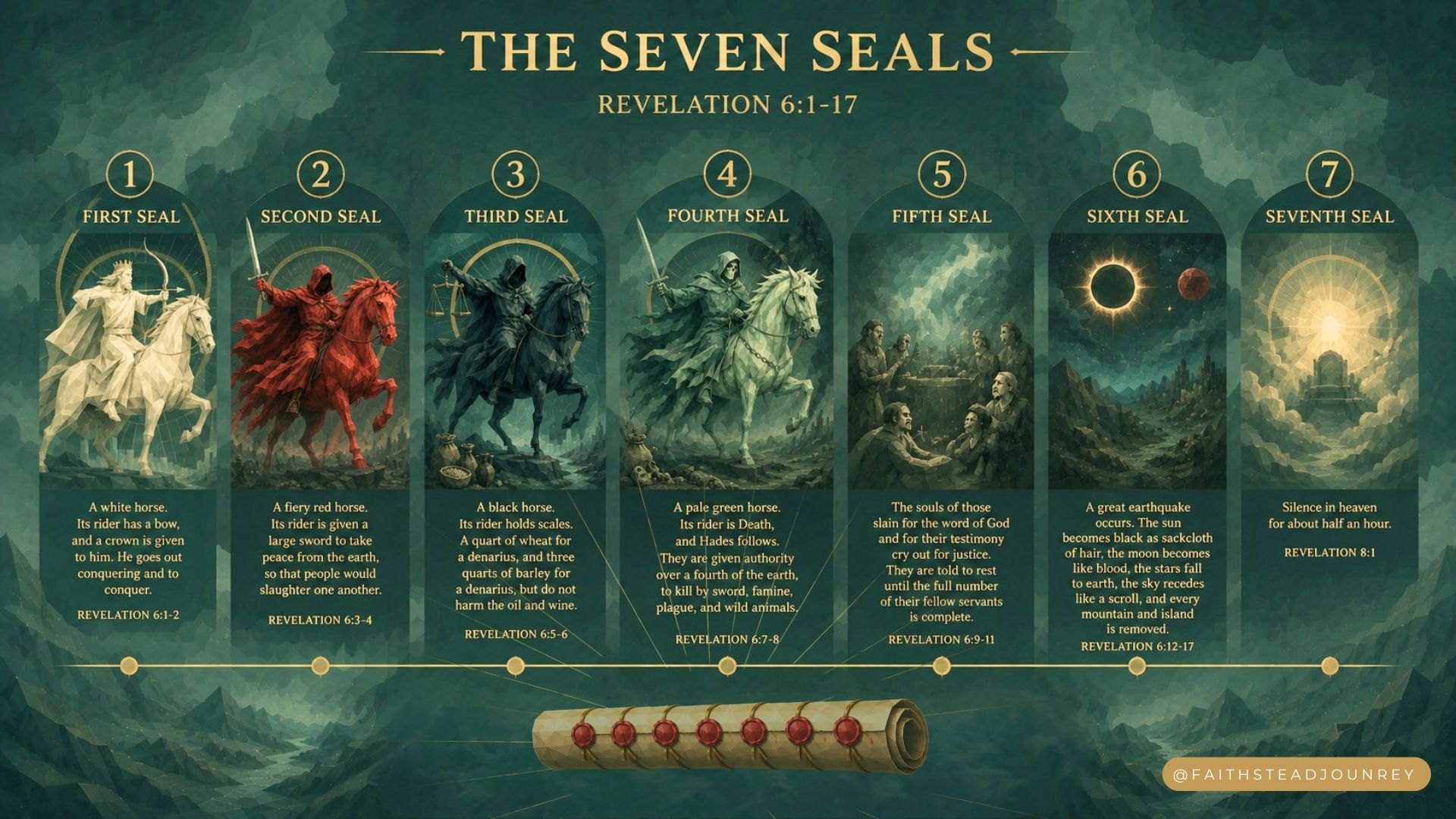
This week is all about the seals!
Recap
Last week we got a glimpse of the throne room and saw that the One seated on the throne had a scroll that was sealed with seven seals in His right hand. No one in heaven, on earth, or under the earth, was worthy to open it except the Lion of the tribe of Judah. Some scholars say this scenario may have echoed something familiar to the original audience. A Roman will or legal document was often sealed with seven seals and signed by seven witnesses. Those same witnesses were typically present for the official opening of the will, marking the moment it was carried out. Which I think if true would give us another interesting angle into why only the Lamb with the seven eyes, seven horns, and seven spirits is worthy to open the scroll, because He was the only One present from the beginning.
This week, we watch as the Lamb begins to open the scroll.
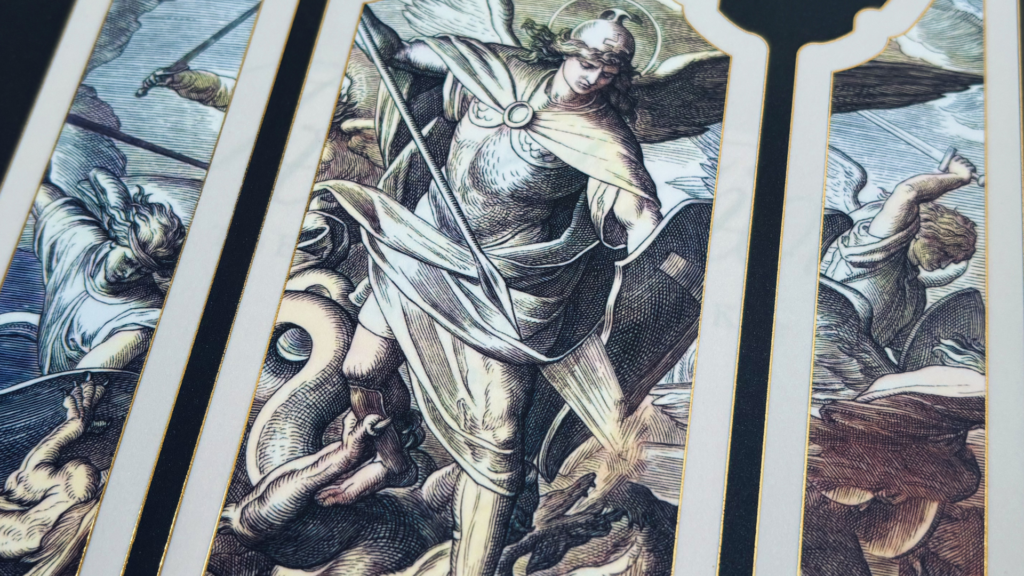
The First Four Seals
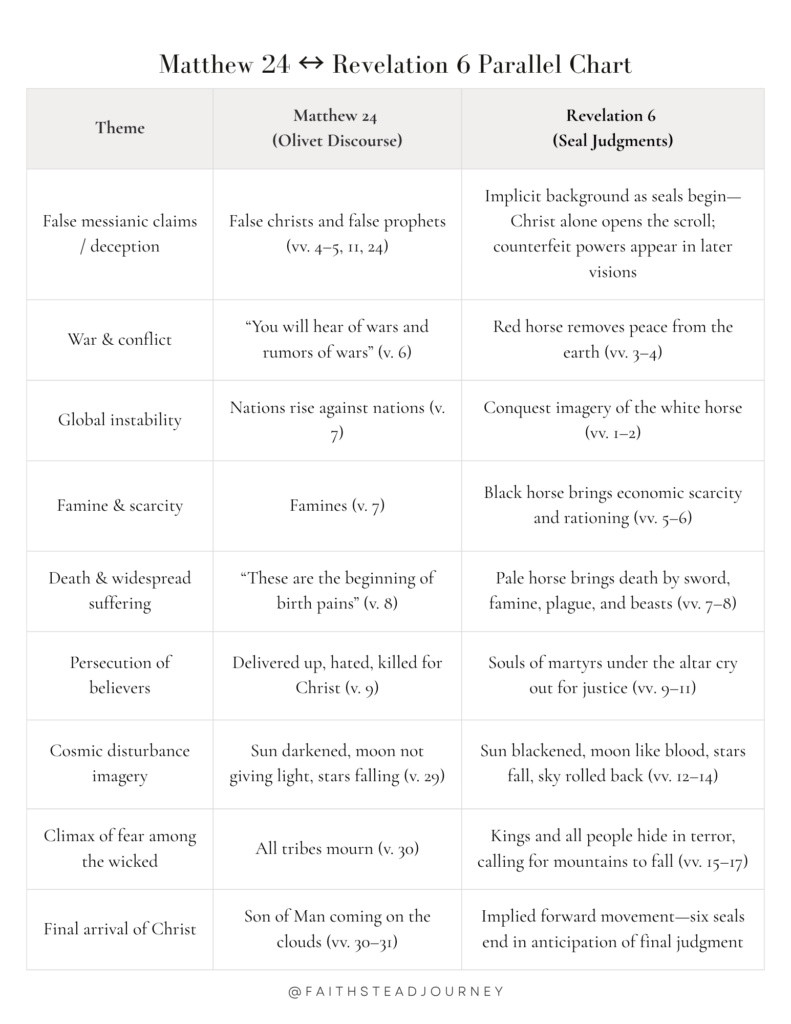
As each seal is opened, different events unfold: conflict, war, famine, death, persecution, and major cosmic signs. I found it interesting that a similar picture appears in Matthew 24, where Jesus describes what the world will be like before His return. He talks about wars, disasters, persecution, and signs in the heavens. When you compare these passages, you start to see that they are describing the same reality from two different angles—Jesus in teaching form, and John in symbolic vision.
In Matthew 24:6–8, Jesus says there will be wars, famines, and earthquakes, and He calls these the beginning of birth pains. In Revelation 6, the first four seals reveal four horsemen representing conquest, war, famine, and death. Even though the images are different, the message is the same: the world will experience tribulation as history moves toward its final goal.
One of the key ideas Jesus uses in Matthew 24 is the phrase “birth pains” (Matthew 24:8). This is an important clue for understanding both passages.
When a woman goes into labor, the contractions:
- start out lighter and spaced apart
- but gradually become stronger
- more frequent
- and more intense as the moment of birth approaches
Jesus uses this picture to describe what history will feel like before His return. The point is not simply that bad things will happen, but that they will increase in both intensity and frequency over time. With the opening of each seal, there also seems to be a growing sense of escalation and urgency.
Jen Wilkin has described it as four different camera angles: the first is like a wide shot, then a medium shot, then a closer side angle, and finally a close-up. As the perspective tightens, the intensity feels stronger and more immediate, helping us feel the weight of what is unfolding.
At the same time, we need to be careful not to assume that our own moment in history is necessarily the worst. We are all shaped by our time and culture, and it is easy to assume that what we are experiencing is uniquely severe. That perspective can sometimes fuel unnecessary fear, rather than steady faith and discernment.
Theological Snapshot
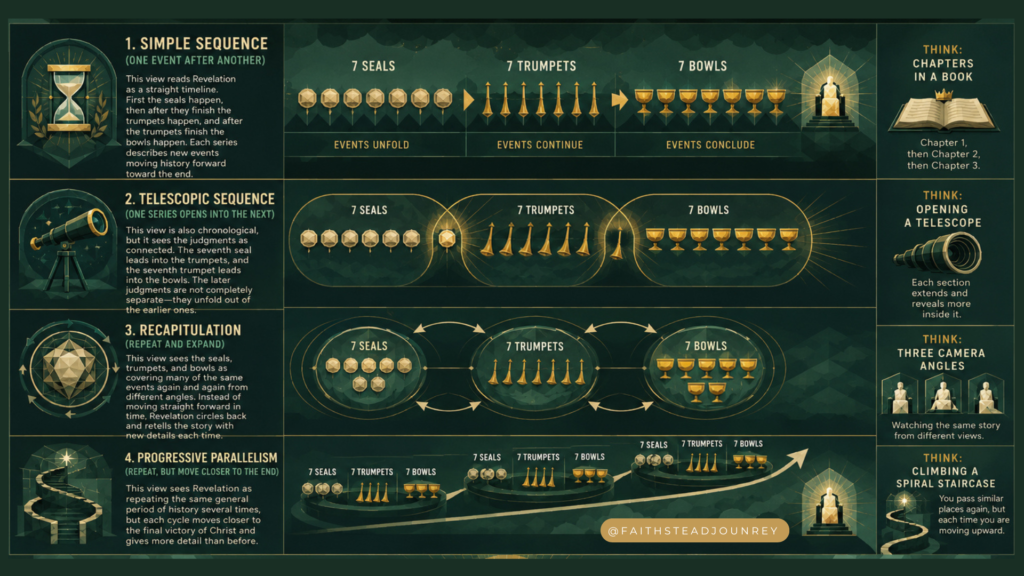
I also want to note that, so far, this study appears to lean toward a recapitulation view in understanding the relationship between the seals, trumpets, and bowls. However, faithful Christians throughout church history have interpreted these passages in different ways. The goal here is not to settle every debate but to read Revelation carefully and recognize that thoughtful believers may arrive at different conclusions.
Simple Sequence (One Event After Another)
This view reads Revelation as a straight timeline. First the seals happen, then after they finish the trumpets happen, and after the trumpets finish the bowls happen. Each series describes new events moving history forward toward the end.
Think: chapters in a book — Chapter 1, then Chapter 2, then Chapter 3.
Telescopic Sequence (One Series Opens Into the Next)
This view is also chronological, but it sees the judgments as connected. The seventh seal leads into the trumpets, and the seventh trumpet leads into the bowls. The later judgments are not completely separate—they unfold out of the earlier ones.
Think: opening a telescope—each section extends and reveals more inside it.
Recapitulation (Repeat and Expand)
This view sees the seals, trumpets, and bowls as covering many of the same events again and again from different angles. Instead of moving straight forward in time, Revelation circles back and retells the story with new details each time.
Think: watching three different camera angles of the same game.
Progressive Parallelism (Repeat, but Move Closer to the End)
This view sees Revelation as repeating the same general period of history several times, but each cycle moves closer to the final victory of Christ and gives more detail than before.
Think: climbing a spiral staircase—you pass similar places again, but each time you are moving upward.
As we study Revelation, our goal is not only to decide on a structure but to see what each vision teaches us about Jesus, His kingdom, and how His people are called to endure and worship.
The Fifth Seal
When we reach the fifth seal, something distinct happens. The souls of martyrs cry out for justice under the altar. John sees believers who were killed for their faith, and they cry out to God, asking, “How long, O Lord, until you judge and avenge our blood?” This is a question about justice and timing—they are asking when God will finally make things right. God responds by giving them white robes, which signals their vindication, and He tells them to wait a little longer until the full number of God’s people is complete. In Matthew 24:9, Jesus similarly warns that His followers will be hated and killed because of Him. In both cases, God sees the suffering of His people and assures them that justice is coming, which sets the stage for the sixth seal.
The Sixth Seal
“Then I saw him open the sixth seal. A violent earthquake occurred, the sun turned black like sackcloth made of hair; the entire moon became like blood; the stars of heaven fell to the earth as a fig tree drops its unripe figs when shaken by a wind; the sky was split apart like a scroll being rolled up; and every mountain and island was moved from its place.” – Revelation 6:12-14
Here we see seven parts of the earth judged:
- earthquake (land)
- sun
- moon
- stars
- sky
- mountain
- island
“Then the kings of the earth, the nobles, the generals, the rich, the powerful, and every slave and free person hid in the caves and among the rocks of the mountains.” Revelation 6:15
Here we see seven parts of humanity judged:
- kings
- nobles
- generals
- rich
- powerful
- slave
- free
What we see in this passage is a picture of total, all-encompassing judgment. First, John describes judgment coming upon the entire created world—earth, sky, and heavenly lights—showing that nothing in creation is untouched. Then he shows judgment reaching every level of humanity, from the most powerful rulers to the most ordinary people. No one is exempt or hidden from what is happening.
The repeated use of “seven” in both sections emphasizes completeness. In Revelation, seven often symbolizes fullness or totality. Here, it highlights that God’s judgment is not partial or random—it is complete, thorough, and reaches every part of both creation and humanity.
At the same time, the response of the people in verse 15 shows something important: when humanity faces the reality of God’s power, human status, wealth, and strength no longer matter. Everyone responds the same way—by trying to hide.
The fifth and sixth seals are closely connected, with the sixth seal functioning as the beginning of God’s answer to the question raised in the fifth. In the sixth seal (Revelation 6:12–17), we begin to see that answer unfold as dramatic signs appear in the heavens and people on earth are filled with fear, recognizing that the “wrath of the Lamb” is arriving. In other words, the question asked in the fifth seal—“How long?”—starts to be answered in the sixth seal as God’s justice becomes visibly apparent in history, even though it is not yet the final judgment. This reveals a pattern in God’s timing: His justice is certain, but it unfolds according to His sovereign plan, and His people are called to trust Him as they wait.
The Redeemed
During the sixth seal, Revelation shifts in chapter 7 before the final seal is opened. This chapter shows two key visions: the sealing of God’s people and the great multitude worshiping before the throne.
In Revelation 7:1–3, John sees four angels holding back the “four winds of the earth.” The number four in Revelation often points to the whole world—north, south, east, and west. In other words, nothing on the earth is outside of what is being described. The judgment is being restrained everywhere, not just in one place.
But this restraint is not random—it has a purpose.
Right after this, another angel tells the four angels not to harm the earth until God’s servants are sealed on their foreheads. This shows us that before judgment continues, God marks and protects His people. Their sealing doesn’t mean that they didn’t suffer affliction and death in their physical bodies, but it does mean that they’re sealed for salvation. The sealing is a sign of belonging and preservation, meaning they are known and secured by God even in the middle of coming judgment.
Then in the same chapter, John sees two groups:
First, the 144,000, symbolizing God’s sealed people on earth.
Second, a great multitude that no one can count, standing before the throne from every nation, tribe, people, and language.
This interlude is important because it shows that even in the middle of suffering and judgment, God is still working out His plan of salvation.
Notice that the tribes of Dan and Ephraim are not mentioned. Readers familiar with the Old Testament may recognize that these tribes are at times associated with idolatry. Symbolically, this highlights a contrast: those who worship the Creator are marked as redeemed, while those who turn to worship the created are shown as excluded from God’s redeemed people.
Seven Promises
The second half of Revelation 7 echoes many of the throne room scenes in Revelation 5, where the Lamb is revealed as both victorious and worthy to shepherd His people. What begins as heavenly worship in chapter 5 now becomes the lived reality of God’s people in chapter 7.
John then presents seven promises of blessing for those who stand before the throne:
- The One seated on the throne will shelter them
- They will no longer hunger
- They will no longer thirst
- The sun will no longer strike them, nor any scorching heat
- The Lamb will shepherd them
- The Lamb will lead them to springs of living water
- God will wipe away every tear from their eyes
Together, these promises form a picture of complete restoration and divine care. The imagery moves from physical needs—hunger, thirst, and exposure—to deeper spiritual realities of guidance, satisfaction, and comfort. The fourth promise really resonated with me since I live in Texas and the scorching heat we experience here is REAL. I can’t wait until the day when we will no longer live under the scorching heat.
At the center of it all is the unity of the throne and the Lamb: God reigns as protector, while the Lamb leads as shepherd. What was once glimpsed in worship in chapter 5 is now experienced in fullness—God’s presence becoming shelter, provision, and healing for His people.
The final promise, that every tear is wiped away, brings the vision to its climax. It signals not only the end of suffering, but the intimate nearness of God, who personally removes the sorrow of His people. In this way, Revelation 7 presents a complete reversal of earthly suffering and a foretaste of the renewed creation.
Revelation 6–7 reminds us that nothing is random. God is in control. We are not promised protection from physical harm in this present life, but we are promised protection from spiritual harm. In this way, His people are safe in His hands, and His plan of salvation is moving forward. And at the center of it all is Jesus—the Lamb—who opens the scroll and holds all of history together.
The Seventh Seal
“When he opened the seventh seal, there was silence in heaven for about half an hour.” – Revelation 8:1
After all the dramatic events of the first six seals, one might expect the opening of the seventh seal to bring the greatest display of action. Instead, what follows is silence.
Jen Wilkin has compared this silence to the rest symbol in a piece of music—a deliberate pause that is just as meaningful as the notes themselves. In the same way, after six seals that portray a kind of unfolding “de-creation,” the seventh seal introduces rest. Silence here suggests rest, and rest suggests that all labor has ceased. God’s people are no longer striving to endure, and in some profound sense, the activity of judgment also pauses in solemn stillness. It is a moment where everything stops.
This idea of silence before God is not unfamiliar in Scripture:
- “The Lord is in his holy temple; let all the earth keep silence before him.” (Habakkuk 2:20)
- Silence falls before the day of the Lord (Zephaniah 1:7)
- Stand firm and you will see the deliverance the Lord will bring you today…. (Exodus 14:13-14)
We also see a similar pattern at the edge of the Red Sea, where God tells His people, in essence, to stand still and watch Him fight on their behalf. The people of God are not always called to act; sometimes they are called to stand still, and to trust that the Lord Himself will accomplish what they cannot.
The seventh seal also functions as a transition point. It does not simply end the sequence; it opens into the next cycle of Revelation, showing a repeated pattern in the structure of the visions.
In the past, I associated Revelation with fear or escapism. I hope I get raptured and not left behind in the Great Tribulation. But the main aim of the Book of Revelation is to give us hope and endurance.
A helpful way to understand this is through the image of prisoners of war. Imagine you are a prisoner held in enemy territory, and you receive a message: your country is coming with force and weapons to rescue you and defeat those holding you captive. If you are aligned with your country, that news is not meant to terrify you. It brings hope. The same event that brings fear to your enemies brings confidence and endurance to you.
In the same way, Revelation announces that God is coming in judgment. For those who reject Him, that is terrifying news. But for God’s people, it is not meant to produce panic—it is meant to produce endurance. It means evil will not win forever, and rescue is on the way. Revelation is not given to drive believers into fear or escape, but to strengthen them to remain faithful while they wait.
The message is that the Alpha and Omega is already over all of history. He stands at the beginning and the end, and nothing is outside His rule. So even when judgment is described in powerful and unsettling images, the call to God’s people is not fear—it is faithful endurance. In the end, God will set everything right, and His justice will also be His rescue.
I’ve compiled all of my Revelation Reloaded reflections into one PDF so you can read through them in one place, revisit them as you study, or keep them alongside your Bible as you journey through Revelation for yourself.