This is one of the richest patterns in Scripture because it tells a single story from beginning to end: God’s desire is not merely to save people from something, but to dwell with people.
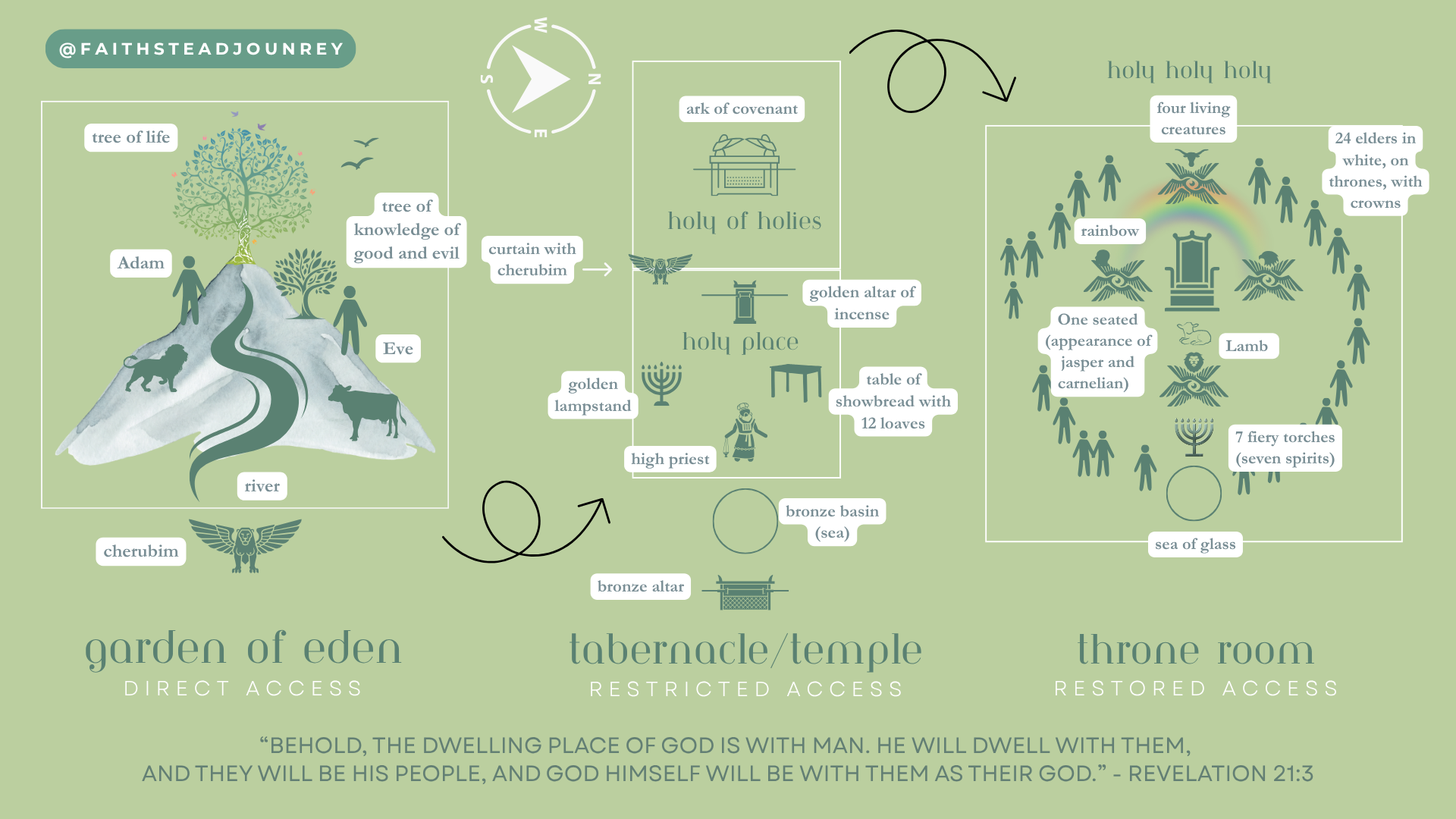
Eden → Tabernacle/Temple → Throne Room → New Creation are not disconnected images. They’re progressive revelations of the same reality.
1. Eden: Humanity was created for communion, not merely obedience
In Eden, God does something unique: He walks among humanity.
The Bible describes God walking in the garden in the cool of the day. Eden is more than paradise—it functions like the first sanctuary.
Notice the temple language hidden inside Eden:
- God’s presence dwells there
- Humanity serves and keeps it (same Hebrew words later used for priestly service)
- Eastward entrance (like later temple imagery)
- Precious stones and gold appear
- Rivers flow outward bringing life
Adam and Eve were not simply gardeners—they were entrusted with extending God’s ordered presence into the world.
The human calling began as worship.
2. The Tabernacle and Temple: God moves toward people in exile
After Eden is lost, Scripture becomes the story of God rebuilding access.
The tabernacle in the wilderness looks strangely familiar:
- Lampstand shaped like a tree
- Cherubim guarding sacred space
- Gold and precious materials
- Holy place → Holy of Holies mirroring movement toward God
The temple becomes a symbolic return to Eden.
But there is tension. God dwells there…but only partially.
There are:
- veils
- sacrifices
- priests
- boundaries
The message becomes:
God is near, but sin still prevents full communion.
The temple says: Eden is remembered, but not yet restored.
3. Revelation: The throne room is not an escape from earth—it is reality unveiled
Then Revelation pulls back the curtain.
The Bible shows:
- a throne
- worship without ceasing
- lightning and glory
- living creatures
- elders
- crystal sea
- the Lamb at the center
This is not a different story. It is Eden from heaven’s perspective.
And notice something beautiful:
The throne room combines garden imagery + temple imagery:
- river of life
- tree of life
- throne
- worship
- God dwelling with humanity
The destination of history is not disembodied souls floating away.
It is:
God’s dwelling with His people again.
Revelation ends not with people going up—but with heaven coming down.
4. What this means for Christians living in the “already and not yet”
What does this mean for us today?
We live in the tension:
- Christ has opened access.
- Full restoration has not arrived.
So our lives become small temples in exile. The New Testament says believers themselves are God’s temple. That means Christian worship now reflects both Eden and the throne room.
We cultivate instead of consume.
Eden was a garden to tend.
Our culture says: Build your own kingdom.
The kingdom says: Cultivate what God entrusted.
Work.
Hospitality.
Parenting.
Art.
Prayer.
All become acts of worship.
We practice presence in a distracted world.
The throne room is centered. Our culture fragments attention.
Christians become people who:
- pray
- feast with gratitude
- keep Sabbath rhythms
- remain attentive to God
Not because heaven has fully arrived, but because we rehearse it.
We worship with hope, not denial.
The tabernacle existed in wilderness. Revelation’s churches suffered. The Christian life is not pretending Eden is restored.
It is saying: God is present even here.
We grieve.
We lament.
We pray “Your kingdom come.”
But we also worship because the throne is occupied.
We become previews of New Creation.
The church is not heaven. But it should feel like a signpost.
Where there is:
- forgiveness instead of revenge
- generosity instead of scarcity
- communion instead of isolation
- holiness without withdrawal
people should catch echoes of Eden and glimpses of the throne room.
One way to summarize the whole arc is:
Eden shows what humanity was made for.
The temple shows how God pursues us after exile.
The throne room shows what is ultimately true right now.
New Creation (the church) shows where history is going.
And in the “already and not yet,” Christian worship becomes practicing the future in the middle of the present.