This week is all about the trumpets!
Trumpets in the Old Testament
Speaking of trumpets, do you remember how from the beginning it was mentioned that Revelation is a commentary on Old Testament prophecy? A large portion of Revelation is not introducing brand-new imagery, but bringing together themes, patterns, and stories already foreshadowed in the Old Testament. John writes like a master weaver—pulling threads from Exodus, Joshua, Isaiah, Ezekiel, Daniel, and the prophets, and forming them into a final, unified vision of God’s ultimate victory.
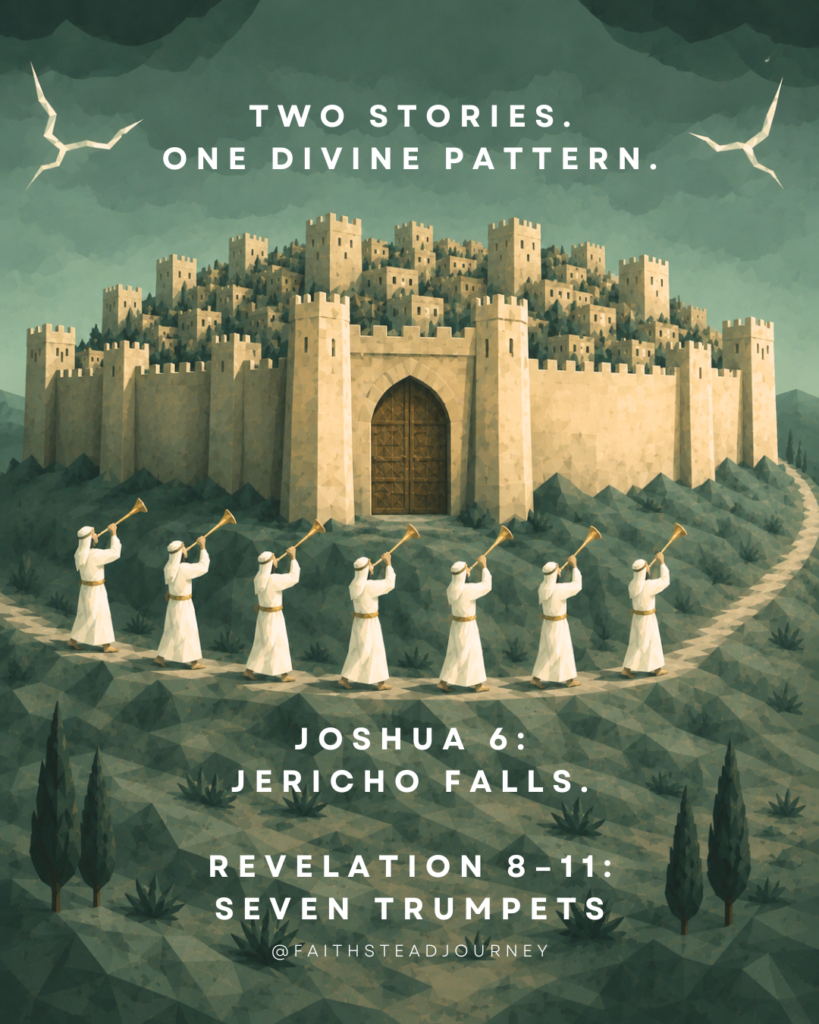
Which leads me to a striking Old Testament connection in Revelation: Jericho and the seven trumpets.
At first glance, these two stories seem separated by centuries and context. One is a military conquest of a fortified city in Canaan; the other is a series of cosmic judgments at the end of history. But when you slow down and pay attention to the details, you begin to see that Joshua’s battle at Jericho is not just an ancient story—it is a prophetic pattern that finds its climax in Revelation.
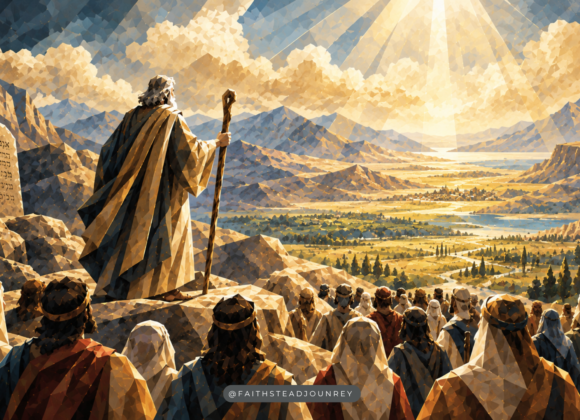
In the book of Joshua, Israel stands before the walls of Jericho, a city that represents resistance to God’s promise. But instead of using conventional warfare, God commands something unusual. The people march around the city in silence for six days, and on the seventh day, seven priests blow seven trumpets as they circle the city. At the final blast, the people shout, and the walls collapse. The victory is unmistakably God’s doing. The city does not fall because of human military strength, but because God intervenes through obedient faith and symbolic action.
Now fast forward to Revelation 8–11, where seven angels sound seven trumpets. Each trumpet unleashes a judgment on the earth: ecological disruption, darkness, spiritual oppression, and escalating warnings. By the time the seventh trumpet sounds, the announcement is made that “the kingdom of the world has become the kingdom of our Lord and of His Christ.” What Jericho begins on a local scale, Revelation completes on a global one.
First, both accounts center on seven trumpets. In Jericho, seven priests blow seven trumpets over seven days. In Revelation, seven angels blow seven trumpets in sequence. The repetition of the number seven signals completeness—God is bringing His plan to its intended conclusion.
Second, both involve a people of God participating in procession rather than warfare. At Jericho, Israel does not storm the walls; they march, listen, and obey. In Revelation, the church does not conquer through military power but through faithful witness, endurance, and worship. The victory belongs to God, not human force.
Third, both narratives show that God brings down what human strength cannot overcome. Jericho’s walls are not merely physical barriers—they represent a fortified resistance to God’s promise. Likewise, the “world system” opposed to God in Revelation is not just political or economic; it is spiritually entrenched rebellion. In both cases, only divine intervention can bring it down.
Fourth, both stories move from silence to sound to collapse. At Jericho, the people are silent as they march until the final moment of trumpet blasts and shouting. In Revelation, there is silence in heaven (Rev. 8:1) before the trumpet judgments unfold, culminating in the final proclamation of God’s kingdom. The pattern is striking: restrained anticipation followed by decisive divine action.
But perhaps the most important connection is theological. Jericho is not just a military victory—it is an act of covenant fulfillment. God is bringing His people into the promised inheritance. Revelation expands that same theme to its cosmic conclusion. The seven trumpets are not merely judgments; they are the process by which God removes every rival power so that His kingdom may fully arrive. Jericho shows the beginning of God’s people entering their promised land; Revelation shows the completion of that promise in the establishment of God’s eternal kingdom.
Yet there is also an important difference that highlights how much greater the fulfillment is in Revelation. Jericho is local, immediate, and physical. Revelation is global, unfolding, and spiritual-cosmic. Jericho brings down one city; Revelation brings down every system of rebellion against God. Jericho opens the way into Canaan; Revelation opens the way into the new creation.
In other words, Jericho is a pattern. Revelation is the fulfillment.
When you place these two stories side by side, you begin to see that the Bible is not a collection of disconnected events. It is a unified story of redemption, where earlier acts of God serve as shadows pointing forward to their ultimate fulfillment in Christ. The fall of Jericho anticipates the fall of all human resistance to God. And the seven trumpets of Revelation declare that what began on the walls of one ancient city will one day reach the entire world.
So the next time you read about the seven trumpets, remember Jericho. Because what happened there was not just history—it was prophecy in motion!!
Under the Altar
Before the first trumpet sounds, John invites us into heaven for an important scene. Earlier in Revelation, when the fifth seal was opened, John saw the souls of those who had been slain for the word of God crying beneath the heavenly altar.
They were not crying for personal revenge, but a plea for God’s righteous justice. Throughout Scripture, God’s people are repeatedly instructed not to take vengeance into their own hands but to entrust judgment to Him. These faithful saints do exactly that. They bring their cries before the throne of God and wait for Him to act.
Now, as Revelation 8 opens, our attention returns to that same heavenly altar. An angel stands before the golden altar with a golden censer, and “the smoke of the incense, with the prayers of the saints, went up in the presence of God” (Rev. 8:4). Then something remarkable happens. The angel fills the censer with fire from the altar and throws it upon the earth, followed by peals of thunder, rumblings, flashes of lightning, and an earthquake.
In other words, the trumpet judgments begin as God’s response to the prayers of His people.
This scene reminds us of another moment in Israel’s history.
Before God sent the ten plagues upon Egypt, He first heard the cries of His oppressed people.
In Exodus 3:7–10, the Lord said to Moses:
” I have observed the misery of my people in Egypt, and have heard them crying out because of their oppressors. I know about their sufferings,and I have come down to rescue them…”
Only after hearing Israel’s cries does God send Moses, confront Pharaoh, and unleash the ten plagues that ultimately lead to Israel’s deliverance.
The pattern is remarkably similar.
In Exodus:
- God’s people cry out under oppression.
- God hears their prayers.
- God acts through mighty judgments.
- His people are delivered.
In Revelation:
- God’s people cry out under persecution.
- Their prayers rise before God’s throne.
- God responds with trumpet judgments.
- His people are ultimately delivered into His eternal kingdom.
This connection helps us understand why the trumpet judgments so closely resemble the plagues of Egypt. John is intentionally presenting the final redemption as a new and greater Exodus. Just as God judged Egypt in order to free Israel from slavery, He will one day judge the powers of evil in order to fully deliver His people. The plagues of Egypt were not merely ancient history—they were a preview of God’s final victory over sin, death, and every kingdom that opposes Him.
This also reminds us of something deeply encouraging about God’s character: He is attentive to His people. He sees their suffering, He hears their prayers, and He acts in His perfect timing. Sometimes His answers are immediate, and sometimes they unfold over generations, but not one prayer offered in faith is forgotten. Before a single trumpet sounds, Revelation assures us that heaven has already heard the cries of the saints.
With that scene in mind, we are now ready to listen as the seven trumpets sound. Like the plagues of Egypt, they are both acts of judgment and invitations to repentance, revealing God’s justice, His patience, and His unwavering commitment to redeem His people.
The Seven Trumpets
Now let’s compare the seven trumpets to the seven seals. Although they are often treated as separate series of end-time events, they are better understood as complementary visions. Both reveal God’s sovereign work in history, but each emphasizes a different aspect of His plan.
The seven seals answer the question, “What is happening in the world?” They reveal the realities that characterize the age between Christ’s first and second coming—conquest, war, famine, death, persecution, and ultimately God’s final victory. They remind us that even in a broken world, Jesus, the Lamb, is in complete control. Nothing happens apart from His authority.
The seven trumpets build upon that foundation by answering a different question: “How is God responding to a rebellious world?” If the seals reveal the conditions of history, the trumpets reveal God’s merciful interventions within history. Like the plagues of Egypt, the trumpet judgments are not merely acts of punishment; they are warnings meant to awaken humanity and call people to repentance before the final judgment arrives.
One of the most noticeable differences is the use of fractions. During the seal judgments we noticed one-fourth language. During the trumpet judgments, one-third of the earth, sea, rivers, and heavenly bodies are affected. This repeated limitation is significant. On one hand, God is demonstrating remarkable restraint and yet we see increasing intensity. His judgments are real, but they are not yet complete. They are measured warnings that reveal both His justice and His mercy. By contrast, when we reach the bowl judgments later in Revelation, those fractions disappear. The warnings have given way to the completion of God’s judgment.
Let’s briefly walk through each trumpet and its significance.
The First Four Trumpets
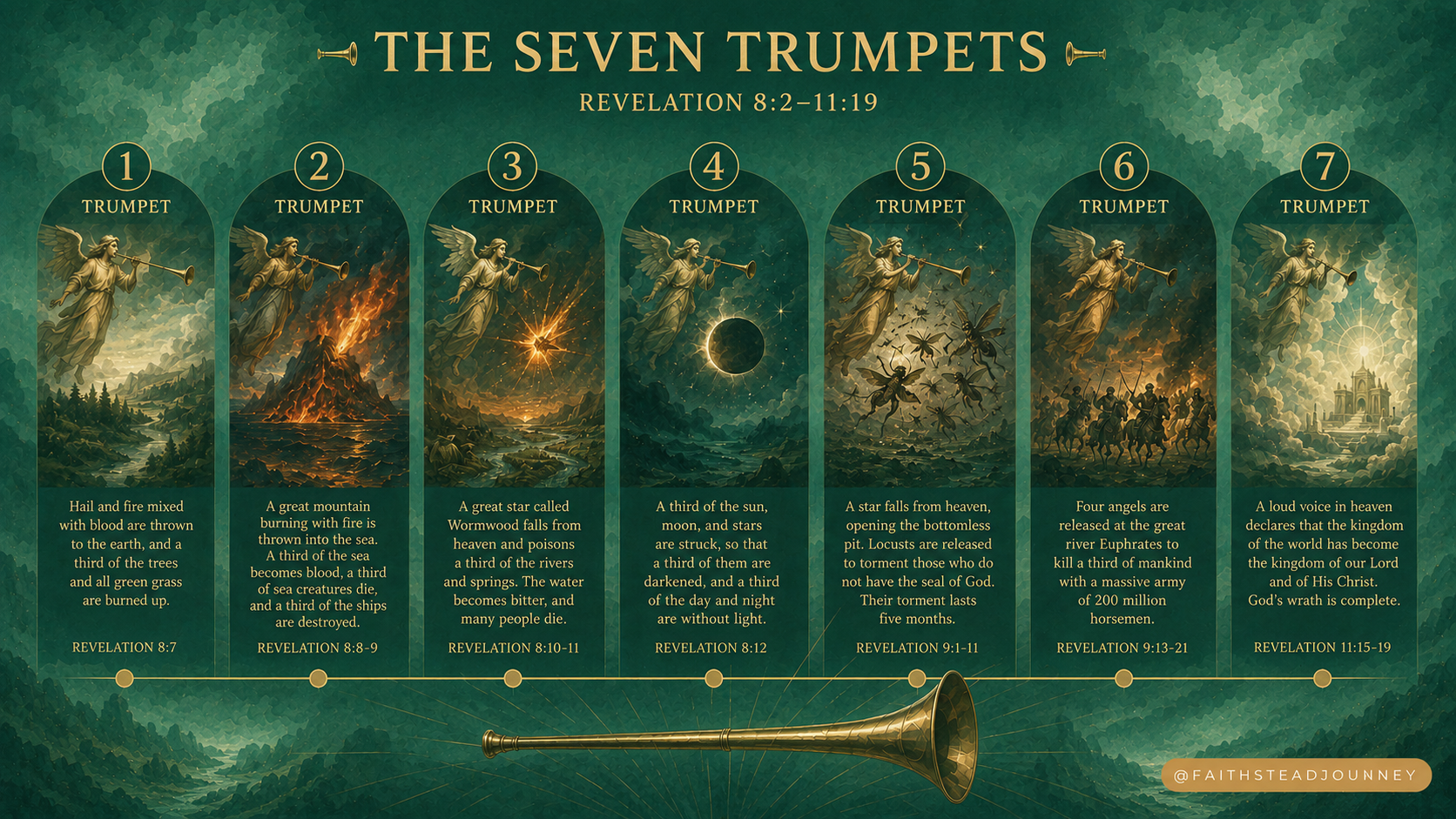
As the first four trumpets sound, there is another remarkable pattern that is easy to miss. The judgments unfold in a deliberate order: the earth, the sea, the rivers and springs, and finally the heavens (Rev. 8:7–12). This progression is not random. John is intentionally moving through the major domains of God’s creation.
At the same time, the trumpets unmistakably echo the plagues of Egypt. Hail and fire recall the seventh plague (Ex. 9:22–26). The sea and rivers turning to blood recall the first plague (Ex. 7:14–24). The darkening of the heavenly lights echoes the ninth plague of darkness (Ex. 10:21–23). Just as God judged Egypt in order to deliver His people from slavery, the trumpet judgments portray God confronting a rebellious world before bringing about the final redemption of His people. The Exodus was not simply an event in Israel’s history—it became the pattern for God’s future acts of salvation and judgment.
But John is doing even more than recalling the Exodus. He is also inviting us to look back to the opening pages of Genesis.
Think back to the opening chapters of Genesis. God created an ordered, life-giving world. He formed the earth, gathered the seas, provided waters to sustain life, and placed the sun, moon, and stars in the heavens to govern day and night. Each realm of creation reflected His wisdom, goodness, and sustaining power.
Now, in Revelation, those same realms begin to unravel.
The first trumpet strikes the earth, burning a third of the land, trees, and vegetation. The second trumpet strikes the sea, turning a third of it to blood and destroying sea life and commerce. The third trumpet strikes the fresh waters, making rivers and springs bitter. The fourth trumpet reaches the heavens, darkening the sun, moon, and stars so that light itself is diminished.
John is painting a picture of de-creation.
This does not mean God is abandoning His creation. Rather, the One who created the world is demonstrating His authority over it. The orderly world established in Genesis begins to come undone as humanity continues in rebellion against its Creator. Throughout Scripture, creation and humanity are closely connected. When sin entered the world, the ground was cursed (Gen. 3:17–19). The prophets often described God’s judgment using the language of creation unraveling—darkened skies, trembling earth, dried-up waters, and cosmic disturbances. Revelation gathers all of these prophetic images into one powerful vision.
There is also a practical progression in the first four trumpets. Each judgment touches something humanity depends upon for life.
- The earth provides food.
- The sea provides both food and commerce.
- The rivers and springs provide drinking water.
- The sun, moon, and stars regulate light, seasons, and the rhythms of life.
One by one, the foundations of human security are shaken. John reminds us that the stability we often take for granted is not self-sustaining; it is a gift upheld by God. Every breath, every harvest, every sunrise, and every drop of water ultimately comes from His gracious hand.
Yet even in judgment, God’s mercy is unmistakable. Notice the repeated phrase: “a third.” The earth is not completely destroyed. The sea is not entirely turned to blood. The rivers are not all made bitter. The heavenly lights are only partially darkened. These are measured, restrained judgments intended to awaken the world before the final judgment comes. God is giving humanity opportunity after opportunity to repent.
Ultimately, however, the story does not end with de-creation. Just as Genesis begins with creation, Revelation ends with a new creation. The temporary unraveling of the present world prepares the way for God to make all things new. The curse will be removed. The sea of chaos will be no more. Death, mourning, crying, and pain will pass away. The same Creator who once spoke light into darkness will once again restore His creation in perfect beauty and harmony.
The Fifth Trumpet
Before the fifth trumpet sounds, an eagle cries, “Woe! Woe! Woe!” announcing a shift in the vision. The first four trumpets primarily affected the created order—the earth, sea, rivers, and heavens. The final three trumpets, often called the three woes, intensify the judgments by focusing directly on humanity.
A star falls from heaven and is given the key to the abyss. When it is opened, smoke pours out, darkening the sky, and terrifying locust-like creatures emerge.
These are clearly no ordinary locusts.
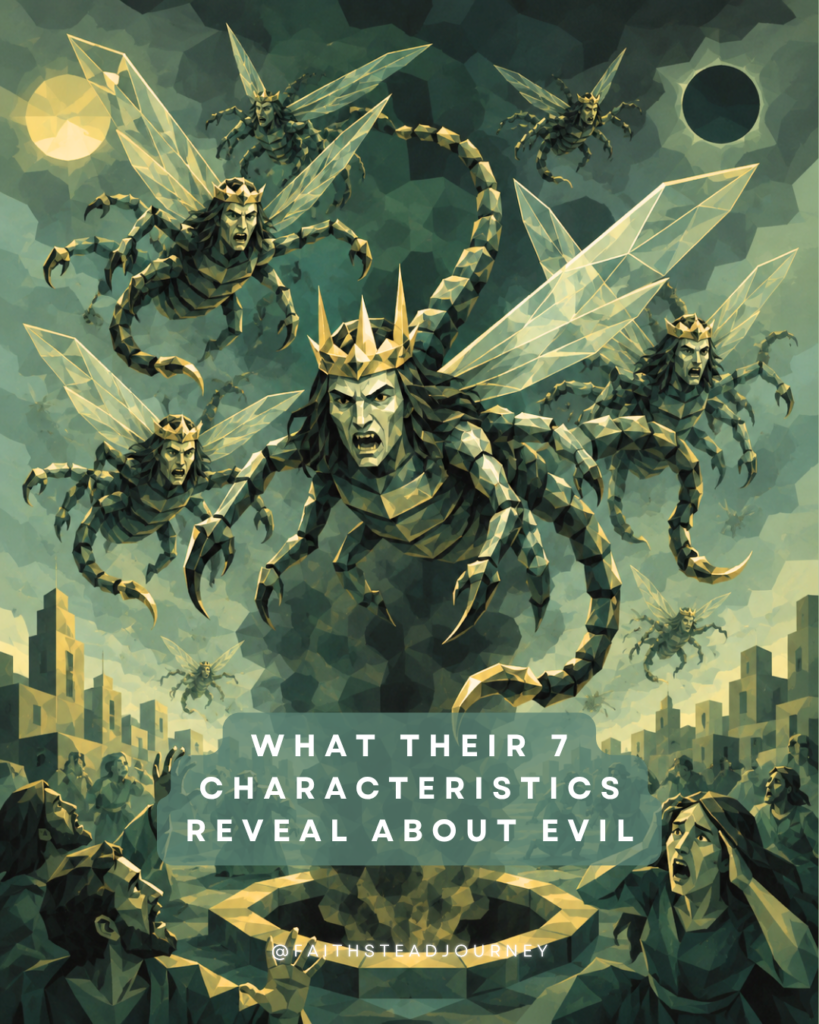
John describes them with a combination of human, animal, and military imagery and guess what he uses seven distinct characteristics. Remember, the number seven consistently symbolizes completeness or fullness. Here, the seven attributes portray the complete character of these terrifying agents of judgment.
- Crowns like gold on their heads – counterfeit authority
- Faces like human faces – intelligent
- Hair like women’s hair – seductive and alluring
- Teeth like lions’ teeth – violent destruction
- Breastplates like iron – difficult to resist (human strength alone cannot overcome spiritual evil)
- The sound of their wings was like the rush of many horses and chariots rushing into battle –overwhelming and terrifying
- Tails with stings like scorpions – lingering pain
Taken together, these seven characteristics reveal a sobering truth about evil. It is often intelligent, attractive, persuasive, and seemingly invincible before it becomes destructive. Satan rarely tempts by presenting sin as ugly; he disguises it as desirable. Yet behind every false promise lies pain and destruction. At the same time, Revelation reminds us that these terrifying forces are never independent of God. They cannot act beyond the limits He establishes. Even in this frightening vision, God’s sovereignty remains absolute.
One additional observation is worth noting. These locusts are a grotesque combination of human, animal, and military imagery. Unlike the glorious heavenly creatures around God’s throne, whose symbolic features reflect His majesty and perfect rule, these beings emerge from the Abyss and embody terror, deception, and destruction. They are not new creations but twisted imitations, reminding us that Satan cannot create life or beauty—he can only corrupt and parody what God has made. Just as the first four trumpets portray the de-creation of the physical world, these demonic creatures portray the corruption of God’s good order through evil. Yet Revelation assures us that Christ will ultimately remove every distortion and restore creation in the new heavens and the new earth.
Perhaps the most sobering part of this trumpet is that the judgment reflects the spiritual condition of those who have rejected God. Throughout Scripture, persistent rebellion eventually leads God to give people over to the consequences of their own sin (cf. Romans 1). The torment pictured here reminds us that separation from God always produces misery. Sin promises freedom but ultimately enslaves.
Yet even this terrifying vision is still an act of mercy. The purpose is not annihilation but warning. God is calling people to recognize where rebellion leads before it is too late.
The Sixth Trumpet
The sixth trumpet releases four angels who had been restrained at the great river Euphrates. An enormous cavalry follows, bringing widespread destruction.
While the imagery is vivid and symbolic, John’s emphasis is not on calculating the size of the army or identifying each detail. Instead, he directs our attention to humanity’s response—or rather, its lack of response.
After witnessing unimaginable judgments, John writes one of the saddest statements in the entire book:
“The rest of the people… did not repent.”
This is the tragedy of the sixth trumpet.
The greatest problem facing humanity is not a lack of evidence. It is the hardness of the human heart.
The plagues of Egypt show this clearly. Pharaoh saw God’s power again and again, yet instead of repenting, his heart only became more stubborn. The repeated resistance of Pharaoh also reveals something deeper about the human condition: even overwhelming evidence is not enough to change a hardened heart. Had there been ten more plagues, Pharaoh still would not have repented. The issue was never insufficient revelation—it was entrenched rebellion.
In the same way, the judgments reveal that God’s justice is never impulsive or cruel. Jen Wilkin notes, God is “longsuffering even with those who set themselves in total opposition to Him”. He does not act immediately in full judgment; He stretches out opportunity after opportunity for repentance. The plagues were not the overflow of a quick temper, but the restraint of divine patience.
What we often underestimate is not the goodness of God, but the depth of human sin and the capacity of the heart to harden itself against truth. The plagues of Egypt and the trumpet judgments of Revelation both reorient us to that reality. They expose sin not as a surface-level mistake, but as a deep resistance to God’s authority that only grace can overcome.
The Two Witnesses
Just as there was an interlude between the sixth and seventh seals, John pauses again before the seventh trumpet.
This pause is significant.
Rather than immediately continuing with more judgments, God redirects our attention to His Word and His witnesses.
John is given a little scroll and instructed to eat it. It is sweet in his mouth but bitter in his stomach. God’s Word is always sweet because it reveals His truth and promises. Yet it is also bitter because proclaiming that truth often brings suffering, opposition, and grief over the reality of coming judgment.
Then John is given another interesting instruction.
He is told to measure the temple of God and the altar, and count those who worship there (Rev. 11:1).
This imagery comes from the Old Testament, where measuring often symbolized ownership, protection, and careful distinction. God is not measuring to discover something unknown, but to show that He knows exactly who belongs to Him. It is a picture of God marking out His people and preserving them as His own.
But John is also told to exclude the courtyard outside the temple, because it has been given over to the nations to be trampled for a set time.
This creates an important tension. God’s people are secure in Him, yet they still live in a world of pressure, opposition, and suffering. The inner reality of belonging to God is protected, but the outer experience of life in this fallen world is marked by conflict. This reflects a larger New Testament truth: the church is now God’s temple (1 Cor. 3:16), yet we still live in bodies that are vulnerable in this present age. As Jesus said, “Don’t fear those who kill the body but are not able to kill the soul” (Matt. 10:28). There is a real distinction between what can be harmed physically and what is eternally secure in God.
Immediately after this, John is shown how that tension plays out in real life: the two witnesses. Whether understood as two individuals or as a symbolic picture of the witnessing church, their mission is clear: they faithfully proclaim God’s message in the midst of a hostile world.
They are given authority to speak God’s Word with power. Their testimony is not passive—it confronts, exposes, and calls people to repentance. Yet like the measured temple, they belong to God and operate under His authority. Nothing that happens to them is outside His control.
The two witnesses are also given powers that remind us of Moses and Elijah, the two great representatives of the Law and the Prophets. Like Moses, they turn water to blood and strike the earth with plagues. Like Elijah, they shut the heavens so that no rain falls and call down fire from heaven. These parallels are intentional. Throughout the Gospels, Moses and Elijah appear together at Jesus’ transfiguration, bearing witness that the Law and the Prophets find their fulfillment in Christ (Matt. 17:1–8; Luke 24:27).
Seen together, the witnesses present a beautiful threefold testimony:
- The Law points to Christ.
- The Prophets point to Christ.
- The Church continues to bear witness to Christ.
From Genesis to Revelation, God has never left Himself without a witness.
The lives of the two witnesses also mirror the life of Jesus Himself. They faithfully proclaim God’s Word despite opposition. They are hated by the world, rejected, and eventually killed. Their enemies celebrate what appears to be their defeat, but death is not the end of their story. God raises them to life, vindicates them before their enemies, and calls them into His presence.
This pattern should sound familiar because it is the pattern of the gospel itself:
faithful witness → suffering → apparent defeat → resurrection → vindication → glory.
It is the pattern first lived perfectly by Jesus Christ.
It is also the pattern Jesus said His disciples should expect. He told them, “If anyone would come after Me, let him deny himself and take up his cross and follow Me.” Throughout the New Testament, believers are called to participate in Christ’s life—not only in His resurrection, but also in His sufferings (Rom. 8:17; Phil. 3:10–11).
In this sense, the two witnesses are more than prophetic figures; they become a picture of the church’s calling in every generation. We are called to proclaim God’s Word faithfully, even when it is unpopular. We should not be surprised by opposition or rejection, for our Lord experienced the same. Yet we also live with the same hope: just as Christ was raised and vindicated, all who belong to Him will one day share in His resurrection and glory.
Revelation reminds us that success is not measured by popularity, influence, or earthly triumph, but by faithful witness. Our task is not to win the world’s approval but to bear testimony to the One who has already conquered through His death and resurrection.
The Seventh Trumpet
One of the beautiful patterns in Revelation is that the sixth trumpet ends with humanity refusing to repent, while the seventh trumpet begins with heaven worshiping.
Loud voices proclaim:
“The kingdom of the world has become the kingdom of our Lord and of his Christ, and he will reign forever and ever.”
This is the goal toward which the entire book has been moving.
Finally, the heavenly temple is opened, and the ark of the covenant is seen. Throughout Israel’s history, the ark represented God’s presence, His covenant faithfulness, and His throne among His people. Its appearance here is a beautiful reminder that God’s promises have never failed. The God who delivered Israel from Egypt, who remained faithful through every generation, and who heard the prayers of His saints is the same God who now brings history to its appointed climax.
And I loved how Jen Wilkin ended this section of the study:
One of the greatest mistakes I think we make in coming to the book of Revelation is to strain our eyes ahead. The true assurance this book offers us is not found in straining our gaze forward, but in looking over our shoulder at the faithfulness of God to all generations.
jen wilkin
I’ve compiled all of my Revelation Reloaded reflections into one PDF so you can read through them in one place, revisit them as you study, or keep them alongside your Bible as you journey through Revelation for yourself.