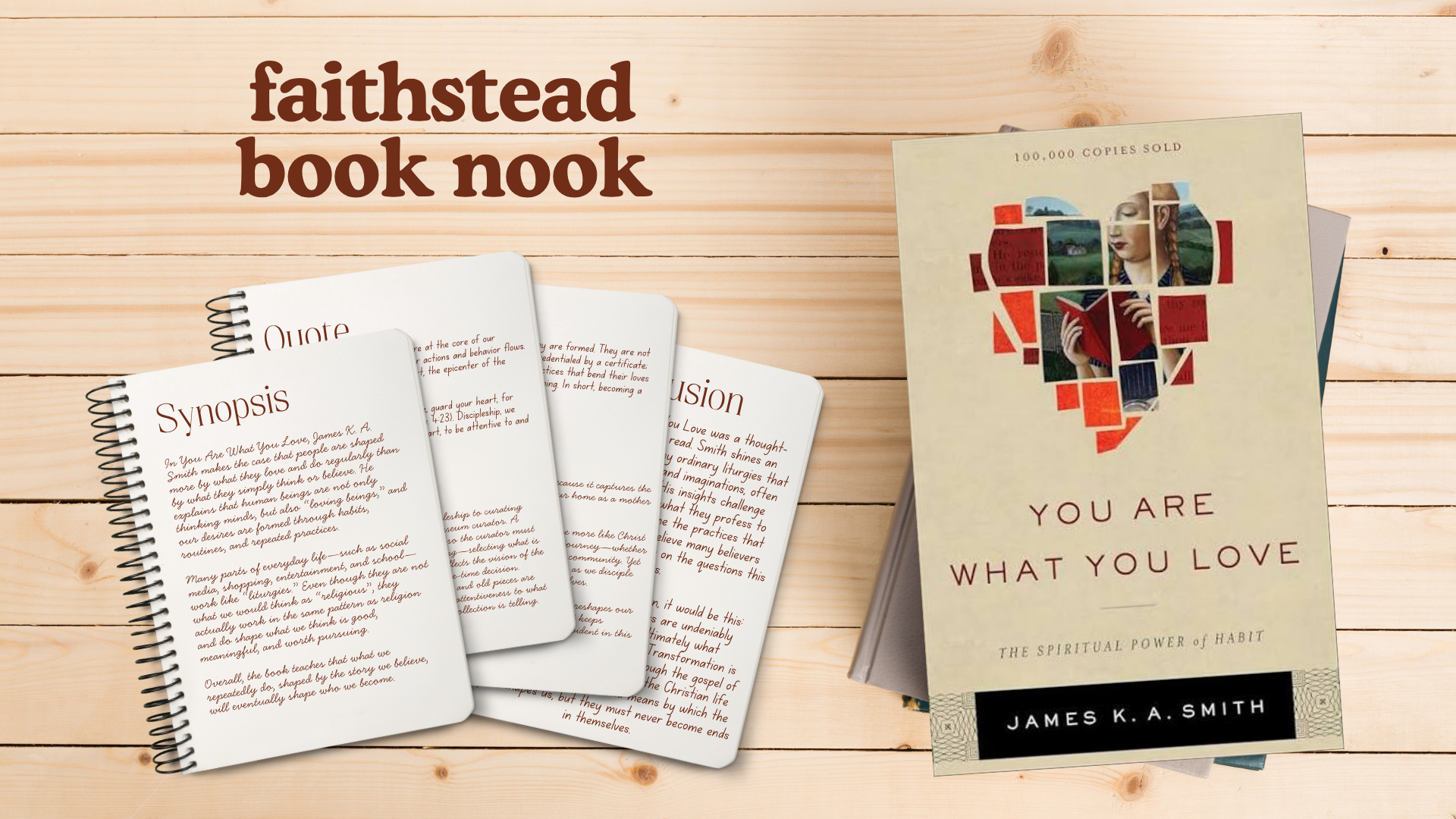
In You Are What You Love – The Spiritual Power of Habit, James K. A. Smith makes the case that people are shaped more by what they love and do regularly than by what they simply think or believe. He explains that human beings are not only thinking minds, but also “loving beings,” and our desires are formed through habits, routines, and repeated practices.
Many parts of everyday life—such as social media, shopping, entertainment, and school—work like “liturgies.” Even though they are not what we would think as “religious”, they actually work in the same pattern as religion and do shape what we think is good, meaningful, and worth pursuing.
A key point Smith makes is that our loves are shaped by our imagination, which is formed through the stories we believe. Because of this, the question is not just what we think is true, but what story we are living in and rehearsing every day. These stories shape what we desire and what we think will make us happy.
For this reason, change does not happen only by learning new information, but by practicing new habits that reshape our hearts over time. The practices we repeat slowly form what we love.
Smith also argues that Christian worship is important because it tells a true story about reality and re-forms our desires toward God. Practices like prayer, singing, confession, and communion help believers step into that story and live it out.
Overall, the book teaches that what we repeatedly do, shaped by the story we believe, will eventually shape who we become.
Quote:
Our wants and longings and desires are at the core of our identity, the wellspring from which our actions and behavior flows. Our wants reverberate from our heart, the epicenter of the human person. Thus Scripture counsels, “Above all else, guard your heart, for everything you do flows from it” (Prov. 4:23). Discipleship, we might say, is a way to curate your heart, to be attentive to and intentional about what you love.
Reflection:
I love how Smith compares discipleship to curating your heart. It reminds me of a museum curator. A museum only has so much space, so the curator must carefully choose which pieces belong—selecting what is valuable and deciding what best reflects the vision of the museum.
But curation is not a one-time decision. Exhibits change, new pieces arrive, and old pieces are swapped out. There is an ongoing attentiveness to what fills the space and what story the collection is telling.
In the same way, discipleship is not simply deciding once to follow God and then leaving our hearts unattended. Our hearts are constantly being shaped by new desires, influences, ambitions, fears, and habits. To “curate your heart” means paying attention to what we are allowing in, what we are holding onto, and what may need to be removed.
Different seasons of life may require different forms of intentionality, but the goal remains the same: to cultivate a heart whose loves are increasingly ordered toward God.
Quote:
If you think of love-shaping practices as “liturgies,” this means you could be worshiping other gods without even knowing it. That’s because such cultural liturgies are not just one-off events that you unwittingly do; more significantly, they are formative practices. That do something to you, unconsciously but effectively tuning your heart to the songs of Babylon rather than the songs of Zion (Ps. 137).
Reflection:
Smith makes a good point here that the habits we pick up from culture are never neutral but do something to us and it would do us good to discern the vision of the good life that is carried in our cultural patterns.
Liturgies are not just religious rituals—they are any repeated practices that shape what we love. And this tuning happens gradually. A musician doesn’t suddenly realize their instrument is out of tune—it shifts little by little. In the same way, our hearts are shaped through repeated exposure to certain values, stories, and habits until they begin to feel normal.
Smith compared the mall with a cathedral. Like a cathedral, the mall has its own rituals, symbols, and vision of the “good life.” Through attractive displays, carefully designed spaces, music, and advertising, it invites people to believe that happiness, identity, and fulfillment can be found through consumption. Smith’s point is that we are not merely thinking beings who make rational choices; we are worshiping beings whose hearts are formed by the practices we repeatedly engage in. In this way, the mall disciples us into the values of consumerism, training us to seek satisfaction in acquiring rather than in God.
Similarly, weddings are also a type of liturgy: elaborate invitations, engagement shoots, carefully planned photo opportunities, and the expectation of creating a once-in-a-lifetime moment worthy of memory—or even online attention. The anticipation builds around one extraordinary day.
And it does not end at the wedding. Even in marriage, there is often an expectation that love must constantly feel exciting and extraordinary—that to sustain marriage we must continually escape the routines of ordinary life through romantic retreats and experiences to “keep the spark alive.”
Smith’s concern is not that weddings, beauty, or celebration are wrong. Rather, he asks what story these rituals are teaching us to believe. If the practices surrounding marriage train us to expect a spouse to complete us, constantly affirm us, satisfy our desires, and help us achieve self-fulfillment, then marriage itself can quietly become another form of self-love.
It’s easy to assume that because something looks good, productive, or even spiritual, it must be forming me well. But cultural liturgies are often subtle. Constant busyness can train us to worship achievement. Serving others can become a way of earning approval. Productivity can become identity. Marriage can become centered on self-fulfillment. Good things can slowly become ultimate things.
By contrast, Scripture presents a different story. Biblical marriage reflects Christ and His bride and the family points beyond itself to God’s kingdom. Marriage becomes not simply a place where my desires are fulfilled, but a place where love is practiced through faithfulness, sacrifice, and mutual formation.
Smith argues that culture is not inherently evil, but neither is it neutral. Every cultural practice is shaping our loves and directing our desires toward a particular vision of the good life. The question is not whether we are being formed, but what we are being formed to love. True discipleship, therefore, requires recognizing these competing liturgies and intentionally embracing Christian practices that recalibrate our hearts, tuning them once again to the songs of Zion.
Quote:
The point is that the tenets of a consumer gospel are caught rather than taught; the ideals are carried in the practices, not disseminated through messages. The same is true for other cultural liturgies. The list of such “secular” liturgies is very contextual and will vary not only from country to country but from generation to generation. This is why pastors need to be ethnographers, helping their congregation name and “exegete” their local liturgies.
Reflection:
This quote reinforced the importance of recognizing that formation happens long before we consciously evaluate ideas. Every culture has its own liturgies—repeated practices that quietly shape what people love and pursue. As a Christian parent and educator, this is a sobering reminder that discipleship involves more than passing on biblical knowledge. It requires intentionally cultivating habits and rhythms that orient the heart toward Christ while helping others discern the competing stories embedded in everyday life.
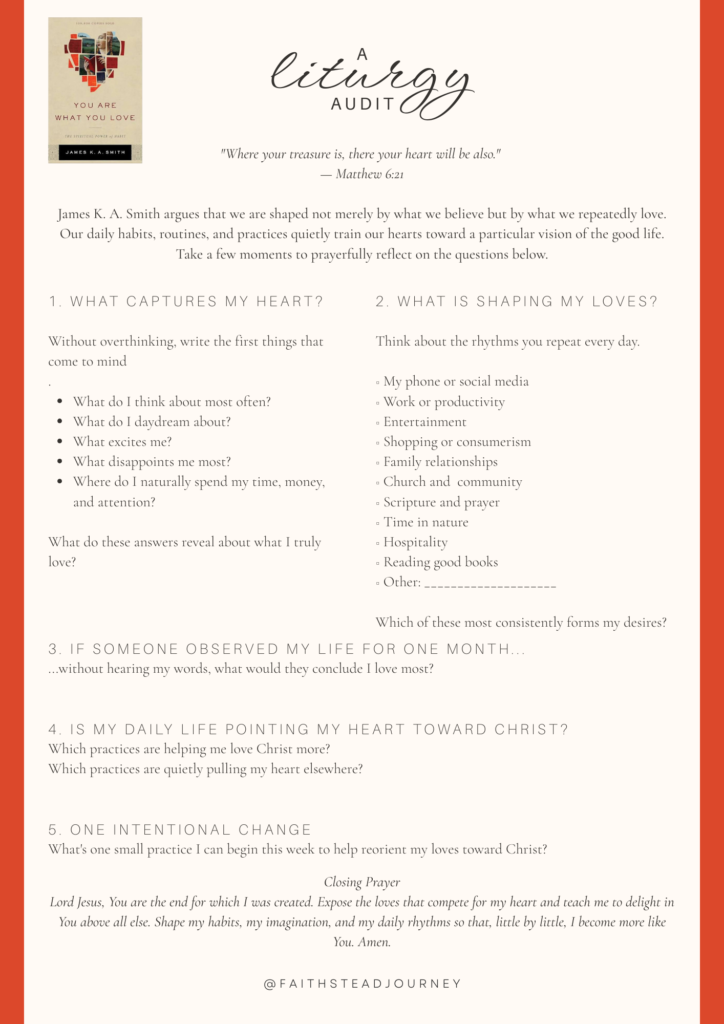
Smith also encourages his readers to conduct a liturgical audit of their own lives. What routines, habits, and practices are forming me? What is shaping the loves of my family and children? Every household has liturgies, whether intentional or unintentional, and parents have a responsibility to examine what those daily rhythms are teaching.
Smith’s call for pastors to become ethnographers is especially compelling. Ethnographers are researchers who study people by observing and participating in their everyday lives to understand their culture, beliefs, habits, and social practices from the inside. It suggests that faithful ministry requires not only interpreting Scripture but also interpreting culture, helping believers recognize the hidden liturgies that are shaping their loves. At the same time, this raises a challenge for many modern churches.
In many congregations, relationships between pastors, deacons, and members are not deep enough for this kind of personal shepherding to take place. We often treat church as the place where we simply study the Bible, while assuming that conversations about our work, family rhythms, technology, entertainment, and other everyday practices belong somewhere else. However, these ordinary practices are precisely where discipleship is taking place. Learning the Scriptures is essential, but learning to live them out—to recognize and replace the competing liturgies that shape our hearts—is how we bear fruit. This kind of formation requires not only biblical teaching but also authentic Christian community, where believers can lovingly examine one another’s lives and encourage one another in practices that cultivate a deeper love for God.
Quote:
Indeed, the telos for Christians is Christ: Jesus Christ is the very embodiment of what we’re made for, of the end to which we are called. This is why Paul’s exhortation to “put on love” is equivalent to the exhortation to “put on the Lord Jesus Christ”. This is how we become human. This is what we’re “here for.”
Reflection:
There is something wonderfully hopeful about this passage. If Christ is not only our Savior but also the very picture of what it means to be truly human, then the Christian life is not simply about becoming “better” people—it is an invitation to become the people we were always created to be. That thought fills me with awe. Holiness is not the shrinking of our humanity but its blossoming. We become most ourselves as we become more like Him.
But how does such a marvelous transformation take place? Not by trying harder or collecting more theological facts, but by returning again and again to the beautiful story of God’s redemption. Week after week, Christian worship invites us into that story until it begins to feel more real than the countless stories competing for our hearts. Slowly, almost imperceptibly, the melodies of the gospel begin to retune our own hearts. Smith’s image reminds me that we are less like machines that need more information and more like stringed instruments waiting to be tuned. Stories, songs, poetry, symbols, and beauty awaken our loves in ways that arguments alone never could. As God’s Word becomes the center around which our imaginations revolve, we begin to see the whole world differently. Ordinary moments shimmer with eternal significance because they belong to Christ’s story.
This also makes me realize that worship is never confined to Sunday morning. The liturgies of the church are meant to spill over into the quiet rhythms of everyday life—around the family table, during ordinary work, in conversations with our children, and in the countless unseen choices that make up a day. Paul Miller’s J-Curve beautifully illustrates this reality. The Christian life follows the pattern of Jesus Himself: dying before rising, surrender before joy, humility before glory. Every inconvenience embraced with love, every forgiveness offered, every sacrifice made in faith becomes another small participation in Christ’s own life. The extraordinary is woven into the ordinary.
Perhaps this is what Smith means when he says that we become what we love. We are not transformed in one grand, dramatic moment but in thousands of quiet ones. Like a garden slowly turning toward the sun, our hearts lean almost unnoticed toward whatever light they behold most often. What a beautiful thought that God, in His kindness, has given us rhythms of worship, Scripture, prayer, song, and fellowship—not merely as duties to perform, but as gracious gifts that patiently tune our hearts until one day we discover that the things Christ loves have become the things we love too. And perhaps that is what it means to become truly human.
Quote:
Teachers of virtue are not born; they are formed. They are not “produced” by a diploma or merely credentialed by a certificate; they are shaped by immersion in practices that bend their loves and longing toward Christ and his coming. In short, becoming a teacher of virtue takes practice.
Reflection:
This quote resonates deeply with me because it captures the very heartbeat I hope to cultivate in our home as a mother and homeschool educator. The goal has never been simply to become more like Christ ourselves, but to invite others into that journey—whether our children, friends, or members of our community. Yet there is a beautiful irony in God’s design: as we disciple others, we are continually discipled ourselves. The very act of pouring into another soul reshapes our own. It is a gracious cycle of formation that keeps compounding over time. God’s wisdom is evident in this symbiotic relationship.
I especially loved Smith’s story about promising to have coffee ready for his students before an early morning seminar. At first glance, making coffee seems insignificant, but over time the repeated practice quietly transformed him. His attention shifted from himself to the people he was serving. What began as a simple act of hospitality became a daily liturgy of love, prayer, and self-forgetfulness. Virtue was not produced by good intentions alone but cultivated through ordinary, embodied habits.
This immediately brought to mind the influence of Sally Clarkson, whose books and talks have profoundly shaped my vision for the home. She has helped me see that discipleship is woven into the ordinary rhythms of family life—shared meals around the table, unhurried conversations, reading good books together, opening our home to others, and serving one another in small, consistent ways. These practices may appear mundane, but they are quietly training our hearts. The home itself becomes a place where virtue is practiced before it is taught.
Smith’s point is both encouraging and freeing. We do not become teachers of virtue by first attaining perfection. Rather, God forms us as we faithfully practice the very virtues we hope to pass on. In His kindness, He uses the ordinary rhythms of loving and serving others to shape us into the kind of people who can genuinely lead them toward Christ.
Conclusion:
Overall, You Are What You Love was a thought-provoking and enriching read. Smith shines an important light on the many ordinary liturgies that quietly shape our desires and imaginations, often without our awareness. His insights challenge Christians to look beyond what they profess to believe and honestly examine the practices that are forming their loves. I believe many believers would benefit from reflecting on the questions this book raises.
If I were to offer one caution, it would be this: while our habits and liturgies are undeniably formative, they are not ultimately what transforms the human heart. Transformation is the work of the Holy Spirit through the gospel of Jesus Christ. The practices of the Christian life are gifts of God’s grace and means by which the Spirit shapes us, but they must never become ends in themselves.
Perhaps this conviction is shaped by my own background in a legalistic church culture. I have seen sincere people who genuinely desired to become more Christlike devote themselves to spiritual disciplines and outward practices, yet slowly drift into pride, self-righteousness, and judgment of others. It is possible to exchange one set of liturgies for another and unknowingly begin trusting the practices rather than the Savior they are meant to point us toward.
Paul reminds us in Titus 1:15, “To the pure, everything is pure, but to those who are defiled and unbelieving nothing is pure; in fact, both their mind and conscience are defiled.” The issue is ultimately not the practice itself but the condition of the heart. Christian habits are beautiful and necessary, but they only bear lasting fruit when they flow from—and continually lead us back to—the gospel of God’s saving grace. As we immerse ourselves in the story of Christ, the Holy Spirit uses these ordinary rhythms to conform us to His image. Our confidence, therefore, rests not in our disciplines but in the God whose grace is transforming us from the inside out.
With that in mind, I created the following Liturgy Audit—not as a checklist to earn God’s favor or another spiritual metric to measure ourselves by, but as an invitation to prayerfully examine our hearts.
I hope you enjoy this simple Liturgy Audit and find it to be a helpful starting point for prayerful reflection. My prayer is that it doesn’t simply encourage you to change a few habits, but that it helps you become more aware of the loves that are shaping your heart and draws you ever closer to Christ.