

Recap: Where Have We Been?
I feel like the book of Hebrews is one long run-on sentence! It’s easy to get lost in the weeds if we don’t keep track of what the author has been talking about. So, before we move on, let’s take a quick step back and recap.
Earlier in this chapter, the author reminded us that God had also promised His people a rest that is still to come. When God brought the Israelites out of Egypt, He led them toward the Promised Land—a place of rest after their years of slavery and wandering. Yet many of them failed to enter because of their unbelief and disobedience.
The warning is clear: we must not follow the same pattern. Just as the Israelites had a promise of rest before them, we too have a promised rest ahead of us. We must take God’s Word seriously and strive to enter that rest through faith rather than fall into the same pattern of unbelief.
And we cannot hide our unbelief behind outward appearances. God’s Word is living and active, able to expose the thoughts and intentions of our hearts. Nothing in all creation is hidden from His sight. We will all have to give an account to Him.
That’s a sobering place to leave us, isn’t it? We have a promise of rest, but we are also confronted with the holiness of God and the reality that He sees us as we truly are. So where does that leave us?
Thankfully, the author doesn’t leave us trembling before a God to whom we must give an account without telling us where to turn. He immediately points us to Jesus, our great High Priest. The One who sees us completely is also the One who invites us to draw near to God through Him.
Christ the Better High Priest
“Since then we have a great high priest who has passed through the heavens, Jesus, the Son of God, let us hold fast our confession.” – Hebrews 4:14
Under the old covenant, the high priest entered the Most Holy Place in the tabernacle or temple once a year on the Day of Atonement. This room represented God’s special dwelling among His people, and the high priest entered it with sacrificial blood to make atonement for their sins.
Now, when the author says Jesus “passed through the heavens,” he is evoking a similar image, except that Jesus entered not an earthly sanctuary made by human hands, but the very presence of God in heaven. Just as the high priest passed through the sanctuary and beyond the veil into the Most Holy Place, Jesus passed through the heavens to appear before God on our behalf. But there is a difference. The earthly high priest had to offer sacrifices year after year, while Jesus offered Himself once for all, securing our redemption through His own blood.
The author is showing us that the answer to our sin is not to try harder to make ourselves worthy to stand before God, but to look to Christ, who has done for us what we could never do for ourselves. The One we have confessed as our Savior is the very Son of God who has opened the way for us to draw near to Him. So even when we struggle with sin, weakness, or doubt, we don’t have to abandon our hope. Since our confidence doesn’t rest on our own ability to remain faithful or on how well we’re doing spiritually, but on who Jesus is and what He has done for us, we can hold fast our confession.
Christ the Better High Priest that Sympathizes
For we do not have a high priest who is unable to sympathize with our weaknesses, but one who in every respect has been tempted as we are, yet without sin. Let us then with confidence draw near to the throne of grace, that we may receive mercy and find grace to help in time of need.” – Hebrews 4:15-16
Have you ever wondered what it must have felt like for Jesus to be weak and yet sinless? I don’t know if it’s something we can ever quite comprehend, but I like how Jen Wilkin explained it: “Jesus can sympathize with our weaknesses because He was tempted in every way we are. Yet, He is without sin and that means He lacks the thought, “Maybe that would turn out great.” The appeal of what Satan has to offer Him is not the appeal that it would be for you and me.”
Think about how temptation works in our own lives. We know what God has said, but somewhere along the way, we begin to imagine that disobedience might offer us something better. We start believing that what we want right now might be worth the cost.
Give me a bag of potato chips, and I can convince myself that “just one more” is a perfectly reasonable idea. I know how this ends, and yet, in the moment, the immediate pleasure seems worth it. That is part of sin’s deception: it makes what we want right now seem more desirable than what we know is good.
We do this with far more serious things, too. We know that an angry response will wound someone, but we convince ourselves that making our point will feel worth it. We know that dishonesty will compromise our integrity, but we imagine that a little exaggeration will protect our reputation. We know that resentment will poison our hearts, but holding on to our bitterness can feel more satisfying than forgiving someone who has hurt us. We know that God calls us to trust Him, but when waiting becomes painful, taking matters into our own hands can seem like the better option.
Sin rarely introduces itself by telling us how miserable we will be in the end. It promises relief, pleasure, control, vindication, or security. It invites us to believe that we can have what we want without paying the price God has warned us about. And all too often, we believe it.
But consider Jesus.
When Satan tempted Him in the wilderness, Jesus was genuinely hungry after forty days of fasting. He offered Jesus the kingdoms of the world without the path of suffering that lay before Him. Yet Jesus chose the path of obedience that would lead Him to rejection, anguish, and the cross. He genuinely suffered. Satan even tempted Jesus to grasp something apart from the Father’s will rather than trust and obey Him. Yet Jesus did not yield. He answered Satan with the Word of God and remained faithful to His Father.
This brings us to something remarkable about His sinlessness. Jesus’ freedom from sin did not make Him less able to sympathize with us. In a very real sense, it meant He experienced the full weight of temptation without escaping it through surrender.
Think about it this way: when we give in to temptation, the struggle often ends before we have experienced its full cost. We want the pleasure, so we take the shortcut. We want relief, so we lash out. We want to protect ourselves, so we bend the truth. We surrender to the temptation, and in that surrender, we escape the continued struggle of resisting it. But Jesus never did that.
He never relieved the pressure of temptation by yielding to sin. He remained obedient when obedience was costly. In this sense, Jesus shows us something of what true humanity was always meant to be.
Sin is not what makes us human. It is what corrupts our humanity. Jesus did not need to sin in order to understand us. He is not less human because He never sinned. He is the truly faithful human, the One who lived in perfect obedience to God. And He is able to sympathize with us not because He has committed our sins, but because He knows the reality of our weakness and the cost of remaining obedient in the face of temptation.
What a comfort that is. Our High Priest does not look upon our struggles with detached disapproval. He knows the cost of obedience. He knows what it is to suffer. And He is able to help us when we are tempted.
But there is something else here that amazes me. Jesus gains nothing by stooping to identify with us. We are the ones who gain everything. He is not made greater by welcoming us. He does not become more glorious by showing us mercy. He does not need our companionship to complete Him. And yet the Son of God came near.
Now Hebrews tells us that we can approach His throne with confidence.
Notice the astonishing contrast: a throne, yet a throne of grace. A place of divine authority and holiness, yet a place where needy sinners are invited to receive mercy and help. Jesus, our great High Priest, has opened the way for us through His once-for-all sacrifice and continues to intercede for His people.
Jesus’ sympathy is more than the reassurance that He understands how we feel. He is not merely saying, I know what that is like. He is our living High Priest, who represents us before God and gives us access to the Father. He not only understands our need; He is able to help us in it. That’s why He invites us to draw near because He knows we need mercy and grace to help in time of
Christ the Better High Priest that Deals Gently
“For every high priest chosen from among men is appointed to act on behalf of men in relation to God, to offer gifts and sacrifices for sins. He can deal gently with the ignorant and wayward, since he himself is beset with weakness. Because of this he is obligated to offer sacrifice for his own sins just as he does for those of the people. And no one takes this honor for himself, but only when called by God, just as Aaron was.
So also Christ did not exalt himself to be made a high priest, but was appointed by him who said to him, ‘You are my Son, today I have begotten you’; as he says also in another place, ‘You are a priest forever, after the order of Melchizedek.’” – Hebrews 5:1-6
The writer of Hebrews now explains what qualifies someone to serve as a high priest and why Jesus is the perfect fulfillment of this role.
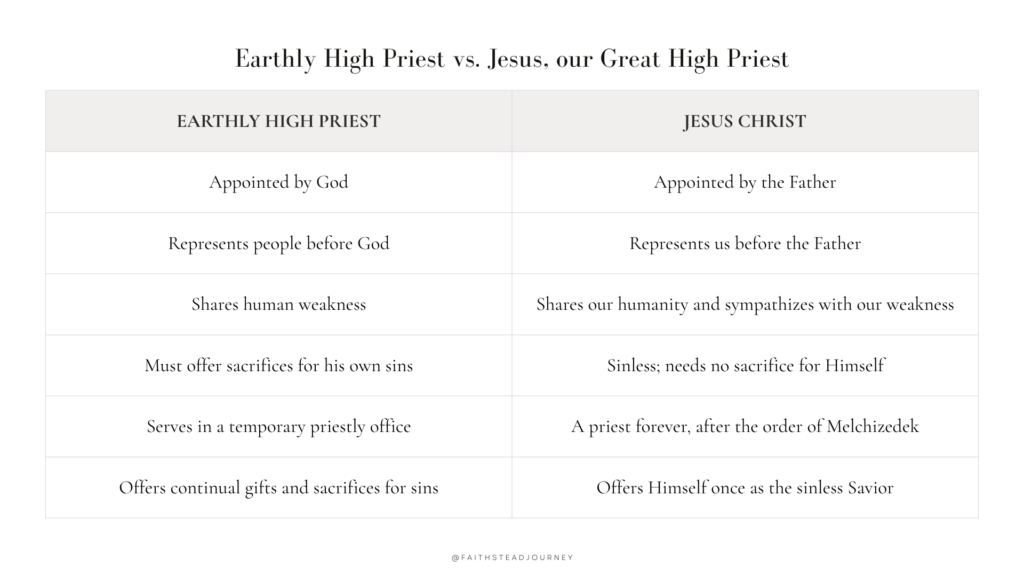
Under the old covenant, the high priest was appointed to represent the people before God. He offered gifts and sacrifices for their sins, serving as a mediator between a holy God and a sinful people. But notice two important qualifications in this passage: the high priest was chosen from among men, and he was appointed by God.
First, he needed to be one of the people he represented. He was not detached from their human experience. He knew what it was to be weak, to struggle with temptation, and to need God’s mercy himself. Because he shared their weakness, he could “deal gently with the ignorant and wayward”.
This is something I have to remind myself of as a parent. Sometimes my kids react in ways that frustrate me, and before I lose my patience, I have to remember that I was the same way at their age. I didn’t always listen, respond well to correction, or make the wisest choices either!
Remembering my own weaknesses helps me be more patient with theirs. That doesn’t mean I ignore disobedience, but I can correct them with grace instead of frustration, remembering that they’re still learning and growing, just as I am.
Yet the human high priest had a significant limitation: he was a sinner himself. In fact, he was obligated to offer sacrifices for his own sins as well as for the sins of the people. He could represent sinners before God, but he also needed forgiveness. He could offer sacrifices for others, but he could not offer himself as a perfect sacrifice.
Second, the high priest could not appoint himself. This honor belonged to those called by God, just as Aaron had been. The priesthood wasn’t a position someone could claim through personal ambition or influence. God Himself established it.
And this is a good thing! Imagine if the high priest’s position depended on his own merit or popularity. What if he had to earn his place or win an election every few years? His confidence would rest on his own performance or the approval of others rather than God’s calling.
There is a beautiful reminder of grace here: God’s purposes don’t ultimately depend on human striving, but on His calling. Paul makes a similar point in Romans 9:16: “So then it depends not on human will or exertion, but on God, who has mercy.”
And now the writer applies these same qualifications to Jesus, while showing us how much greater He is. The Bible passage above tell us that Christ did not exalt Himself to become High Priest. He was appointed by the Father. The writer supports this claim with two Old Testament quotations.
The first comes from Psalm 2:7: “You are my Son, today I have begotten you.” This is a royal declaration concerning God’s appointed King, and Hebrews uses it to establish the identity and authority of the Son. Jesus is not merely another human priest seeking a position. He is the Son whom God has appointed.
The second quotation comes from Psalm 110:4: “You are a priest forever, after the order of Melchizedek.” This introduces a priesthood different from Aaron’s, one that does not depend on the succession of mortal priests. Jesus’ priesthood is enduring. He will remain our High Priest forever.
The old covenant priests could sympathize with sinners because they shared their sinful weakness. Jesus sympathizes with us because He truly entered our human experience, yet He remained without sin. That’s the beautiful contrast: Jesus shares our humanity without sharing our sin. The writer of Hebrews is preparing us to see that Jesus is greater than the priests who came before Him.
Christ the Better High Priest Learned Obedience
Now the author takes us deeper into the humanity of Jesus and helps us see what it meant for Him to become our great High Priest.
“In the days of his flesh, Jesus offered up prayers and supplications, with loud cries and tears, to him who was able to save him from death, and he was heard because of his reverence. Although he was a son, he learned obedience through what he suffered. And being made perfect, he became the source of eternal salvation to all who obey him, being designated by God a high priest after the order of Melchizedek.” – Hebrews 5: 7-10
Jesus, the Son of God, did not move through His earthly life untouched by sorrow or suffering. We see this most clearly in the Garden of Gethsemane, where He prayed to His Father as He faced the suffering of the cross. His prayers were not evidence of weak faith. They reveal His real humanity and His complete dependence on the Father.
But why does it say that “he was heard because of his reverence”? Didn’t Jesus end up on the cross? The Father did not abandon His Son or ignore His prayer. Rather, He answered in keeping with His saving purpose. Jesus was not delivered from death by avoiding the cross; He was delivered through death by being raised from the dead.
Verse 8 says something that might seem surprising: “Although he was a son, he learned obedience through what he suffered.” If Jesus is perfect, why did He have to learn obedience?
To understand this, we need to remember who Jesus is. He is fully God and fully man. As God, the Son is omniscient; He does not lack knowledge or need to discover what is right. Yet when the eternal Son took on human nature, He did not merely appear to be human. He entered into the full experience of human life.
That means that Jesus grew from infancy into childhood and adulthood. He had to learn to walk and talk. Luke tells us that He “increased in wisdom and in stature” (Luke 2:52). This does not mean that He ceased to be God or that His divine nature became limited in knowledge. Rather, the Son truly experienced human development. He learned and grew in His human life, as real human beings do.
In the same way, Jesus learned obedience—not because He had ever been disobedient, but because He experienced what obedience looked like in the actual circumstances of human life. He obeyed His earthly parents, followed the Father’s will, endured rejection, resisted temptation, and ultimately submitted Himself to death on a cross. He knew what obedience meant, but He also lived it out through every trial and suffering His mission required.
So when Hebrews says Jesus “learned obedience,” it is not describing a flaw in His character. It is showing us the depth of His willingness to identify with us. He entered our human experience and faithfully obeyed where we have so often failed. And through His suffering, He completed the mission His Father had given Him, becoming the perfect Savior and our great High Priest.
What comfort this gives us! Jesus does not merely tell us to obey God through suffering from a distance. He has walked the path of obedience Himself. He understands its cost, sympathizes with our weakness, and has secured our salvation through His perfect obedience.
This passage also invites us to examine our own lives. If Jesus, the sinless Son of God, learned obedience through suffering, how much more do we need to learn to walk in obedience through suffering to our Father? However, we live in a culture that seeks to avoid suffering at all costs. We want comfort, convenience, and immediate relief from anything that makes us uncomfortable. And while there is nothing wrong with seeking relief from suffering when we can, we must be careful not to assume that every hardship or suffering is something to escape or that an easy life is necessarily a fruitful one.
I once read a story about someone who watched a butterfly struggling to emerge from its chrysalis. Feeling sorry for it, the person decided to help by pulling the chrysalis off the butterfly. But the struggle was part of the process by which its wings developed the strength needed for flight. By intervening, the person unintentionally hindered the butterfly’s development, leaving it with deformed wings unfit for proper flight. The person’s good intentions had actually done harm. The lesson is a sobering one: not every struggle is bad. Sometimes the difficulty itself is part of the process of growth.
We see a similar principle in parenting. As parents, we naturally want to protect our children from pain and frustration. We don’t like watching them struggle, fail, or feel disappointed. But if we rush in to remove every obstacle, we can actually hinder their growth. Have you ever noticed how children who are always given what they want and rescued from every difficulty have a harder time accepting correction, exercising self-control, or obeying when things don’t go their way? In our desire to spare them discomfort, we can unintentionally rob them of opportunities to develop patience, humility, and perseverance. Sometimes, loving our children means allowing them to struggle, experience disappointment, and learn from their mistakes. Of course, these illustrations don’t mean we should leave our children without help or ignore suffering that needs our attention. Wise love knows when to intervene and when to patiently allow someone to work through a challenge.
If we understand this as imperfect, earthly parents, how much more can we trust our perfectly wise and loving Father? God does not promise to shield His children from every hardship. In His providence, He can use trials to expose our sinful attitudes, teach us to depend on Him, and develop in us the character we might never learn if life were always easy. Sometimes the very thing we want God to remove becomes an opportunity for Him to teach us patience, humility, perseverance, or trust.
This is why James tells us to count it all joy when we face trials, because the testing of our faith produces steadfastness and maturity (James 1:2–4). We don’t rejoice because suffering is pleasant, nor do we need to seek it out. We rejoice because we know our Father is wise and faithful, and He can use even painful seasons for our good and His glory.
Verse 9 tells us that Jesus, “being made perfect, became the source of eternal salvation to all who obey him.” Again, this does not mean Jesus was morally imperfect and had to become sinless. He was already without sin. He was made perfect in the sense that He brought His mission to completion. Through His suffering, death, and resurrection, He accomplished everything necessary to save His people. He became the perfect and fully qualified Savior and High Priest.
Notice, too, that this salvation is eternal. The old covenant priests offered sacrifices repeatedly, and every priest eventually died. He does not merely make salvation possible and leave us to finish the job. Jesus offered Himself once for all, and His saving work is complete.
But what does it mean that He is the source of salvation to those who obey Him? It does not mean we earn salvation by our obedience. Scripture consistently teaches that we are saved by grace, not by our works. Rather, genuine faith in Christ is a faith that hears Him, trusts Him, and follows Him. Our obedience is not the price we pay to receive salvation; it is the fruit of the salvation He has secured for us.
Finally, verse 10 tells us that God designated Jesus “a high priest after the order of Melchizedek.” This brings us back to the main theme of Hebrews: Jesus did not appoint Himself; the Father appointed Him. And unlike the priests descended from Aaron, Jesus belongs to a greater and enduring priesthood, one that the author will explain more fully in the chapters ahead.
From Milk to Solid Food
“About this we have much to say, and it is hard to explain, since you have become dull of hearing. For though by this time you ought to be teachers, you need someone to teach you again the basic principles of the oracles of God. You need milk, not solid food, for everyone who lives on milk is unskilled in the word of righteousness, since he is a child. But solid food is for the mature, for those who have their powers of discernment trained by constant practice to distinguish good from evil.” – Hebrews 5:11-14
The author of Hebrews has just introduced an important truth about Jesus: He is our great High Priest, appointed by God according to the order of Melchizedek. This is a deep and wonderful subject, and the author has much more to explain. But before he can continue, he pauses to address a problem among his readers. They have become “dull of hearing.”
Notice that he doesn’t say they are incapable of understanding. Rather, they have become sluggish in how they listen and respond to God’s Word. They have had time to grow in their understanding of the faith, but instead of maturing, they have become spiritually stagnant.
This is a sobering warning for us. Spiritual maturity doesn’t happen automatically just because we’ve been Christians for a long time. We can attend church for years, listen to sermons, read our Bibles, and even teach others, yet remain spiritual babes. Growth requires more than exposure to truth; it requires receiving that truth, believing it, and putting it into practice.
The author uses the picture of a baby who needs milk compared with a mature person who can eat solid food. Milk isn’t bad. Every believer begins with the basic truths of the faith, and those foundations remain essential throughout our lives. The problem is that these Christians should have progressed beyond needing the same elementary instruction repeated to them.
Imagine an adult who only drinks out of a milk bottle because he refuses to learn to chew and eat solid food. What should have been a temporary stage has become a sign that something is wrong. I’ve heard Christians say that loving God and having a personal relationship with Jesus is enough, as though studying Scripture isn’t really necessary. But how can we have a relationship with someone we don’t truly know? Imagine being married to someone but never communicating with them, listening to them, or making an effort to understand their heart. We wouldn’t call that a healthy, intimate relationship. In the same way, we cannot separate knowing Jesus from learning who He has revealed Himself to be through His Word. If we love Him, shouldn’t we want to know Him more deeply?
Others avoid theological discussions because they can be uncomfortable or lead to disagreement. Of course, we shouldn’t be contentious or argue simply to prove we’re right. But thoughtful theological discussion is healthy for the body of Christ when we approach one another with humility and a genuine desire to understand God’s Word more clearly. As we examine Scripture together, ask difficult questions, and consider different interpretations, we sharpen one another’s understanding and grow in discernment.
The “solid food” here includes deeper teaching about Christ’s priesthood, particularly the subject of Melchizedek that the author is preparing to explain. You might wonder why this matters. Yet the author of Hebrews considers this an important truth for mature. believers to understand. Why? Because the more deeply we understand who Jesus is and what He has accomplished for us, the more firmly we can be anchored in Him.
I have firsthand experience with the detrimental effects of failing to understand this truth. I grew up in a cult that elevated its apostle to the position of high priest, effectively replacing the sufficiency of Christ’s once-for-all sacrifice. I was taught that I needed this human leader to mediate between me and God. Understanding what Hebrews teaches about Christ’s unique and eternal priesthood helps us recognize just how dangerous it is when anyone or anything is placed in the position that belongs to Jesus alone. No human mediator can do what Christ has done for us. He alone is our great High Priest, and His sacrifice is completely sufficient to bring us to God.
Verse 14 tells us that mature believers are those “who have their powers of discernment trained by constant practice to distinguish good from evil.” Discernment, like any skill, develops through practice. It reminds me of my childhood piano lessons. I practiced my scales over and over until they became almost second nature. Even though I rarely play piano anymore, I can still play those scales because of the muscle memory I developed through repetition. In the same way, as we continually study God’s Word and practice applying it to our lives, our spiritual discernment begins to develop a kind of muscle memory. We become more accustomed to recognizing what is true and what is false, what honors God and what doesn’t. Rather than being easily swayed by every new idea or teaching, we learn to instinctively compare what we hear and experience against the truth we have come to know so well. Discernment becomes less like a skill we are learning from scratch and more like a practiced response that has become second nature.
Something interesting I came across recently was a reel about AI. Someone took an old black-and-white family photo from a Christmas dinner and asked AI to colorize it. The result looked great! But when he placed the original and edited photos side by side, you could spot a few extra decorations in the background and, more surprisingly, an entirely new person standing right in the middle of the family photo! What was unsettling was how easily that person blended in. If I hadn’t seen the original photo or known the family, I might never have realized anything was wrong. Without the original copy, it’s easy to be deceived by something that looks convincing on the surface.
Think about counterfeit money: the better you know genuine currency, the more readily you can spot a fake. In the same way, the more deeply we know God’s Word, the better equipped we are to recognize teachings, attitudes, and behaviors that contradict His truth.
This illustrates why discernment matters. It is very easy to drift and be deceived if we are not firmly rooted in God’s Word. False teaching doesn’t always appear obviously wrong. Sometimes it sounds convincing because it uses familiar biblical language while subtly shifting our attention away from Christ and His finished work. If we aren’t growing in our understanding of Scripture, we may not recognize when something that sounds spiritual is actually leading us away from the truth.
The author wanted to explain Christ’s superior priesthood, but his readers’ spiritual immaturity was keeping them from grasping the richness of what God has revealed about His Son. This is why growing in God’s Word matters. If we remain spiritually immature, we become “unskilled in the word of righteousness,” more vulnerable to deception, less able to discern good from evil, and less prepared to stand firm when our faith is tested.
We cannot separate growing in our knowledge of Christ from growing in our obedience to Christ. The more we understand who Jesus is and what He has accomplished for us, the more deeply we can rest in His finished work.
I really like how Pastor Norm Wakefield explained the difference between a baby who drinks milk and a toddler who eats solid food. A baby cries whenever he is hungry, but a toddler has begun to learn that his parents will provide for him in due time. He doesn’t have to panic every time he feels hungry because he has learned to trust the ones who care for him.
In a similar way, spiritual maturity grows as we learn to trust our heavenly Father. We begin to respond to life’s uncertainties not with the same fear and restlessness we once knew, but with a growing confidence in God’s character and promises. This doesn’t mean we never struggle or that we no longer need Him. Rather, as we grow in our knowledge of Christ, we learn to recognize what is true, respond in obedience, and rest more fully in the sufficiency of His finished work.
This is why the author of Hebrews is so earnest in urging his readers to move beyond spiritual infancy and press on toward maturity. He wants them to grasp the deeper truths about Christ so that they will learn to trust Him more fully, hold fast to their confession, and persevere in faith. He wants them to enter God’s Sabbath rest—to stop relying on their own works and to remember what Christ has already accomplished. Spiritual maturity doesn’t mean we need Christ less; it means we understand more deeply why we need Him and learn to trust Him more completely.