
Leaving Elementary Doctrines
“Therefore let us leave the elementary doctrine of Christ and go on to maturity, not laying again a foundation of repentance from dead works and of faith toward God, and of instruction about washings, the laying on of hands, the resurrection of the dead, and eternal judgment. Ad this we will do if God permits.” – Hebrews 6:1-3
The sentence starts with, surprise: therefore… which means we need to go back and recall what was being said in the last chapter.
The author is writing to Hebrews who would have been very well acquainted with the Old Testament scriptures and practices. He had just rebuked them for being spiritually immature (Hebrews 5:11-14). They should have been teachers by now but they still needed someone to teach them the basic principles of God’s Word.
So when he says, “Let us leave the elementary doctrine of Christ and go on to maturity,” he’s not saying that the foundational truths don’t matter but that we must now build on the foundation instead of continually laying it again.
Think of the difference between learning the alphabet and learning to read great literature. You never stop needing the alphabet, but you should grow beyond practicing your letters forever.
The six teachings in Hebrews 6:1–2 are especially interesting because they sound like a mixture of Jewish religious foundations and basic Christian teaching. The author is showing his readers that they need to move forward in understanding how God’s promises, the Old Testament Scriptures, and the work of Jesus fit together.
Let’s look at each one through the eyes of the original audience.
1. Repentance from dead works
What it meant: Turning away from sinful or spiritually fruitless ways of life and turning toward God.
The Greek expression translated “dead works” is somewhat broad. It may refer to sinful deeds that lead to death, works that cannot give spiritual life, or human efforts that cannot cleanse the conscience and bring us to God. Hebrews uses related language in 9:14, where Christ’s blood cleanses our conscience from dead works so that we can serve the living God.
For a Jewish audience, repentance was already a familiar concept. The prophets repeatedly called Israel to turn away from idolatry, disobedience, and empty religious observances and return to the Lord. But the gospel brought a deeper question: Could their own works make them clean before God, or did they need the cleansing that only Christ could provide?
The author will later explain that the old sacrificial system could not finally perfect the worshiper or cleanse the conscience (Hebrews 9:9–14; 10:1–4).
In today’s terms: Turn away from sin and from any attempt to establish your own righteousness before God. Repentance is not merely feeling bad about what you have done; it is turning to God in faith, trusting His provision rather than your own ability to make yourself right with Him.
A helpful distinction: the author is not teaching that obedience is worthless. Hebrews calls believers to persevere in obedience. Rather, our works cannot replace Christ’s saving work.
2. Faith toward God
What it meant: Trusting the God who revealed Himself to Israel and believing His promises.
The Jewish audience already believed in the one true God. Faith in God was not a new idea introduced by Christianity. The Old Testament repeatedly presents faith as trusting God’s character and promises, even when their fulfillment seems distant. Hebrews 11 will make this point by tracing faith through Abel, Noah, Abraham, Moses, and others.
But now the question is how faith in the God of Israel relates to Jesus the Messiah. The author has already declared that God has spoken definitively through His Son (Hebrews 1:1–2). The issue is not abandoning faith in the God of Abraham for a different God. It is recognizing that the God they already profess to trust has spoken and acted through His Son.
In today’s terms: Trust God by believing what He has revealed about Himself and His Son. Biblical faith is not simply believing that God exists; it is relying on His promises and trusting His provision for our salvation.
This also helps explain why returning to the old covenant system as though Christ had not come would be such a serious step backward.
3. Instruction about washings
What it meant: Teaching about ritual washings and cleansing, and possibly Christian baptism.
The Greek word translated “washings” is baptismōn, which can refer to washings or ritual purifications. The plural is significant because the Jewish Scriptures prescribed various cleansing practices, and Jewish religious life included ritual washing.
For example:
– Old Testament purification: Priests washed before serving, and certain forms of uncleanness required washing (Exodus 30:17–21; Leviticus 15).
– Jewish purification practices: Mark 7:3–4 describes washing traditions associated with Jewish religious life.
– John’s baptism: A baptism associated with repentance and preparation for the coming Messiah (Mark 1:4).
– Christian baptism: A public identification with Jesus Christ and the Christian faith (Romans 6:3–4).
Scholars differ on whether Hebrews 6:2 refers primarily to Jewish purification practices, Christian baptism, or instruction distinguishing the two. We should not claim certainty where the text does not give it. However, the broader argument of Hebrews is clear: the readers need to understand cleansing in light of what Christ has accomplished.
Hebrews 9:10 refers to various regulations involving food, drink, and washings, while Hebrews 9:13–14 contrasts external purification with Christ’s power to cleanse the conscience.
For the original audience, this meant understanding how the old covenant’s purification practices related to the greater cleansing accomplished by Jesus.
In today’s terms: Understand the difference between outward religious practices and the cleansing that comes through Christ. Religious ceremonies may have an important God-given purpose, but they cannot substitute for the cleansing of sin that Christ provides.
4. Laying on of hands
What it meant: The symbolic act of placing hands on someone or something to express identification, blessing, appointment, or the imparting of a particular responsibility or gift.
Laying on of hands was familiar in the Old Testament:
– Identification with a sacrifice: An Israelite placed a hand on an animal being offered (Leviticus 1:4).
– Appointment and commissioning: Moses laid his hands on Joshua as he commissioned him to lead Israel (Numbers 27:18–23).
– Blessing: Jacob laid his hands on Joseph’s sons when blessing them (Genesis 48:13–20).
The practice also appears in the New Testament in connection with commissioning workers, prayer, healing, and the reception of the Holy Spirit (Acts 6:5–6; 8:14–17; 13:2–3).
For Jewish readers, this was a familiar symbolic practice. The author is including it among the foundational teachings his audience should already understand.
In today’s terms: Understand the biblical significance of acts such as blessing, commissioning, and identifying someone with a particular calling or ministry. The physical act itself is not a substitute for God’s work or a guarantee of spiritual power.
5. Resurrection of the dead
What it meant: The future resurrection of the dead when God raises the dead to life.
This teaching was not foreign to Judaism. The Old Testament contains the hope of resurrection, most explicitly in Daniel 12:2, which speaks of those who sleep in the dust awakening to everlasting life or everlasting contempt.
By Jesus’ time, resurrection was a significant point of disagreement among Jewish groups. The Sadducees denied the resurrection, while the Pharisees affirmed it (Acts 23:6–8).
The Christian proclamation made this hope even more concrete: Jesus the Messiah had been raised from the dead, and His resurrection was the guarantee of the resurrection to come (1 Corinthians 15:20–23).
Hebrews will later speak of Abraham’s confidence in God’s ability to raise the dead (Hebrews 11:17–19).
For the original audience, this was foundational to the Christian hope. The author wants them to understand not only that resurrection is true, but how God’s promises find their fulfillment in Christ.
In today’s terms: Believe that death is not the end. God will raise the dead, and the resurrection of Jesus assures His people that death will not have the final word.
6. Eternal judgment
What it meant: God’s final judgment of humanity, with everlasting consequences.
The Old Testament already taught that God judges the world in righteousness. Daniel 12:2 connects resurrection with the contrasting destinies of everlasting life and everlasting contempt.
Jesus also taught about final judgment, and the New Testament repeatedly affirms that everyone will give an account to God.
Hebrews itself emphasizes the seriousness of this reality:
– Hebrews 4:13 — Nothing is hidden from God’s sight.
– Hebrews 9:27–28 — Death and judgment are certain, and Christ will appear a second time for the salvation of those who eagerly await Him.
– Hebrews 10:26–31 — Rejecting the truth of God’s revelation is a serious matter.
In today’s terms: Recognize that our lives have eternal significance. God will judge justly, and we cannot treat His revelation or His Son as though our response does not matter.
This is especially important in Hebrews because the author is warning his readers against drifting away from Christ. He is not merely trying to frighten them; he wants them to take God’s promises and warnings seriously and persevere in faith.
Putting the six teachings together
Notice how these teachings fit together. The author isn’t simply giving his readers a list of doctrines to memorize. He wants them to grow in understanding how God’s whole plan of salvation comes together in Christ.
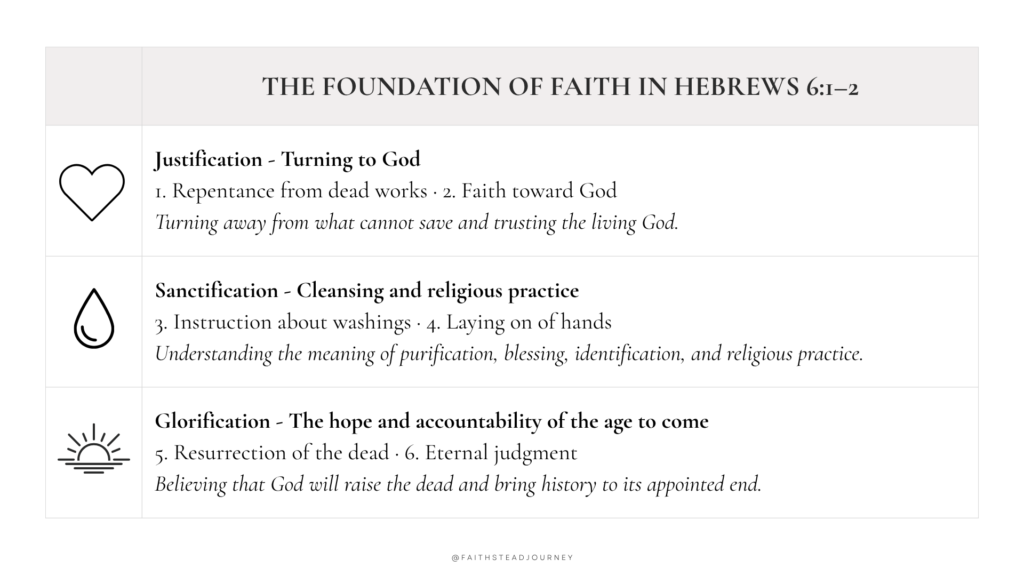
These groupings are a helpful way to study the list, although Hebrews does not explicitly divide the six teachings into these three categories.
An important distinction:
– Justification: Repentance and faith fit naturally with our response to the gospel, although repentance and faith are not themselves the same thing as justification.
– Sanctification: Washings and laying on of hands are religious practices, not simply synonyms for sanctification.
– Glorification: Resurrection and judgment clearly concern the future, but judgment is not identical to glorification.
However, I think this gives us an interesting framework in understanding the point the author is trying to make. He wanted them to understand not only how we begin in the faith, but also how God is making us holy and where our hope is ultimately leading.
The author is not contrasting a bad Jewish faith with a good Christian faith. He is addressing people who know the Scriptures and urging them to recognize that God’s promises, priesthood, sacrifices, and covenant purposes find their fulfillment in Jesus.
This is why Hebrews repeatedly uses the language of better: Jesus is better than the angels, greater than Moses, and the mediator of a better covenant. The author wants his readers to understand the significance of what God has done in Christ rather than remain spiritually immature.
And that leads directly to verse 3: “And this we will do if God permits.”
Even growth in understanding is dependent on God’s grace. The author intends to move forward with his readers, but he recognizes that spiritual maturity is not something we produce independently of God.
Something to remember is that maturity does not mean moving beyond the gospel. It means growing in our understanding of the gospel’s depth, seeing how all of Scripture points to Christ, and learning to live with the discernment and perseverance that such understanding produces.
Can Believers Lose Their Salvation?
“For it is impossible, in the case of those who have once been enlightened, who have tasted the heavenly gift, and have shared in the Holy Spirit, and have tasted the goodness of the word of God and the powers of the age to come, and then have fallen away, to restore them again to repentance, since they are crucifying once again the Son of God to their own harm and holding him up to contempt. For land that has drunk the rain that often falls on it, and produces a crop useful to those for whose sake it is cultivated, receives a blessing from God. But if it bears thorns and thistles, it is worthless and near to being cursed, and its end is to be burned.” – Hebrews 6:4-8
This is one of the most controversial passages in Scripture. The author describes people who have been enlightened, tasted the heavenly gift, shared in the Holy Spirit, tasted the goodness of God’s Word and the powers of the coming age—and yet fall away.
What does this mean? Can someone who has truly been saved lose their salvation?
Remember, if Scripture is the inspired Word of God, we can be confident that God never contradicts Himself. We can let Scripture interpret Scripture, allowing the passages we understand more clearly to help us understand those that are more difficult. So, what does the Bible teach us about our salvation?
God preserves those who truly belong to Christ. Jesus says in John 10:27–29 that His sheep hear His voice, follow Him, receive eternal life, and will never perish. No one can snatch them out of His hand or the Father’s hand. If we understand that eternal life is a gift that was offered solely on the basis of God’s grace, then we can rest in the assurance that salvation cannot ultimately be earned by our works or maintained by how we perform.
Paul gives us another beautiful assurance in Romans 8:29–30. Those whom God foreknew, He also predestined; those He predestined, He called; those He called, He justified; and those He justified, He glorified. The chain of God’s saving work is unbroken. Paul goes on to ask, in Romans 8:35–39, what can separate us from the love of God in Christ Jesus. His answer is that nothing in all creation can separate believers from His love, needless to say our weaknesses and failures.
Likewise, Philippians 1:6 assures us that He who began a good work in us will bring it to completion at the day of Jesus Christ. And 1 Peter 1:3–5 describes believers as those who are born again to a living hope through Christ’s resurrection and who are being guarded by God’s power through faith for a salvation ready to be revealed.
Our salvation, then, does not ultimately depend on our ability to hold ourselves securely in God’s hands. It depends on God’s faithfulness to complete the saving work He has begun.
Then why does the author of Hebrews give believers such a serious warning about turning away from God?
Jesus gives us a helpful picture in the parable of the weeds (Matthew 13:24–30, 36–43). A farmer planted good seed in his field, but an enemy came during the night and sowed weeds among the wheat. For a time, the two grew side by side, and it was not immediately obvious which plants were genuine wheat and which were weeds. Jesus explains that the field represents the world, where the sons of the kingdom and the sons of the evil one remain together until the final judgment.
We can also see a related distinction within the visible church. Not everyone who professes faith or experiences the blessings of the Christian community has necessarily been regenerated by the Holy Spirit. People may hear God’s Word, witness His work, participate in the life of the church, and even experience extraordinary spiritual privileges without possessing genuine, saving faith.
Consider Judas. Jesus sent the Twelve out to preach and gave them authority to perform mighty works (Matthew 10:1–8). Yet Jesus later identified Judas as the one who would betray Him (John 6:70–71). Judas’s outward participation in Jesus’ ministry did not mean his heart had been transformed by saving grace.
This helps us understand why Hebrews gives such a serious warning. The author describes people who have experienced remarkable spiritual blessings, yet who fall away from Christ. These experiences do not necessarily prove that a person has been regenerated. There is a difference between participating in the visible church and possessing the inward, saving work of the Holy Spirit.
The warning, then, is that we must not presume upon God’s grace while growing indifferent to His Word. We must not confuse familiarity with the gospel for faith in the gospel, or spiritual experiences for a heart that truly rests in Christ.
The warning is not that a genuine believer might lose salvation through a single failure, a season of doubt, or a struggle with sin. Rather, it warns that someone who professes faith and has experienced the blessings of the Christian community can still turn away from Christ.
When the author describes those who fall away as “crucifying once again the Son of God to their own harm and holding him up to contempt” (Hebrews 6:6), he is not saying that Jesus is literally crucified again, but that they are treating Him with the same contempt as those who rejected Him and handed Him over to be crucified. Like those who cried, “Crucify him!” despite hearing His teaching and witnessing His works, they reject the very One God sent to save them.
This warning would have been especially sobering for the original readers. They had received the Scriptures, the promises, and the covenant shadows that pointed forward to the Messiah. Now that Christ had come and fulfilled those promises, to turn away from Him would be to reject the very One to whom all those things pointed. If they abandoned Christ and returned to the old covenant shadows as though He were not the promised Savior, they would be treating Him as unworthy of their trust and allegiance—effectively siding with those who had delivered Him to be crucified rather than embracing Him as the fulfillment of God’s promises.
Next, the author illustrates his warning with a picture of two fields. Both receive the same rain, yet they produce different crops. One produces useful vegetation and receives a blessing, while the other produces thorns and thistles and faces judgment. The rain represents the spiritual blessings and privileges the people have received, while the crops reveal the outcome of how those privileges have been received.
In the same way, experiencing the blessings of God’s Word and participating in the life of His people does not, by itself, prove that a person has been regenerated (produce good crops). Isaiah 55:10-13 reminds us that just as the rain and snow water the earth and brings forth produce, the word that goes out from His mouth, never returns empty, but will accomplish that which he purposes, and shall succeed in the thing for which it was sent. The evidence of genuine saving faith is not merely what we have experienced, but a faith that continues to cling to Christ and bears fruit by His grace. The thorns and thistles warn us that receiving spiritual privileges while ultimately rejecting Christ leads to judgment (being burned).
As sobering as this warning is, this is actually an expression of God’s mercy. For the believer, it is one of the means God uses to preserve us in faith. Through His Word, He exposes false confidence, warns us against the deceitfulness of sin, and calls us to keep holding fast to Christ. We do not persevere by our own strength; God faithfully sustains us through His promises, His warnings, and His grace.
For the person who has not truly trusted in Christ, this warning is also an act of mercy. The judgment described is real, but so is the invitation of the gospel. As long as we hear His Word today, we must not harden our hearts. There is still a chance to repent, turn to Christ, and receive the salvation He freely offers. The warning is not given to drive the humble and repentant away from Christ, but to awaken us to our need for Him.
For those who belong to Him, God uses this warning to keep us clinging to Christ; for those who have not yet believed, it is a gracious call to come to Him while today is still called “today” (Hebrews 3:13).
Three Marks of Genuine Christianity
“Though we speak in this way, yet in your case, beloved, we feel sure of better things—things that belong to salvation. For God is not unjust so as to overlook your work and the love that you have shown for his name in serving the saints, as you still do. And we desire each one of you to show the same earnestness to have the full assurance of hope until the end, so that you may not be sluggish, but imitators of those who through faith and patience inherit the promises.” – Hebrews 6:9-12
Earlier, we established that within an assembly of professing Christians, there can be both regenerate and non-regenerate individuals. Here, however, the author expresses his confidence that his readers possess the better things that accompany salvation. His confidence is not an infallible declaration of their spiritual condition, but a strong conviction based on the evidence he has witnessed in their lives.
This also helps us understand why the author has given them such stern warnings. He isn’t necessarily warning them because he has concluded that they are apostates or unbelievers. Rather, he is writing as a loving shepherd who desires to protect and preserve those in his care. Think of a good parent: a parent doesn’t withhold a warning simply because they trust their child to make the right decision. They warn precisely because they love their child and want to protect them from danger. In the same way, the author’s warnings are not evidence that he expects them to fail, but that he desires them to persevere.
And this brings us to an important distinction: good works are not the cause of our salvation, but they are the necessary fruit and evidence of it. We aren’t saved by what we do for God; we are saved by what God has done for us through Christ. Yet genuine faith does not remain fruitless. It produces a changed heart that begins to bear the fruit of love, obedience, and service.
Some might argue that the thief who died beside Jesus and was promised paradise never had the opportunity to demonstrate good works. But I would argue that his response to Jesus gives us a beautiful picture of the fruit of genuine faith.
In John 6:29, Jesus says, “This is the work of God, that you believe in him whom he has sent.” Even believing in Christ is not something we can boast about as though we have earned our salvation. It is by grace through faith that we receive what Christ has accomplished for us.
Look at the thief’s words in Luke 23:40–42. First, he rebukes the other criminal, asking, “Do you not fear God?” Here we see a reverence for God and a recognition of His holiness. He then acknowledges his own guilt, admitting that they are receiving what their deeds deserve, while declaring that Jesus has done nothing wrong. He recognizes his own sinfulness and Jesus’ innocence.
Then he turns to Jesus and says, “Jesus, remember me when you come into your kingdom.” What a remarkable statement of faith! Here is a dying man, witnessing what appears to be the defeat of Jesus, yet he recognizes Him as a King with a kingdom beyond the cross. He places his hope in Christ when there is nothing left for him to offer.
We can see the marks of genuine faith even in this brief encounter:
– Faith: He believes Jesus is innocent and recognizes Him as King.
– Love: He demonstrates reverence for God, concern for what is right, and even speaks up in defense of Jesus.
– Hope: He trusts that Jesus has a kingdom and asks to be remembered when He comes into it.
The thief had no time to build a lifetime of good works, but his words revealed the fruit of a heart that had turned toward Christ. His story reminds us that salvation has never been about how much we can accomplish for God. It has always been about what Christ has accomplished for us.
Again, we must be careful not to confuse the fruit of salvation with the means of salvation. The thief was not saved because he had time to prove himself through good works. He was saved by grace through faith in Christ. Yet even in his final moments, his faith was not fruitless.
The thief on the cross gives us a beautiful picture of these marks of genuine faith, and we see this same combination of faith, love, and hope woven throughout Scripture (1 Corinthians 13:13; Colossians 1:4–5; 1 Thessalonians 1:3). These aren’t three separate virtues that we must independently achieve, but interconnected evidences of God’s saving work in a believer. And I believe these are the very things we see emerging in Hebrews 6:9–12—the better things that accompany salvation and give the author confidence in his readers.
Faith — What we believe and whom we trust.
The author has spent the preceding chapters explaining the superiority of Christ: who He is and what He has accomplished on our behalf. Doctrine matters because we must know the Christ in whom we place our faith. But faith is more than simply agreeing with a collection of doctrinal statements. It is trusting the Christ those doctrines reveal. We aren’t merely acknowledging that Jesus is the better High Priest or that His sacrifice is sufficient; we are resting our confidence in Him and His finished work.
Although the author doesn’t explicitly use the word “faith” in verse 10, he points to the evidence of it in their lives. He says that God is not unjust to overlook their work and the love they have shown for His name in serving the saints. Their love and service are not what earned them salvation; they are the outward expression of an inward faith. Their actions reveal that the truth they profess is something they genuinely believe and live by.
Love — What our faith produces.
Remember, Jesus summed up the greatest commandments as loving God with all our heart, soul, and mind, and loving our neighbor as ourselves (Matthew 22:37–40). In fact, these two loves are inseparable. When we truly love God, that love begins to overflow into how we love and serve others. Think of a cup being continually filled with water. Eventually, it has no choice but to overflow. In the same way, when we understand the depth of God’s love for us and grow in our love for Him, that love inevitably overflows into the lives of those around us. We don’t serve others to earn God’s love or to secure our salvation; we serve because we His love breaks through the dam in our hearts, overflowing into the lives of those around us.
As 1 John 4:19 tells us, “We love because he first loved us.” This outward expression of love is evidence of an inward work of grace. It is fruit that grows from a genuine faith. And this is exactly what the author has observed in these believers: their faith wasn’t merely a profession of words, but something being demonstrated through their love and service to God’s people.
Hope — What keeps us persevering.
The author now turns their attention toward the future. He desires that each of them continue showing the same earnestness so that they may have the full assurance of hope until the end.
Hope is not wishful thinking or simply hoping things will work out. Biblical hope is confident expectation rooted in the promises and faithfulness of God. Notice that the author connects hope with perseverance. He doesn’t want them to become sluggish but to imitate those who, through faith and patience, inherit the promises.
Faith is what we believe. Love is what we demonstrate. And hope is how we persevere. Faith rests in Christ. Love flows from Christ. And hope holds fast to Christ.
These three marks also give us a helpful way to examine our own hearts:
– Faith: Do I genuinely trust in Christ and His finished work, rather than relying on my own efforts?
– Love: Is my faith producing a growing love for God and for others?
– Hope: Am I continuing to trust God’s promises and persevering in faith, even when the journey is difficult?
These questions aren’t meant to make us look inward endlessly or measure ourselves against some standard of perfection. Rather, they help us recognize the evidence of God’s saving work in our lives. And thankfully, the author doesn’t leave us looking inward for our assurance. He knows that our confidence cannot ultimately rest in the strength of our own faith, the consistency of our love, or the perfection of our perseverance. Our assurance must rest in something far more certain: the character and promises of God Himself.
And this is exactly where the author takes us next. In verses 13–20, he turns our attention to God’s promise to Abraham, His unchanging purpose, and the certainty of His oath. He reminds us that God does not lie, His promises do not change, and His purposes cannot fail.
So as we move into the next passage, we’ll see that the reason we can persevere in faith, outpour love, and hold fast to our hope doesn’t rest on the perfection of our grip on Christ, but on the perfection of His finished work and the faithfulness of His promises. Our faith looks to Christ, our love reflects Christ, and our hope rests in the faithfulness of God.
The Certainty of God’s Promises
“For when God made a promise to Abraham, since he had no one greater by whom to swear, he swore by himself, saying, “Surely I will bless you and multiply you. And thus Abraham, having patiently waited, obtained the promise. For people swear by something greater than themselves, and in all their disputes an oath is final for confirmation. So when God desired to show more convincingly to the heirs of the promise the unchangeable character of his purpose, he guaranteed it with an oath, so that by two unchangeable things, in which it is impossible for God to lie we who have fled for refuge might have strong encouragement to hold fast to the hope set before us.” – Hebrews 6:13-18
Remember that the author has just encouraged his readers to imitate those who, through faith and patience, inherit the promises. And what better example to point them to than Abraham, whose life beautifully illustrates what it means to trust God’s promises and patiently wait for their fulfillment?
Let’s recount Abraham’s journey of faith really quickly:
- God promises to bless Abraham, make him a great nation, and to bless the nations of the earth through Him. (Genesis 12, 15, and 17).
- Isaac is finally born 25 years later!
- God tests Abraham by commanding him to offer Isaac (Genesis 22). This could have been another 15-25 years later.
- Abraham obeys, trusting that God is able even to raise Isaac from the dead (Hebrews 11:17–19).
- God confirms His promise with an oath (Genesis 22:15–18).
When people make an oath, they typically swear by someone or something greater than themselves to establish the certainty of their word. It serves as a guarantee that what they have promised is true. But God has no one greater than Himself. He is the highest authority, the source of all truth, and the One whose character never changes. So He swore by His own name.
Why would God do this? Did He need to make an oath to prove that He was trustworthy? Of course not! God cannot lie, and His word is already certain. Rather, as verse 17 explains, He did this to show more convincingly to the heirs of the promise the unchangeable character of His purpose. In other words, God graciously condescends to our weakness and gives us additional assurance of what He has already promised. He did this for Abraham and for us!
The author then points to two unchangeable things: God’s promise and God’s oath.
God’s promise – He declared what He would do.
God’s oath – He swore by Himself that He would do it.
Both rest on the same unchanging reality—God’s character. It is impossible for God to lie. What He promises, He will accomplish. What He purposes, He will bring to pass.
And notice who this assurance is intended for: “we who have fled for refuge.” This is such a beautiful picture of the Christian life. We have recognized that there is no refuge in ourselves, our good works, or anything this world can offer. Our only refuge is God Himself. We flee to Him, trusting in His promises, and find strong encouragement to hold fast to the hope set before us.
We can hold fast to our hope because the One who made the promise is incapable of breaking it.
A Steadfast Anchor
“We have this as a sure and steadfast anchor of the soul, a hope that enters into the inner place behind the curtain, where Jesus has gone as a forerunner on our behalf, having become a high priest forever after the order of Melchizedek.” – Hebrews 6:19-20
One thing that really stands out to me is the magnitude of Abraham’s faith in light of how long he waited. God promised to make him a great nation, yet Abraham waited 25 years just for the birth of one son. Then, decades later, God asked him to give up that very son—the son through whom the promise was supposed to come. And still, Abraham trusted God.
Even when Abraham died, he had not seen the fulfillment of the great nation God had promised. He had only seen the beginning. Yet he believed God.
How much more, then, do we have reason to trust Him? We, as spiritual descendants of Abraham through faith, have not only heard the promise but have seen the great nation that came from him. We have also witnessed the fulfillment of God’s promise to bless all nations through Abraham’s offspring, Jesus Christ. Abraham trusted God’s promise without seeing its full fulfillment. We have the privilege of looking back at what God has already accomplished through Christ, while also looking forward to what He has promised still to come.
And this brings us to Hebrews 6:19–20. The author tells us that this hope is an anchor for our souls, firm and secure, because Jesus has gone before us into God’s presence as our great High Priest.
Our hope, then, is not anchored in our circumstances, our ability to persevere, or even the strength of our own faith. It is anchored in Jesus Christ, who has entered God’s presence on our behalf. Just as God’s promise and oath gave Abraham assurance, we have an even greater assurance in Christ, who has secured our access to God.
I remember hearing a story from Tim Mackie about a time he went mountain climbing with a more experienced friend. As they were making their way down the mountain, his friend secured a rope to a tree and began descending. But Tim hesitated. It was his first time making this kind of descent, and he wasn’t sure he could trust the rope or whether the tree was secure enough to hold his weight.
He watched his friend go down safely, but even then, he struggled to make himself lean back and trust the rope. After some encouragement and reassurance, he finally took the step and began his descent.
Similarly, the author tells us that our hope is an anchor for the soul, firm and secure, because Jesus has gone before us into God’s presence on our behalf.
Here’s the thing: the security of the anchor doesn’t change based on how confident we feel about it. The anchor is either secure or it isn’t. But our willingness to lean back and put our full weight on it reveals how much we trust it.
In the same way, our actions are often a reflection of where our hope is anchored. When life gets difficult, when obedience is costly, or when God’s promises seem slow in coming, do we trust Him enough to lean our full weight on Christ?
The question isn’t whether Christ is a secure anchor. He is. The question is whether we are living like we believe it. Just as Abraham trusted the promise and went ahead of us, may our lives also reflect the confidence we profess, knowing that our hope is fully anchored in Christ.