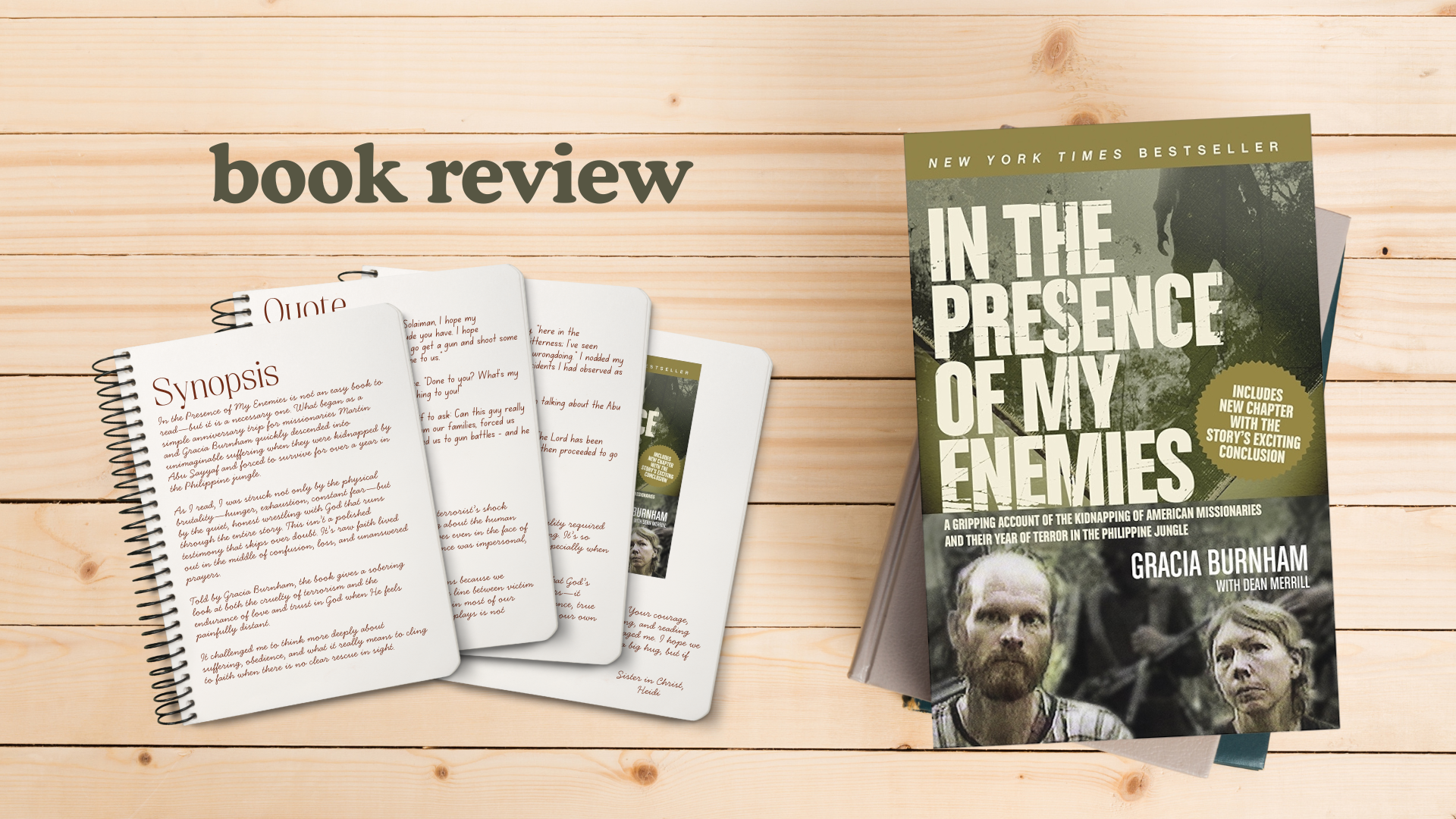
In the Presence of My Enemies is not an easy book to read—but it is a necessary one. What began as a simple anniversary trip for missionaries Martin and Gracia Burnham quickly descended into unimaginable suffering when they were kidnapped by Abu Sayyaf and forced to survive for over a year in the Philippine jungle.
As I read, I was struck not only by the physical brutality—hunger, exhaustion, constant fear—but by the quiet, honest wrestling with God that runs through the entire story. This isn’t a polished testimony that skips over doubt. It’s raw faith lived out in the middle of confusion, loss, and unanswered prayers.
Told by Gracia Burnham, the book gives a sobering look at both the cruelty of terrorism and the endurance of love and trust in God when He feels painfully distant.
It challenged me to think more deeply about suffering, obedience, and what it really means to cling to faith when there is no clear rescue in sight.
Quote:
Martin said at one point “You know, Solaiman, I hope my children don’t take up the same attitude you have. I hope my kids back in the States don’t ever go get a gun and shoot some Muslim because of what you have done to us.”
A look of shock crossed Solaiman’s face. “Done to you? What’s my sin against you? I’ve never done anything to you!”
Martin looked at me incredulously, as if to ask: Can this guy really not see? He’s taken us at gunpoint from our families, forced us through the jungle, starved us, subjected us to gun battles – and he thinks his record is clean?
Reflection:
This exchange between Martin Burnham and the terrorist stopped me cold. Solaiman’s shock reveals something deeply unsettling about the human heart: our ability to justify ourselves even in the face of obvious wrongdoing. To him, violence was impersonal, necessary, even righteous. Because he believed his cause was just, he could no longer see the people standing in front of him as victims. In that moment, we see not only cruelty, but a biblical truth: the human heart is capable of deep self-deception, especially when conscience is overridden by ideology.
What struck me most was Martin’s restraint. After everything that had been done to them, his concern was not revenge, but on preaching the gospel to the terrorist. He refused to let suffering harden his heart into hatred or reduce an entire people to the actions of one man. He modeled a distinctly Christian ethic—one that names evil clearly, yet refuses to answer it with the same spirit. This passage forces an uncomfortable question: how often do we, too, excuse our own sins because our intentions feel right? How often do we minimize the harm we cause because we don’t see ourselves as the villain? The line between victim and perpetrator may not be as clear in everyday life, but the blindness Solaiman displays is not foreign to any of us. Ultimately, this moment exposes both the depth of human self-deception and the quiet power of grace. Even in captivity, Martin’s words bear witness to a kingdom not built on retaliation, but on truth, responsibility, and a refusal to let evil have the final word.
What continues to challenge me is Martin’s restraint. He names wrong clearly, yet refuses to let suffering produce hatred. His concern is not revenge, but forgiveness and grace. That posture reflects a distinctly Christian response to evil: truth without denial, grace without blindness, and a refusal to let injustice define the future. The gospel gives us language for this tension. It teaches us to confess sin honestly, to acknowledge harm without minimizing it, and to entrust ultimate judgment to God. Healing begins not by pretending nothing happened, but by bringing what was hidden into the light—where fear loses its power and grace can finally do its work.
Quote:
“You know,” Martin said to me one day, “here in the mountains I’ve seen hatred; I’ve seen bitterness; I’ve seen greed; I’ve seen covetousness; I’ve seen wrongdoing.” I nodded my head vigorously, thinking back to the incidents I had observed as well.
But then he surprised me. He hadn’t been talking about the Abu Sayyaf as I had assumed.
“I’ve seen each of these things in myself. The Lord has been showing me how incredibly sinful I am.” He then proceeded to go back through the list.
Reflection:
What strikes me here is the depth of humility required to see our own sin in the midst of suffering. It’s so natural to focus on the faults of others, especially when they’ve hurt us deeply. And yet, Martin’s reflection reminds me that God’s conviction doesn’t start with pointing fingers—it starts with examining the heart. True repentance, true transformation, comes when we acknowledge our own brokenness first.
I had a similar season when I noticed anger and bitterness rising in me, I realized that God was using this stripping—this painful uncovering of my own heart—to reveal my true ugliness. And in a strange, painful way, that stripping felt bittersweet. It hurt to see the ugliness in my own heart, to confront the anger and resentment I had carried. And yet, in the middle of that discomfort, I felt God drawing me closer. It was a sweet sorrow—painful, humbling, but strangely freeing. Even in the struggle, I glimpsed the joy of His grace, and there was something comforting in knowing that He could meet me there, in all my brokenness.
The gospel reframes this reality. It doesn’t deny the hurt, the injustice, or the evil in the world, but it shows us a way to respond: with grace, with self-examination, and with the recognition that our hearts need the same mercy we long to see in others. Even in the darkest circumstances, God can reveal our own sin, call us to repentance, and fill us with the love and humility that only He can provide.
Quote:
Another thing that helped my mental outlook, if not my body, was remembering Scripture I had memorized long ago. I would have given anything to have had an actual Bible, of course. But that obviously was not going to happen.
One Sunday I found a piece of paper and began writing down all the promise of God that I could recall…What a comfort it was to review these eternal truths. In the face of the most dreadful circumstances, these were the words of the One I could depend on.
Reflection:
I think this points to a profound truth: the Word of God is not just information—it is life, hope, and strength when everything around us is falling apart. Memorizing and meditating on Scripture equips us to face trials with a source of comfort that cannot be taken away. Even in isolation, even in suffering, God’s truth remains.
I have personally experienced this. In my darkest hours, when all hope seemed lost, I would reach for the Bible and find solace in reciting God’s promises. That practice planted a deep passion in me—for studying Scripture, for memorizing verses, and even for learning hymns. When God strips everything else away, His Word remains.
This is also why a big part of my homeschooling focuses on memorizing Bible verses and hymns. Everything else can be taken from us, but God’s Word and His truth are eternal investments—more precious than gold. They cannot be stolen or destroyed, and they are what sustain us through the hardest moments, guiding us through the darkest times.
Quote:
Martin was in a reflective mood. He said, “I really don’t’ know why this has happened to us. I’ve been thinking a lot lately about Psalm 100 – what it says about serving the Lord with gladness. This may not seem much like serving the Lord, but that’s what we’re doing, you know? We may not leave this jungle alive, but we can leave this world serving the Lord ‘with gladness’; we can ‘come before his presence with singing’ [Psalm 100:2].”
Reflection:
Martin died shortly after saying this, yet even in fear, danger, and uncertainty, he chose to see their captivity as an opportunity to serve God. It reminded me of Job: why do bad things happen to good people? Job never got an answer—but he humbled himself and praised God anyway.
Like Job, the Burnhams chose worship in the midst of suffering. We can’t always control what happens to us, but we can control our response. We can choose to trust God. We can choose to worship Him. We can choose to serve the Lord with gladness, even when circumstances are painful.
Faith isn’t about understanding every trial—it’s about trusting the One who is good, worthy, and unchanging. Martin’s example reminds us that true worship is not borne from circumstances, but from a heart surrendered to God.
In Closing
I highly recommend this book. The Burnhams’ story is a powerful reminder that even in the darkest circumstances, God is present, faithful, and worthy of our trust. Their courage, resilience, and unwavering faith inspire us to hold fast to God’s promises, choose worship over despair, and let His truth guide us through every storm. It’s a book that challenges the heart, strengthens faith, and points us to the hope that never fails.