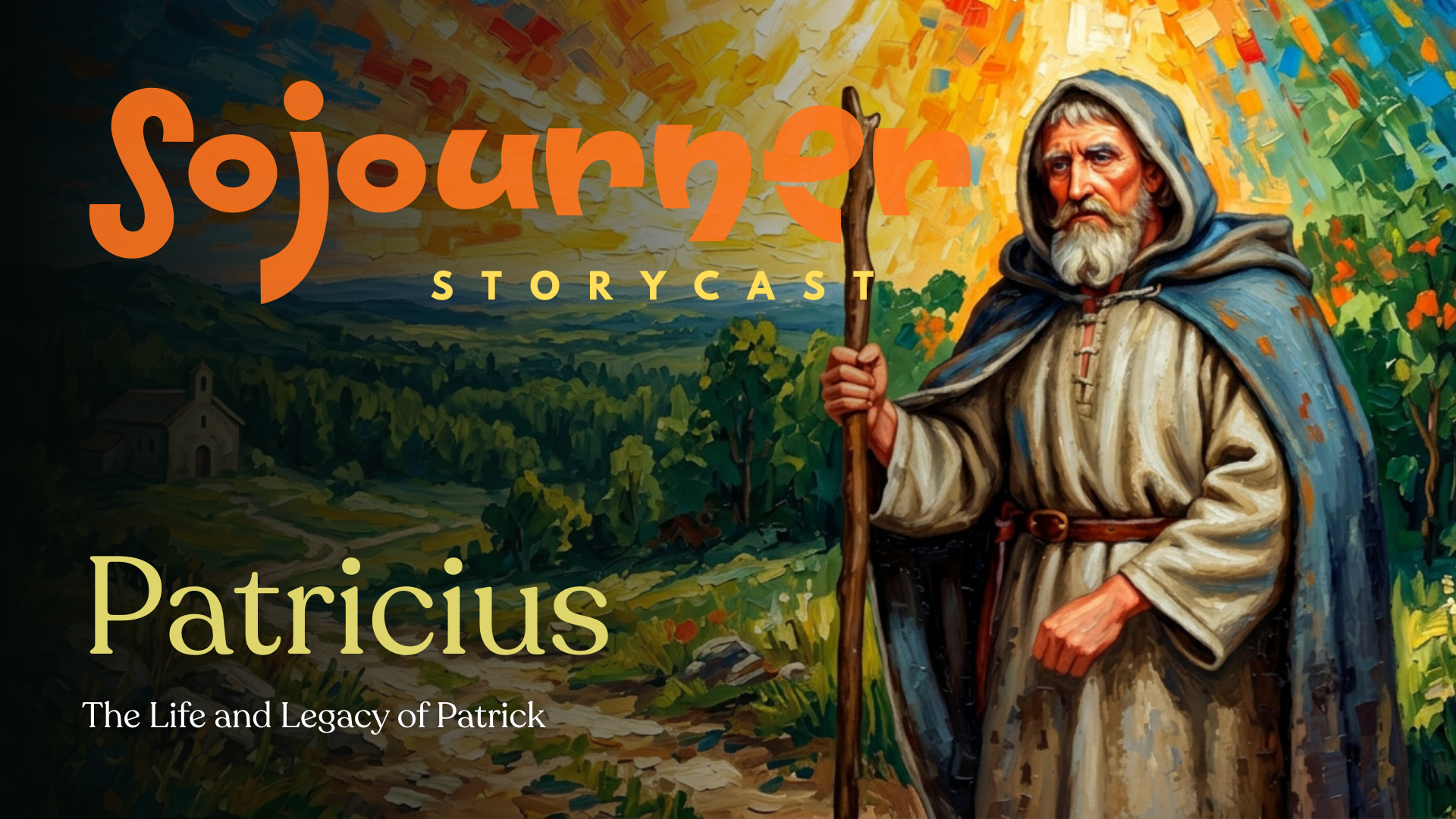
Hi Sojourners, and welcome to our St. Patrick’s Day special! While many celebrate St. Patrick’s Day with shamrocks, parades, and stories of leprechauns, we’re going to travel back nearly sixteen hundred years to discover the true story behind the real Patrick—a man whose faith, courage, and love for God changed the course of a nation.
An Idyllic Childhood in Roman Britain
On a quiet evening along the coast of Britain, at the far western edge of the Roman Empire around 401 AD, a boy named Patricius slept peacefully in his family’s country home. His name meant “noble,” and in the English we speak today, he is known as Patrick.
Patrick’s life had been comfortable. His father, Calpurnius, was an officer in the local Roman government and also served in the church. Patrick had grown up in a home where Scripture was read and prayers were said. His grandfather had been a church leader before his father.
Yet Patrick himself paid little attention to such things. Later in life he would admit quite honestly, “I did not know the true God.” Like many boys, Patrick preferred the freedom of running through the fields with friends to listening to sermons or studying the Scriptures.
But God sometimes begins His greatest work in a life through events we would never choose.
Kidnapped
That night, while the household slept, shadows moved silently along the shoreline.
Boats had crossed the dark waters of the Irish Sea. Raiders from Ireland had come quietly ashore. In those days such attacks were not uncommon. The raiders sought slaves—young men and women they could capture and sell across the sea.
Before long the silence shattered.
Doors were broken open. Shouts echoed through the house. Patrick was dragged from his home along with several others and forced onto a waiting ship.
He was sixteen years old.
The vessel pushed away from the shore, carrying him farther and farther from everything he had known—his home, his parents, his country. Patrick had been kidnapped!
A Slave in a Strange Land
When the ship finally landed, Patrick found himself in Ireland, a place very different from Roman Britain. Nicknamed the Emerald Island for its lush green hills, the Romans had never ruled there. Ireland was very different from the Roman world Patrick had grown up in. There were no busy cities or carefully built Roman roads. Instead, tribes were scattered across the green countryside, each ruled by its own chief. The people looked to the Druids—religious leaders who practiced ancient rituals including human sacrifice and worshiped many gods. To someone who was used to living the Roman way of life, the Irish seemed uncivilized and barbaric.
Soon after arriving, Patrick was sold to a tribal leader who owned large flocks of sheep. His new master sent him into the hills each day to care for them. For a boy who had once lived comfortably, the change was shocking.
The days were long and lonely. Patrick rose early each morning to lead the sheep into the pastures. He watched them carefully throughout the day, guarding them from danger and making sure none wandered away. A slave who lost a sheep could be punished severely.
Faith Born on the Hillsides
As a boy, Patrick had often ignored his father’s readings from Scripture and the stories of Jesus. But now, alone on the hillsides of a strange land, tending sheep day after day, he had no one but God. The ache of missing his family pressed heavily on his heart.
One evening, overwhelmed by loneliness, Patrick knelt in the grass and prayed from the depths of his soul: “Dear God, I am without my family. My father is gone from me. Be my Father now, as I serve here in this strange land.”
The moment he spoke those words, a peace unlike anything he had known before settled over him. From that day on, Patrick never forgot that prayer. In the quiet hours among the sheep, he continued to pour out his heart to God, and with each prayer his faith grew. He began to understand that he had never truly been alone. God had been watching over him all along. And it was the Spirit of God who had stirred this new found faith and love in his heart.
Patrick’s heart filled with wonder and gratitude toward the God he had once ignored. Looking back on those years, he later wrote, “He protected me and comforted me, as a father cares for his son.”
Patrick prayed—often and earnestly. Sometimes he prayed as many as a hundred times in a single day. Before the first light of dawn touched the hills, he would rise to pray, even in the bitter cold, the rain, and the darkness of early morning.
So full of hope and joy, Patrick shared what he had learned with the other slaves. They laughed and mocked him, calling him names like “holy boy,” but nothing could shake his newfound trust in the God who had become his Father.
The work of caring for sheep and living among the other slaves also changed him. Patrick learned the language of the Irish people and became familiar with their way of life. But perhaps even more importantly, he began to think about others instead of only himself.
Looking back, Patrick admitted something surprising: before he was taken captive, he didn’t even know how to take care of himself. Those difficult years taught him lessons he could not have learned in the comfort of his childhood home.
For six years he lived this way—working, praying, and learning to trust God.
A Dream and a Daring Escape
Then one night something extraordinary happened. Patrick had a dream.
In the dream a voice spoke to him: “Your ship is ready.” He believed God was telling him it was time to escape.
At the age of twenty-two, Patrick finally escaped. He later wrote, “I turned on my heel and ran away, leaving behind the man to whom I had been bound for six years. Yet I came away in the power of God, for it was He who guided my every step for good, and so I felt no fear.”
For many days he escaped on foot—over rugged hills, through thick forests, and across unfamiliar countryside. At night he slept under the open sky, and along the way he faced hunger, exhaustion, and the threat of wild animals that roamed the wilderness.
Yet Patrick pressed on, determined to reach the sea. After nearly two hundred miles, he arrived at the coast where he found a ship preparing to sail.
At first the sailors refused to take him. Patrick was a runaway slave with nothing to offer. But just as he turned away to pray for guidance, they suddenly called him back and allowed him aboard.
Patrick and the crew traveled for many days, stopping once for nearly a month on unfamiliar land. Soon a new challenge arose: the ship ran low on food. Hunger gnawed at the sailors.
Frustrated, the captain turned to Patrick and scoffed, “If your God is truly powerful, then why don’t you ask Him to provide us something to eat?”
Patrick spoke confidently: “Turn to the Lord with all your heart and put your faith in Him, for nothing is impossible for Him.”
Then the impossible happened. A herd of pigs appeared nearby, an answer to Patrick’s prayer. The sailors rejoiced, their fear and hunger giving way to laughter and relief. They feasted for days, giving thanks to God for the unexpected provision.
Even in the midst of this small miracle, Patrick’s heart was filled with something more than relief. He prayed that the men witnessing God’s power might come to believe in Jesus Christ, just as he had learned to trust Him.
It took two years before Patrick finally made it home to Britain and reunited with his family. For a time, Patrick settled back into ordinary life.
But his story was not finished.
A Mission to the Irish People
One night many years later, Patrick had another dream.
This time he saw a man from Ireland carrying many letters in his arms. The man handed one of the letters to Patrick, he opened it and read the title: Voice of the Irish. He seemed to hear the voices of his friends in Ireland calling out together: “Holy boy, we beg you—come and walk among us again.”
Patrick awoke with a deep sense that God was calling him back to Ireland. Not as a slave this time—but as a messenger of the gospel.
But Patrick’s family and the church leaders opposed the idea of him returning. “Do you know what they do to runaway slaves?” they warned. “Ireland is dangerous,” they said. “The people there are barbaric and violent and don’t care about God.” Still Patrick would not be dissuaded, he deeply believed God had called him to preach to the Irish.
And so, after years of preparation, he returned to the island where he had once been enslaved.
The Gospel Spreads Across Ireland
Patrick traveled across Ireland preaching from tribe to tribe, speaking with chiefs and asking permission to share his message. Sometimes he was welcomed. Other times he faced hostility, threats, and even enslavement. Patrick later wrote, “They very much wanted to kill me, but my time had not yet come.” And each time Patrick was delivered from danger or death he knew it was the Lord who set him free.
He told the people about Jesus Christ, the true light who came to save sinners. He explained that the sun they worshiped would one day fade, but Christ was the true Sun who would shine and reign forever. Many listened. Slowly, villages and tribes across Ireland began to turn away from idols and follow Christ.
Patrick also helped teach people how to read and write, so they could study the Scriptures. Christian communities began to grow across the island, and these communities would later become centers of learning that helped preserve books and spread the gospel throughout Europe.
For Patrick, there was no other work worth doing—this mission of spreading God’s Word would be his life until the very end.
Why Patrick’s Story Still Matters Today
Why Patrick’s Story Still Matters Today
1. God Often Prepares Us Through Hardship:
Patrick’s story reminds us that loneliness, struggle, and suffering are not wasted. It was in the quiet hills of Ireland, tending sheep as a young slave, that Patrick drew closest to God. These difficult seasons shaped his faith, teaching him to trust God even when life seemed frightening or uncertain. Hardship can be a classroom where God trains us for His greater plan.
2. Compassion Flows from Humility and Awareness of Sin:
Patrick wrote, “I am Patrick – a sinner, a very simple man, the least of all believers, and despised by many… It was there that the Lord opened my unbelieving heart…He looked down on my low condition and had compassion on me, young and foolish as I was. He kept me before I knew Him and before I could tell the difference between good and evil…I was like a stone stuck into deep mud, but He who is powerful came and, in His mercy, reached down, pulled me out, and placed me on top of a wall.” Patrick knew he was a sinner who had once ignored God’s blessings, and that awareness made him tender-hearted toward others. He cared for people whom others looked down on and called barbaric. Though he was born with status, he never considered himself better than others because he knew he was a sinner saved only by God’s grace. Because he understood grace, he could share the love of Christ without pride, hoping that all would know the Savior who had rescued him.
3. His Life Continues to Inspire Generations:
“That is why I cannot be silent, as I should not be, about the great benefits and grace the Lord so kindly granted to me in the land of my captivity. This is how we can respond to such blessings: after we are corrected and learn to know Him, we praise Him and proclaim His great wonders to every nation under heaven,” Patrick wrote.
Patrick’s work was bigger than himself or his time. The churches he founded and the leaders he trained became a springboard for more missionaries, spreading the gospel far beyond Ireland. Even generations later, his example of faith, courage, and sacrificial love inspired others to take the message of Christ to places where it had been forgotten. Historians note that after his death, violence and the slave trade in Ireland declined.
Key Scripture
Key Scripture
1 Timothy 1:15 says:
“Here is a trustworthy saying that deserves full acceptance: Christ Jesus came into the world to save sinners—of whom I am the worst.
Just as Paul humbly called himself the worst of sinners, Patrick recognized his own failings—how he had once ignored God’s Word and wasted the blessings of his youth. Yet, like Paul, he experienced Christ’s mercy and grace in a profound way. His heart didn’t hold anger toward those who had captured him; instead, it overflowed with love, so much so that he longed to return to Ireland to share the gospel even with his former captors. Patrick’s life shows how God’s grace can transform us, turning mercy received into love freely given.
The True Legacy of Patrick
Patrick died on March 17 in around 493 AD, near the end of the fifth century. Today that date is remembered as St. Patrick’s Day. And it is noted that in less than sixty years after Patrick’s mission began, the good news of Christ had reached nearly all of Ireland, and countless people had come to faith.
Over the centuries many legends grew around his life— One of the most famous legends about Patrick is that he drove all the snakes out of Ireland. However, snakes didn’t exist in Ireland, so many believe the story is symbolic—representing Patrick’s fight against evil and the idol-worshipping Druids.
Another popular legend is that Patrick used a three-leafed shamrock to explain the Trinity—how God is one God in three persons: Father, Son, and Holy Spirit. But the truth is, no object in nature can fully explain God’s mystery. The shamrock can be a helpful picture, but it can’t capture the reality of the Trinity. Patrick himself understood this; he taught the Trinity through God’s Word, showing that some truths about God are bigger than anything we can see or hold in our hands.
Yet the true story of Patrick is far more powerful than any legend. So when St. Patrick’s Day comes around this year, we can remember that long ago there lived a man who knew suffering, yet trusted God. A man who forgave those who had once enslaved him. And a man who returned willingly to a land of danger so that others might hear about Christ.
If Patrick’s story touched your heart, share this episode with a friend, so they too can see what it means to be a true sojourner—one who journeys into unknown lands with courage, faith, and a message of hope.
And remember, God can use our loneliest moments to draw us closer to Him. He can transform hardship into courage, loneliness into devotion, and even our smallest acts of faith into a life that overflows with love for others. Like Patrick, we can trust that God is shaping us through every trial, preparing us to share His grace in ways we never imagined.
Links to podcast: