
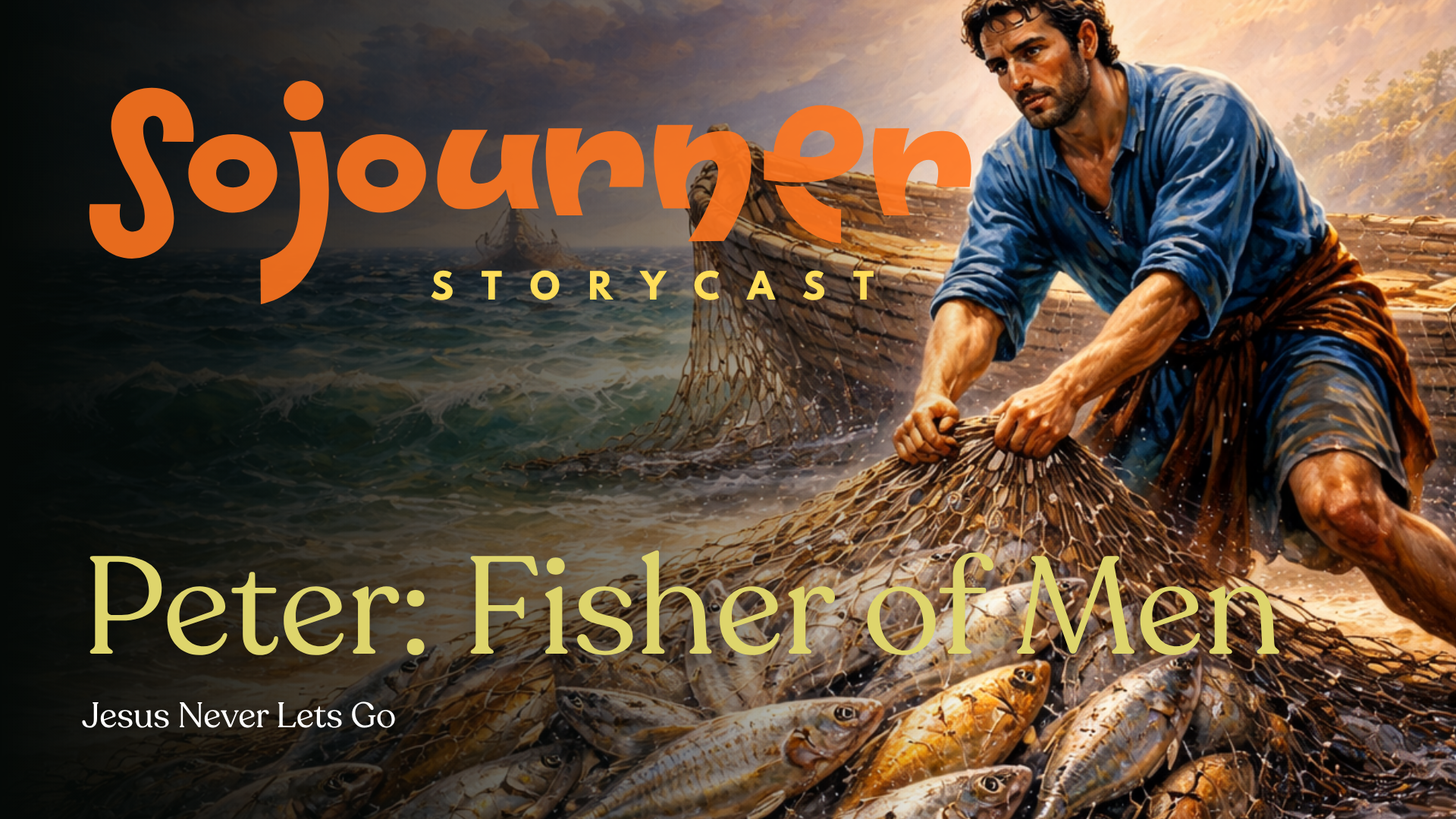
A Miraculous Catch
The sparkling waters of the Sea of Galilee shimmered as the sun peeked over the hills. The morning air felt crisp and cool as Peter and his friends made their way back to shore after a long night of fishing. They had caught nothing. Exhausted and weary, they parked their boats along the shore and turned their attention to a rabbi teaching nearby.
The crowd pushed and shoved. They strained to hear what Jesus was saying. Jesus noticed two boats pulled up and resting by the water’s edge. He stepped into Peter’s boat and began to teach the crowd from there.
When the lesson was done, Jesus turned to Peter. “Put out into deeper water and let down your nets for a catch.”
Peter rubbed his hands together, thinking of the long night. “Master, we’ve worked hard all night and haven’t caught anything. But because you say so, I will let down the nets.”
He lowered the nets again, more from obedience than hope—and then something unexpected happened. Fish, more than he had ever seen in one place, poured into the nets, so many that the ropes began to strain and tear. Peter waved frantically to the other boat to come help, and soon both boats were so full they were nearly sinking!
Peter’s knees bent beneath him as he fell before Jesus. “Go away from me, Lord! I am a sinful man!” he cried, overwhelmed. Everyone with him stared, mouths open at the miraculous catch. Even James and John, sons of Zebedee, who had been working alongside, were astonished.
Jesus responded, “Don’t be afraid. From now on, you will be a fisher of men.”
With that, the boats were pulled to the shore. Peter left the nets, the fish, the familiar life he had known. He followed Jesus—and in that moment, a simple fisherman began a journey that would change the world.
Meet Peter, the Bold Disciple
Hi Sojourners!
Welcome back to the Sojourner Storycast! This is part two of Peter’s story. If you haven’t listened to part one yet, be sure to go back to episode 15 to hear how his journey began.
Before we jump back into the story, let me share a few things about Peter. Peter was one of Jesus’ twelve disciples, and out of all of them, he’s the one we learn the most about in the Bible. He was often the spokesman for the group—the one who would step forward, ask the questions, and say what everyone else might have been thinking.
Peter had a brother named Andrew—who was also one of the twelve disciples. And something many people don’t realize is that Peter was married.
Now, let’s step back into Peter’s story…
The Weight of Awe
The Weight of Awe
This was one of Peter’s first encounters with Jesus. Can you imagine Peter’s mind spinning as all of this happened? He was a skilled fisherman and had spent the entire night fishing—and caught nothing. Not a single fish. Then Jesus, who was not an experienced fisherman, told him to let down the nets again in the same spot. From Peter’s perspective, it probably didn’t make any sense. He had been there all night and knew the waters were empty. Yet he chose to trust someone who probably never fished a day in his life. When Peter set aside his own experience and expertise to simply obey Jesus, miracles happened—the nets overflowed, and God’s power was revealed in a way far beyond anything Peter could have done on his own.
When Peter saw all the fish in his nets, he grasped the full magnitude of what had just happened. This was no coincidence. This was no lucky catch. It was a deliberate miracle that revealed Jesus’ authority over creation itself. Suddenly, Peter felt small and uncomfortable next to Jesus, and was acutely aware of all his flaws. That’s why he fell to his knees and said, “Go away from me, Lord! I am a sinful man!”
Have you ever had someone tell you that you had food on your face or something stuck in your teeth? What was your first reaction? “Stop staring at me! Let me get cleaned up!” Did you feel embarrassed, out of place, and painfully aware of yourself. That’s a little like Peter’s experience. In the middle of his ordinary, messy life, he came face to face with God’s holiness and realized just how different and perfect Jesus was compared to him. That moment of awe and humility was the beginning of Peter’s incredible journey with Jesus, powered not by his own strength, but by God’s.
From that moment on, Peter’s life was never the same. He followed Jesus everywhere—across dusty roads, through crowded villages, and onto quiet hillsides where Jesus taught the crowds. Peter watched Jesus heal the sick, starting with his own mother-in-law, calm storms, feed thousands, and forgive sinners. But following Jesus wasn’t always easy. Some people were amazed by Him, while others grew confused or even offended by His teaching. In fact, there came a time when many of those who had been following Jesus decided His words were too hard and turned away. Jesus looked at the twelve disciples and asked, “Do you want to leave too?”
Peter spoke up with courage and conviction: “Lord, to whom shall we go? You have the words of eternal life.”
Peter may not have understood everything yet, but he knew one thing for certain—Jesus would lead them to eternal life, and there was no one else he would rather follow.
But knowing the truth and living it out are not the same thing. Peter’s faith—and his loyalty—was about to be tested in ways he never could have imagined…
A Humble Servant
A Humble Servant
On their last evening together, Jesus gathered His disciples for the Passover meal—which we sometimes call the Last Supper. They sat together at the table, sharing bread and talking quietly when Jesus did something unexpected.
He rose from the table, wrapped a towel around His waist, and began to wash the disciples’ feet. One by one, Jesus knelt and washed their feet. Then He came to Peter.
Peter looked down at Him in shock. “Lord, are You going to wash my feet?”
Jesus answered, “You do not realize now what I am doing, but later you will understand.”
Peter refuses. “No,” he said. “You shall never wash my feet!”
Peter was shocked. In that culture, foot washing was the work of the lowest servant, not a teacher, and certainly not the Messiah. Peter likely felt two things at once: Reverence for Jesus– He believed Jesus was far greater than himself. And discomfort with humility – The idea of Jesus serving him felt wrong. Peter thought he was honoring Jesus by rejecting the foot washing, but he was actually resisting what Jesus was doing. This is a pattern we see in Peter throughout the Gospels: he loves Jesus deeply but sometimes tries to correct or redirect God Himself. Peter’s personality is on full display—impulsive, sincere, devoted, but often misunderstanding what Jesus is teaching.
But Jesus just replied, “Unless I wash you, you have no part with Me.”
Jesus was explaining that this foot washing had a spiritual meaning. Jesus came to serve us and cleanse us from sin and that kind of spiritual cleansing can only come through Him. Peter cannot remain in relationship with Jesus unless he allows Jesus to serve him in this saving way. Peter never wanted to be separated from Jesus. Once Peter realized that the foot washing was connected to belonging to Jesus, he swung to the opposite extreme.
“Then, Lord,” he said quickly, “not just my feet—but my hands and my head as well!”
This is classic Peter—all or nothing.
If washing meant being connected to Jesus, Peter wanted as much washing as possible.
His heart was sincere. He didn’t want to be separated from Jesus in any way. But again, he misunderstood what Jesus was doing.
Jesus replied. “Those who have had a bath need only to wash their feet; their whole body is clean.”
Jesus wanted to teach His followers an important spiritual truth. Back in Bible times, people would wash their whole body at home, but when they went out and walked along dusty roads, their feet would get dirty. So when they arrived at a house, only their feet needed washing.
Jesus used this everyday idea to explain something very important about following Him. He showed that when someone belongs to Jesus, their sins are fully washed away, like taking a full bath. This happens once, when we trust Him, and it’s called salvation.
But even after we belong to Jesus, we still make mistakes and sometimes do things we shouldn’t. That’s why we need His forgiveness every day. It’s like washing our dusty feet, keeping us clean as we walk with Him.
It was as if Jesus was telling Peter: “You belong to Me, and your sins are fully washed away. But as you go through life, you’ll still need My help every day to stay clean and follow Me.”
After Jesus finished washing their feet, He turned to the disciples and asked, “Do you understand what I have done for you?” He reminded them that they rightly called Him “Teacher” and “Lord,” because that is exactly who He is. Then He explained something important: even though He was their Lord and Teacher, He had humbled Himself to wash their feet. The King of the universe took the lowest servant’s role.
He said this was an example for them to follow—that just as He had served them, they should serve one another. Jesus made it clear that a servant is not greater than the one who sends him, and a messenger is not greater than the one who sends them. He wanted them to understand that true greatness comes from serving others, not from being served. And He promised that when they put this into practice, they would be blessed.
Faith Tested Like Wheat
Faith Tested Like Wheat
Then Jesus’ face grew serious, and He turned His eyes toward Peter. “Simon, Simon,” He said, “Satan has asked to sift all of you like wheat. But I have prayed for you, Simon, that your faith will not fail. And when you have turned back, you must strengthen your brothers.”
Peter’s chest swelled with boldness. “Lord,” he said, “I am ready to go with you to prison and even to death!”
Jesus shook His head gently. “Peter, before the rooster crows today, you will say three times that you don’t know me.”
Sojourners, have you ever heard the term sift like wheat? After farmers harvested wheat, they would thresh it or separate the grain from the husks. Then they would toss it into the air so the wind could blow away the husks and the dirt. What was left was the clean, strong grain that could be used to plant more or feed others. Jesus was telling Peter that his faith would be tested in a similar way—he would face fear, danger, and even failure—but God could use those trials to purify him, strengthen him, and prepare him to help others grow in faith too.
The Three Denials
The Three Denials
Later that night, Peter found himself alone. He could hear his own heart pounding. He followed Jesus as quietly as he could, trying not to be seen. When the soldiers came to arrest Jesus, Peter’s courage flared. On impulse, he drew his sword and swung it at the nearest man. There was a sharp cry, and Peter realized he had cut off the ear of Malchus, the high priest’s servant.
Jesus touched the man’s ear, and Peter could hardly believe his eyes. The wound disappeared as if it had never been there. “Enough,” Jesus said, “My Father’s work must continue.”
And then, without resistance, Jesus allowed Himself to be taken. He did not fight or struggle; He simply stepped forward, letting the mob lead Him away. The crowd of soldiers and temple guards pressed closer, shouting orders and brandishing torches. In the sudden panic, the disciples scattered like leaves in the wind.
Everyone was running away. Peter’s courage from just moments ago seemed to vanish, and fear tightened around his chest. He ran until he reached the gates of the high priest’s courtyard, but there were guards and strangers everywhere. Just when he thought he might be turned away, another disciple who had also been following Jesus saw him and asked the servant girl at the door to let him in.
Peter hurried inside and made his way to the charcoal fire the officers had lit to keep themselves warm from the cold night air. He crouched near the glow, trying to blend in, but he was trembling. The servant girl at the door looked closely at him and said, “You also are not one of this man’s disciples, are you?”
Peter’s throat tightened. He tried to sound confident. “I am not,” he replied.
He moved a little closer to the shadows, but another person noticed him. “Surely you were with Him! You are one of His followers,” the man said. Peter’s knees wobbled.
“No, I am not,” he said, louder this time, trying to sound certain.
Then a relative of the man whose ear Peter had cut off stepped forward. “Did I not see you in the garden with him?” he asked, his voice sharp and accusing. People nearby began to join in. “Surely you are one of them! Your accent shows it—you’re a Galilean!” they said.
Peter’s chest tightened, fear and desperation rising all at once. He shook his head and cried out, calling down curses on himself. “I do not know this man you are talking about!” he shouted, his voice echoing across the courtyard.
Suddenly, a rooster crowed. Across the courtyard, as Jesus was being led by the soldiers, Jesus turned and met Peter’s gaze and in that single, piercing look, he remembered the words Jesus had spoken: Before the rooster crows today, you will say three times that you don’t know me.
Peter could not bear it. He ran outside, burying his face in his hands, and wept bitterly, knowing he had denied the One he loved.
But even in that moment of shame, hope was not lost. Jesus had already prayed for Peter, and He promised that after Peter turned back, he would help strengthen his brothers in faith. Though Peter had stumbled, God’s story was still unfolding as even this was part of God’s greater plan.
Breakfast by the Sea
Breakfast by the Sea
A few days later on Sunday morning, several women came bursting into the room with such excitement it was hard out what they were saying. “Jesus is gone!” one exclaimed. Another added, “The angel said he has risen! He wanted us to tell you all and Peter that Jesus has gone to Galilee to meet you all!”
But the disciples did not believe the women because their words didn’t make any sense to them. But Peter got up and ran to the tomb. He bent over and saw the strips of linen lying by themselves. Then he went away, wondering what had happened.
Not long after that, early one morning at the Sea of Galilee also known as the Sea of Tiberius, Peter and some other disciples were on a boat. They had been fishing the whole night, but had caught nothing. A man on the shore called out to them and asked, “Friends, don’t you have any fish?”
No,” they answered.
Then the man said, “Throw your net on the right side of the boat. There you will find some fish.” When they did, they could not pull the net into the boat. There were too many fish in it.
Scenes of a similar catch flashed through Peter’s mind. It was déjà vu! This man could only be… “It is the Lord!” exclaimed one of the disciples. As soon as Peter heard that, he put his coat on and jumped into the water and swam to shore.
When he got to shore, Jesus said, “Bring some of the fish you have just caught.”
So Peter climbed back into the boat and dragged the net to shore. It had 153 large fish inside and yet the net was not torn.
“Come and have breakfast,” Jesus had prepared a fire, much like the charcoal fire where Peter had denied Jesus three times. As the disciples gathered, Jesus took some bread and fish and fed them.
When Jesus and the disciples had finished eating, Jesus asked Peter, Simon, son of John, do you love me more than these?
“Yes, Lord,” he answered. “You know that I love you.”
Jesus said, “Feed my lambs.”
Again Jesus asked, “Simon, son of John, do you love me?”
He answered, “Yes, Lord. You know that I love you.”
Jesus said, “Take care of my sheep.”
Jesus spoke to him a third time. He asked, “Simon, son of John, do you love me?”
Peter felt bad because Jesus asked him the third time, “Do you love me?” He answered, “Lord, you know all things. You know that I love you.”
Jesus said, “Feed my sheep.
And just like that, Jesus restored Peter. Three times Peter had denied the One he loved, yet Jesus had never let him go. Now, by another fire, three times Peter declared his love.
Key Scripture
Key Scripture
Psalm 23:1–3
The Lord is my shepherd; I shall not want. He makes me lie down in green pastures. He leads me beside still waters. He restores my soul. He leads me in paths of righteousness for his name’s sake.
Just like the Lord restores our souls in Psalm 23, He restored Peter after his failures. Peter had denied the One he loved, yet Jesus met him again—patient, gentle, and full of grace—guiding him back to the path of purpose. On the shore, Jesus prepared a fire and cooked breakfast for Peter and the disciples, caring for them tenderly like a good shepherd. He healed Peter’s heart, gave him a mission, and showed that following Him wasn’t about perfection, but about trusting the Shepherd who leads, restores, and directs our steps.
Jesus had called Peter to be a fisher of men, but we see Jesus as the true fisher of men. Many have speculated the significance of the number of 153 from the miraculous catch. It is most popularly associated with the completeness of the church reaching all peoples, cultures and nations since it is believed that at that time there were only 153 known species of fish. Jesus the true fisher of men casts His net for all nations, tongues, and tribes, and the Bible reminds us that the net was not torn.
Peter’s story reminds us that no matter how far we stumble, Jesus never loses anyone. God’s love for those who belong to Him is steadfast, like that strong, unbreakable net. He restores us, nourishes us, and calls us to walk in paths of righteousness, inviting us to care for others with the same tender love and faithfulness that He pours into our lives.
If Peter’s story encouraged you, share it with a friend so they too can see that God’s love is never dependent on what we do. He didn’t give Peter what he deserved (punishment) —he gave him what he didn’t deserve (love). And the same God who restored Peter is the same God who calls each of us today, meeting us with grace, forgiveness, and a purpose. Don’t forget to tune in next week for part 3 of Peter’s story.
And remember… no matter how far you stumble, God’s love for those who belong to Him is like that strong, unbreakable net—it never fails, never tears, never gives up.
Links to podcast: