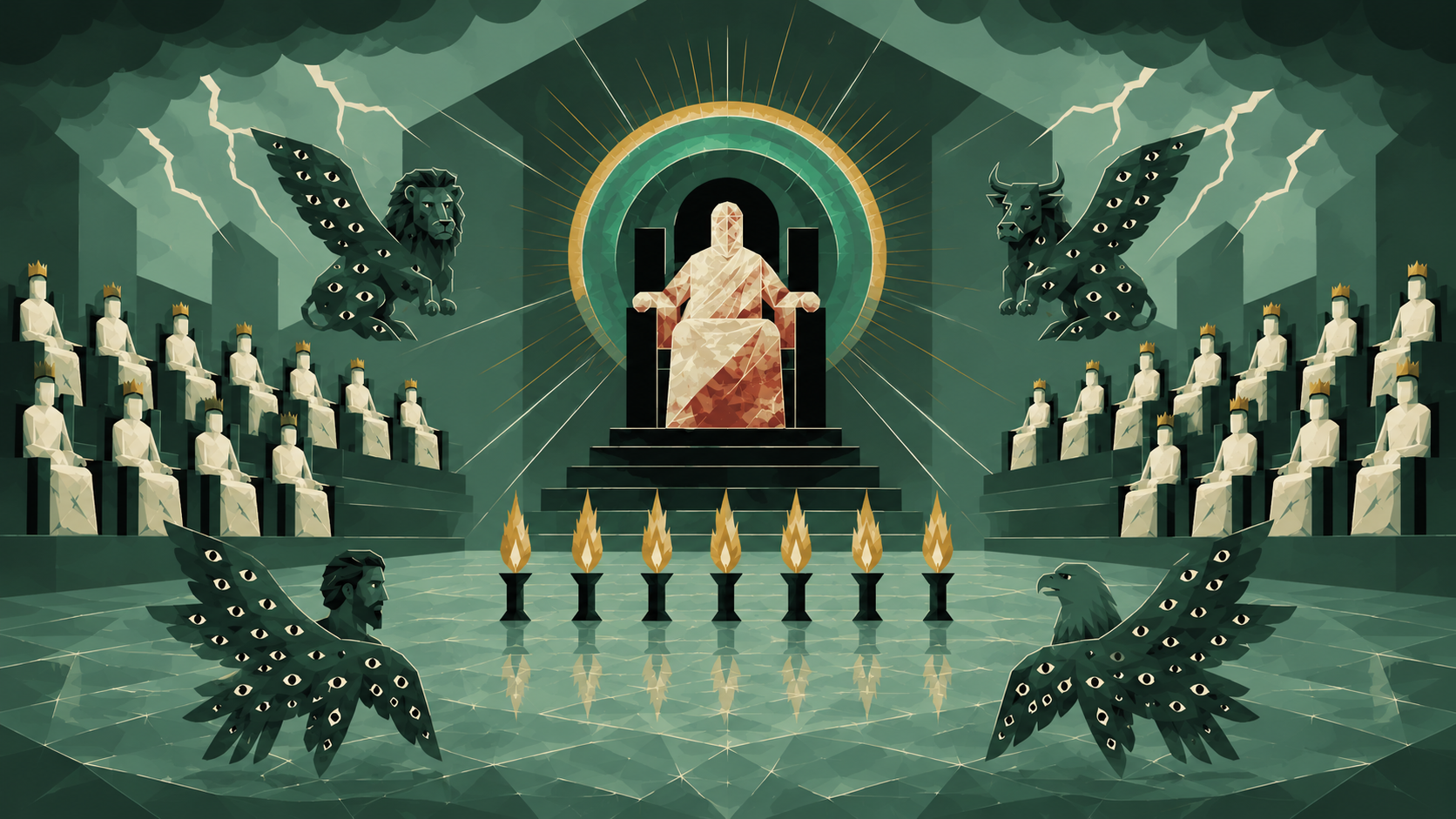
This week is all about the throne room and we are loaded with imagery!
Chapter 4
After this I looked, and there in heaven was an open door. The first voice that I had heard speaking to me like a trumpet said, “Come up here, and I will show you what must take place after this. – Revelation 4:1
The open door shows that John is being invited into the throne room of God Himself. Under the Old Covenant, access to God’s presence was limited and guarded. But through Christ, heaven is opened. Jesus Himself said: “I am the door.” — John 10:9. So the open door reflects the reality that through Jesus, believers have access to the Father.
The door also represents revelation — God unveiling heavenly truth that humans could not discover on their own. Revelation is not merely information; it is God allowing someone to see reality from heaven’s perspective. And this fits right in with the purpose of the Book of Revelation which is to unveil who Jesus Christ is.
Last week, we left off with the letters to the seven churches. We got a glimpse the struggle, compromise, persecution, and spiritual warfare on earth. Then suddenly the scene shifts from troubled churches on earth to God’s throne in heaven. The earth may look chaotic, but heaven is still ruled by God and the throne is occupied.
And John’s invitation to the throne room before Revelation reveals judgments and future events is no coincidence. This order is intentional because before understanding the future, John must first see who rules the future.
Chapter 4 is deliberately built like a heavenly “Most Holy Place” vision, and almost every detail echoes the Tabernacle/Temple system in the Old Testament. John is not just describing heaven—he’s showing that the earthly Tabernacle was a copy and shadow of a greater heavenly reality (Hebrews 8–9).
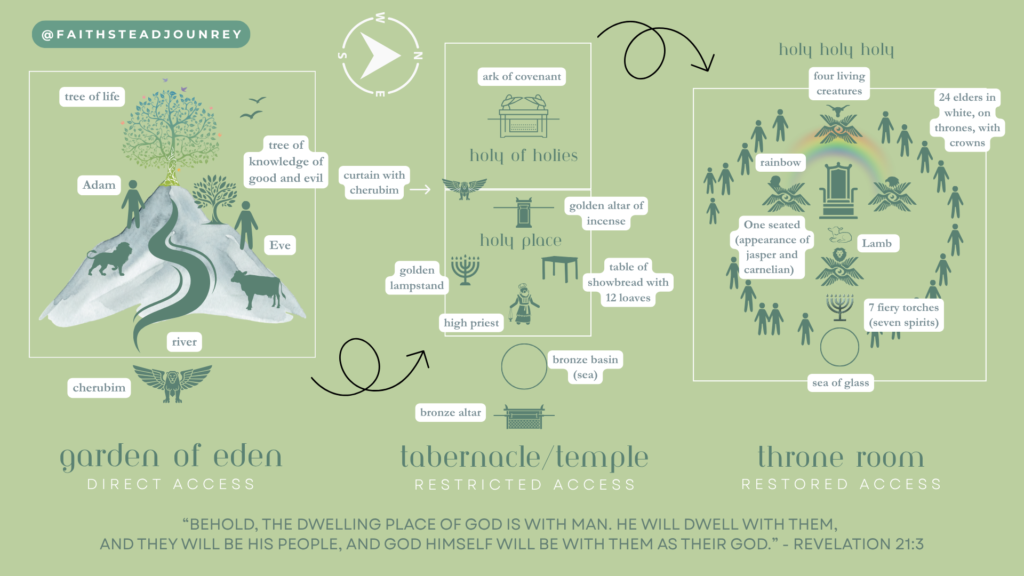
Here’s how the throne room and tabernacle connect.
I. Throne
This is the central reality: God’s kingship and presence.
- In the Tabernacle, the closest earthly symbol is the Ark of the Covenant, where God is said to “sit enthroned between the cherubim.”
- The Holy of Holies represented God’s throne room on earth.
II. The One seated had the appearance of jasper and carnelian (ruby)
These stones represent glory, holiness, and covenant representation.
- Jasper often symbolizes purity, brilliance, and divine radiance.
- Carnelian (red) evokes blood, judgment, and sacrifice.
- In the High Priest’s garments, precious stones represented Israel before God (Exodus 28).
- Carnelian is the first stone on the ephod and jasper is the last. This is the picture of the Alpha and Omega and a representation of the people of God in the image of the One seated on the throne.
III. Rainbow like emerald around the throne
This recalls God’s covenant mercy.
- The rainbow first appears in Genesis 9 (Noahic covenant) as a sign of restraint in judgment.
- In the Tabernacle context, the veil and curtains often used blue/green/purple imagery of heaven and life.
- Emerald green emphasizes life, restoration, and mercy surrounding judgment.
- God’s presence is not only terrifyingly holy—it is covenantally merciful.
IV. Twenty-four thrones and elders in white with crowns
This reflects representative priestly kingship.
- 24 = likely 12 tribes (Old Testament Israel) + 12 apostles (New Covenant people) → the full people of God.
- White garments = priestly purity (like the priests in the Tabernacle).
- Crowns = kingly reward and authority under God.
V. Lighting, thunder, and voices from the throne
This is classic Sinai + Tabernacle imagery.
- At Mount Sinai (Exodus 19), God’s presence came with thunder, lightning, and trumpet blasts.
- The Tabernacle carried that same “Sinai presence” into Israel’s camp in a contained form.
- God’s throne is the ultimate “Sinai”— holiness that both reveals and warns.
VI. Seven fiery torches (seven spirits)
This connects directly to the lampstand (Menorah).
- The Menorah had seven lamps burning continually in the Holy Place.
- It symbolized God’s perfect light and Spirit among His people.
VII. Sea of glass like crystal
This parallels the bronze basin (Sea) in the Tabernacle/Temple.
- In the Tabernacle, the bronze “sea” was for washing/cleansing of priests.
- Here it becomes a crystal sea—no longer for washing, but already perfectly purified.
- No waves = no chaos, no uncleanness, no barrier.
- Access to God is now complete purity and peace before His presence.
VIII. Four living creatures full of eyes (lion, ox, man, eagle)
These are throne guardians and worship beings, echoing cherubim.
- Cherubim were placed:
- On the Ark of the Covenant
- Woven into the veil and curtains
- The number four = completeness as it relates to the created world (four corners of the earth, four compass directions, four winds) Four living creatures = all creation
- Four living creatures echo the promises God made to Noah and all living creatures after the flood. “Understand that I am establishing my covenant with you and your descendants after you, and with every living creature that is with you—birds, livestock, and all wildlife of the earth that are with you—all the animals of the earth that came out of the ark. I establish my covenant with you that never again will every creature be wiped out by floodwaters; there will never again be a flood to destroy the earth.” – Genesis 9:8-11
- Lion = wildlife
- Ox = livestock
- Man = Noah and his descendants
- Eagle = birds
- Full of eyes = perfect awareness, vigilance, perception
- How significant is it that we see the promise given to Noah echoed here? After this scene, there will be a flood—not of water, but of God’s wrath poured out against the ungodly. Yet God has promised to preserve the faithful. In this way, the four living creatures can be understood as symbolically representing creation preserved through the flood of divine judgment, bearing witness to God’s sustaining mercy even in the midst of wrath.
One of the most important things to notice in Scripture is repetition. When something is repeated twice, it signals emphasis. When something is repeated three times, it is the highest form of emphasis in Hebrew thought—it is the Bible’s way of saying, “This is ultimate, complete, and cannot be ignored.”
- “Holy, holy, holy” — This is the only attribute of God repeated in three like this in all of Scripture. It emphasizes His absolute holiness, perfection, and uniqueness.
- “Lord God Almighty” — highlights God’s total authority:
- Lord — He rules and reigns
- God — He is the only true divine being
- Almighty — He possesses unlimited power over all creation
- “Who was, and is, and is to come” — emphasizes God’s eternal nature:
- Who was — He exists before all things
- Who is — He is present and active now
- Who is to come — He will continue forever into the future
I thought it was awesome how when the four living creatures gave glory, honor, and thanks to the One seated and the throne, the twenty-four elders would bow, worship, and cast their crowns before the throne. They recognize the glory that belongs to God and whatever glory is in them, they give Him credit as being the source of it. To give glory to God is to recognize that He is glorious and that He has delegated some of that glory to you, the creature, and therefore the glory belongs to Him.
In the past, I had always wondered about the rewards and honor system in heaven. I mean the Bible does teach that we can store up treasure in heaven. If I did more, I thought I’d probably get a better mansion or more glow? I don’t know, it seems pretty silly now. But now I realize that whatever glory or reward we do get, our greatest reward and joy is to give that glory back to God and cast our crown before the throne.
Our Lord and God,
you are worthy to receive
glory and honor and power,
because you have created all things,
and by your will
they exist and were created. – Revelation 4:11
The ultimate basis for God’s worthiness of worship is that He created all things, and by His will they exist and continue to be sustained. True worship begins with recognizing God as Creator, not merely as Deliverer, Savior, or Friend. When we glorify Him as Creator, we are drawn back to the foundational truth: everything exists because of Him. This humbles us and teaches that God is worthy of worship regardless of our circumstances.
Worship is not primarily entertainment, an emotional experience, or a religious performance. Rather, it is creation rightly responding to the glory, worthiness, and majesty of God. Our motivation is rooted in who God is, and in gratitude for His work in creation and redemption. True worship flows from awe, reverence, and amazement at God’s character, His sustaining power, and His saving love. It shapes our hearts to live with constant recognition of His glory, giving God the honor that is due Him in all aspects of life—even in the ordinary moments.
From Eden to the throne room, God’s purpose has always been the same: to dwell with His people and be rightly worshiped in His glory.
Chapter 5
There is a scroll with seven seals that no one can open. Some scholars have suggested that this imagery would have been familiar to early Christians because it resembles a legal document or a last will and testament. In that sense, the scroll can be understood as representing the “will” of Christ, the declaration of what belongs to His people as their inheritance.
In this reading, the opening of the scroll is not merely the unveiling of future events, but the activation of an inheritance. However, it is significant that the scroll is sealed and cannot be opened by anyone in heaven or on earth except the Lion of Judah, Root of David. What’s interesting is the contrast that when John turns around the see the Lion of Judah, he sees a slain Lamb. And what might seem a bit baffling is that this Lamb is described to have seven horns and seven eyes, which are the seven spirits of God sent into all the earth. This emphasizes Jesus’ omnipotence (horn=power), omniscience (eyes=sees all), and omnipresence (seven spirits). Only Jesus is worthy to execute God’s redemptive plan and bring history to its intended fulfillment.
And they sang a new song:
You are worthy to take the scroll
and to open its seals,
because you were slaughtered,
and you purchased people
for God by your blood
from every tribe and language
and people and nation.
You made them a kingdom
and priests to our God,
and they will reign on the earth. – Revelation 5:9-10
Not only has God promised us a kingdom to be priests, but to also to reign with Him! Wow!
And we see seven attributes that the Lamb receives worship for:
They said with a loud voice,
Worthy is the Lamb who was slaughtered
to receive power and riches
and wisdom and strength
and honor and glory and blessing! – Revelation 5:12
The Lamb receives all complete and perfect worship and recognition. Nothing is missing. Nothing is partial. His worthiness is total. Just as everyone worshipped God in the previous chapter, now all the exact same worship is directed to the Lamb, which shows that Jesus is co-equal with God the Father.
Even more striking is the order of what unfolds. When the seals begin to be opened, the first visible result is not immediate blessing, but judgment. This reflects a consistent biblical pattern: before the people of God fully enter their inheritance, God first deals with what stands in opposition to His kingdom.
A helpful parallel is the conquest of Canaan. Israel’s inheritance was promised, but hostile nations stood in the way. Judgment on those nations was not separate from the promise—it was part of the process of bringing God’s people into what had been given to them.
In the same way, Revelation shows that before the fullness of the new creation and the eternal inheritance is realized, God’s justice is revealed against evil, sin, and rebellion. Judgment is not opposed to redemption; it is the necessary removal of everything that distorts and resists God’s good kingdom.
So the opening of the scroll carries both comfort and seriousness: it is the unveiling of our inheritance in Christ, but also the righteous unfolding of God’s judgment that clears the way for His promised kingdom to fully come.
But the good news is Revelation is not a battle between good and evil. It is a battle that is already won.