The First Passover
For over a thousand years, God’s people have remembered one night. One rescue. One meal. One God who brought His people out of slavery. And this year, Jesus is celebrating it with His disciples in an upper room.
The table is set and familiar words are spoken. Because every Passover, the same story is told. A story that began with a family in a distant land, Jacob’s family in Egypt, a family chosen by God.
This little family grew and grew and grew until it became a great nation called Israel. But the people of Egypt feared them and so they treated them cruelly by enslaving them and Pharaoh, the king of Egypt, even ordered all the baby boys of Israel to be killed.
The children of Jacob longed to be free. They longed to leave behind the land of their slavery and return to the land God had promised long ago to their ancestor Abraham. For generations they had labored beneath Pharaoh’s hand, carrying burdens they had never chosen and living under a sky that must at times have felt silent.
So they cried out.
And God heard them.
He raised up a deliverer named Moses and sent him to stand before Pharaoh with a message both simple and impossible to ignore:
“Let My people go.”
But Pharaoh’s heart was hardened. Again and again he refused.
And so God began to strike Egypt.
The river turned to blood. Frogs covered the land. Gnats and flies filled the air. Disease struck the livestock. Painful boils broke out. Hail fell from heaven. Locusts devoured what remained. Darkness spread across the land until even daylight seemed to disappear.
Nine plagues had come, and still Pharaoh would not yield.
Then came the final plague.
This one would pass through every household.
No family would be untouched—not Egyptian and not even Israel—unless they trusted the provision God had given.
Each household was told to take a lamb, to eat together, and to mark their doorway with the lamb’s blood.
And God promised that when judgment passed through the land, the houses marked by the blood of the lamb would be passed over and spared.
Inside those homes, families waited through the long night with sandals on their feet and bread prepared in haste. Parents held their children close. Lamps burned low. Outside, Egypt mourned.
And when morning came, everything had changed.
The people who had entered the night as slaves stepped out into the dawn as a free people and left Egypt.
That is why this night was remembered forever as the Passover – because on that night, when death passed through the land, it passed over every house covered by the blood of the lamb.
And so now, as Jesus and His disciples gather to remember the Passover, Jesus does something unexpected. He takes the bread and instead of speaking of the past, He speaks of Himself.
“This is My body,” He says, given for you.
Then He lifts the cup.
“This is My blood,” poured out for many.
And in that moment, the echoes of Exodus grow louder as the story they have told for a thousand years begins to reveal a deeper meaning.
That very night, Jesus would be arrested and led away.
And just as the blood on the doorposts once marked a people for deliverance, so now Jesus’s blood would be shed—not spread across the wood of a doorway, but poured out upon a cross.
Only now the rescue would be greater.
The Exodus had never been the final deliverance. It had always been pointing forward to this moment.
For just as death once passed over the homes of those who trusted God in Egypt, so now a greater passing over was coming—not from Pharaoh, but from sin and death itself.
And all who trust in Christ, the true Passover Lamb, would be brought out—not from slavery in Egypt, but from the bondage of sin into the freedom and life of God.
The True Passover
Hi Sojourners!
Did you know you can find the story of the Passover in the book of Exodus in the Bible? The word Exodus means “leaving” or “departure.” It is an important book because it tells the miraculous story of how God brought His people out of slavery and into freedom.
In fact, one of the most famous moments of the Bible is in Exodus when God parted the Red Sea and made a way where there was no way—delivering His people from Pharaoh’s army and bringing them safely through the waters.
But the story of the Exodus is not the main event in the Bible. It is but a shadow. And a shadow is not the real thing—it is the shape of something greater standing just around the corner. A sign pointing forward to the true Exodus that would deliver all of God’s people of all time.
Jesus died on the cross and became our sacrificial Lamb. Just as the homes marked by the lamb’s blood in Egypt were passed over and spared, Jesus shed His blood so that all who trust in Him would be passed over from the judgment of sin and death and welcomed into life with God.
But the story doesn’t end here.
Peter’s Passover
Our story picks up years later during another Passover. But this time, instead of gathering around the Passover table with the rest of God’s people, one of Jesus’s disciples is sitting in prison.
His name is Peter.
You see after Jesus died, rose again, and ascended into heaven; Jesus gave His disciples a mission: go into all the world and tell the good news of the Kingdom of God. And they did. But not everyone welcomed it.
And just like in the days of Exodus, another ruler arose who stretched out his hand against the people of God. His name was Herod. Does that name sound familiar? Let’s pause our story for a moment and explain something that might be a tad confusing.
Herod, Herod, Herod
If you remember the story of Jesus’s birth, you may remember a king named Herod who became afraid when he heard that a new King had been born. He tried to get rid of Jesus and ordered that the baby boys in Bethlehem be killed.
That king was Herod the Great.
But Herod wasn’t just one person’s name—it became the name of a whole royal family.
When Herod the Great died, his kingdom was divided among his sons, and later his descendants continued to rule.
So the Herod in our story is not the same Herod from Jesus’s birth—and it’s not the same Herod from Jesus’s death either.
I know… that is a lot of Herods.
Here’s the easy version:
The first Herod was Herod the Great. He was the king who tried to kill Jesus when Jesus was a baby.
Then came his son, Herod Antipas. He killed Jesus’s cousin, John the Baptist, and later played a part in Jesus being sent to the cross.
Now in our story we meet Herod Agrippa—the grandson. He had arrested many believers in the church and he had just killed one of Jesus’s disciples—James, the brother of John, with the sword.
And here is something interesting: the name James comes from the name Jacob. It seems like the Bible keeps echoing how evil kings and rulers are always trying to harm Jacob’s family, the people of God. When Herod Agrippa saw that James’s death pleased some of the people, he also wanted to do the same to Peter.
Three different Herods. One family.
And sadly, the same pattern.
Again and again, evil rulers tried to harm God’s people.
But just like Pharaoh before them, they discovered something important: No king is greater than God. And no ruler can stop the story He is writing.
Now back to the story.
Peter’s Escape
Just like how the people of Israel had cried out to God in Egypt, now the church was also praying earnestly for Peter. And just like God heard the cries of His people in Egypt. He heard the pleas of the church.
Meanwhile back in prison, Peter was heavily guarded. He was watched by four groups of soldiers with four soldiers in each group, which would be 16 soldiers guarding one man. Talk about tight security.
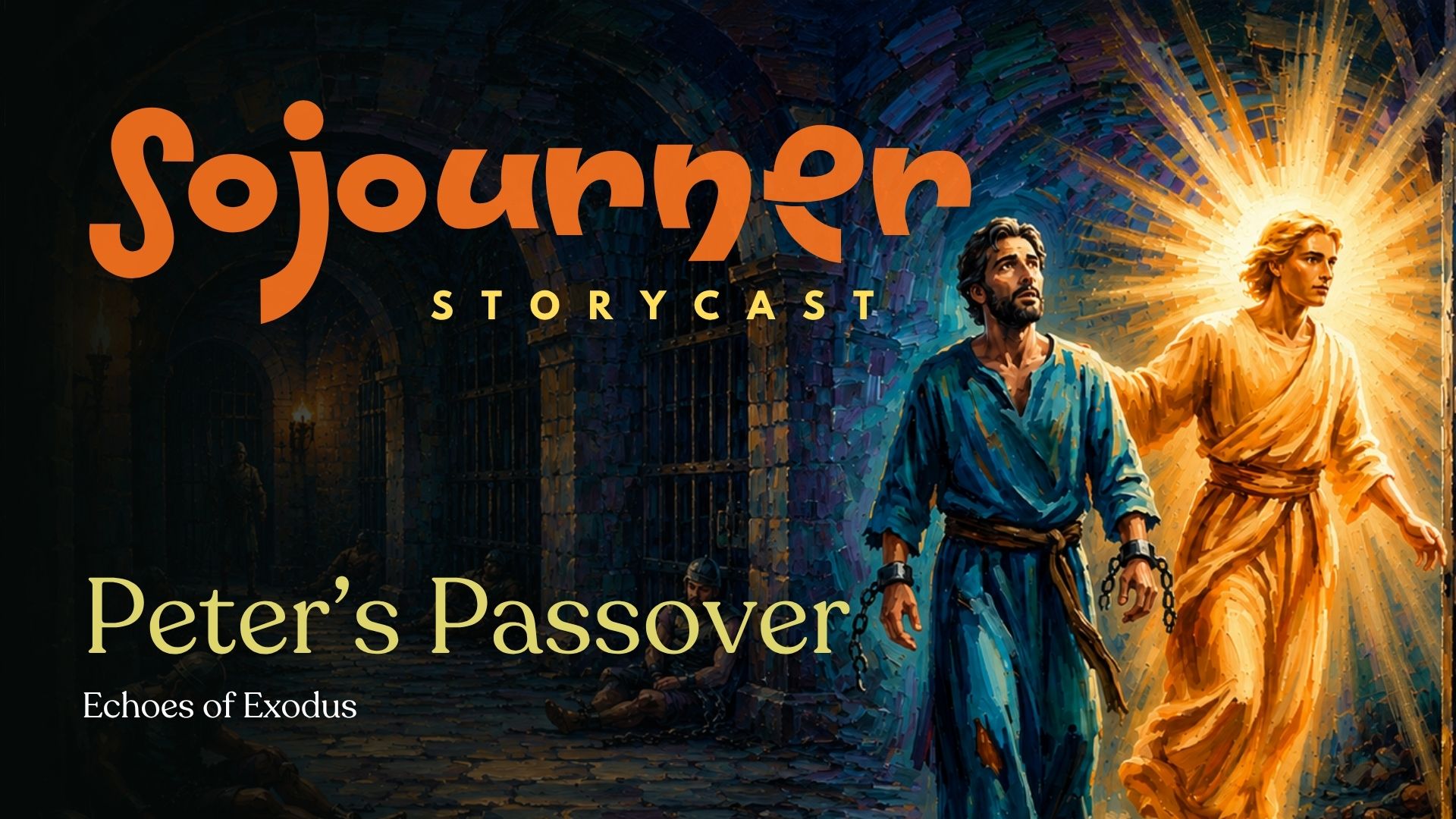
But Peter didn’t seem scared at all. In fact, he was asleep between two soldiers when suddenly an angel came and filled the jail with heavenly light. The angel struck Peter on the side and woke him up. Immediately, the two chains around Peter’s wrists fell off.
“Quick!” the angel said, “Get up! Dress yourself. Put on your sandals. Wrap your coat around you and follow me!” Similar to how the children of Israel were also ordered to have their garments and sandals ready to leave Egypt on the night of the Passover, Peter quickly got up with haste and followed the angel out the prison.
The angel led him past the first set of guards and then past the second set. Peter thought this was all a dream. When they got to an iron door, the door opened for them by itself. It was a miracle! God parted all the obstacles before them, just like how He had parted the Red Sea in the past. And God brought Peter out of prison in a miraculous way just as He had brought His people out of Egypt.
After they had walked down the street, the angel disappeared and that’s when Peter realized he wasn’t dreaming and exclaimed, “Now I know for sure that the Lord has sent his angel. He set me free from Herod’s power. He saved me from everything the Jewish people were hoping would happen.”
When morning came, the soldiers that were guarding Peter were dumbfounded. Herod had them search everywhere for Peter, but when they couldn’t find him, Herod put all the guards to death. And not long after that, the angel of the Lord also struck Herod down so that He was eaten by worms and died.
Echoes
Sojourners, do you see echoes of the story of the Passover in Peter’s story? And that’s not all. Do you remember how the Passover is also an echo of Jesus’s story? Yes, Peter’s story also echoes Jesus’ death and resurrection story.
Let’s see if we can trace the connections.
When Peter was in prison, it seemed almost certain that he would be put to death the next day.
But God intervened.
In the middle of the night, an angel of the Lord appeared and led Peter out of prison, bringing him from what looked like certain death back into freedom and life.
In a way, Peter’s rescue echoes Jesus’s story.
Jesus truly died and was laid in a tomb—but on the third day He walked out alive.
And now Peter too steps out from a place that seemed sealed and hopeless, as though walking out of a tomb and into new life again.
And the echoes do not stop there.
What we didn’t mention earlier is that after Peter was freed, he went to the house of Mary, the mother of John Mark.
Interestingly, another Mary appears in the story of Jesus—Mary Magdalene—the first person to see Jesus after He rose from the dead.
When Peter arrived, he knocked at the door, and a servant girl named Rhoda came to answer.
But when she recognized Peter’s voice, she became so excited that she ran back inside to tell everyone—without even opening the door!
And guess what?
Nobody believed her.
Does that sound familiar?
When Mary Magdalene saw the risen Jesus, she also ran to tell the disciples that Jesus was alive.
And they did not believe her either.
But Peter kept knocking.
Eventually, they opened the door, saw him standing there, and were amazed.
Peter told them how the Lord had rescued him and asked them to share the news with the others and then he departed.
In a similar way, after Jesus appeared alive to His disciples, He also sent them out to tell the good news—and then He departed from them.
A Biblical Pattern
Sojourners, are you starting to notice a pattern? Why do all these stories sound so similar?
The Bible is showing us something beautiful.
Again and again, the Bible seems to want us to connect Peter’s story with the Passover and Jesus’s story. And guess what these aren’t the only stories that connect together. In fact, the whole Bible is showing us something beautiful, it is one big Passover story. It is the story of how God delivers His people from slavery to freedom and from death to life through Jesus.
And as God’s people today, we also are living out this story every day in our own lives. Just like Peter lived out Jesus’ story, the story of Jesus continues in His people today.
Key Scripture
Colossians 1:13–14 says:
He has delivered us from the domain of darkness and transferred us to the kingdom of his beloved Son,in whom we have redemption, the forgiveness of sins.
Sojourners, do you hear the Exodus story in those words?
God rescued His people from Egypt and brought them into freedom.
Jesus walked through the true and greater Passover—through His death, burial, resurrection, and ascension—to rescue us from something even greater than Pharaoh. Sin. Death. And darkness.
Today God is still bringing His people out. Out of fear into peace. Out of darkness into light. Out of slavery into freedom. Out of death into life.
That does not mean life becomes easy or that Christians never suffer or die. But it does mean that death is no longer the end of the story. The grave is not a dead end.
That is why Peter’s rescue gave courage to the early church. If God could open prison doors, He could carry them through anything. If Jesus defeated death, then no earthly king and not even death itself could stop God’s people. And that is still true today. The same Jesus who walked out of the tomb promises that everyone who belongs to Him will share in His life.
The story of Passover is our story too.
If the story of Peter’s Passover encouraged you, share this episode with a friend so they too can see how the story of Passover and Peter’s prison escape echo the life, death, and resurrection of Jesus.
And remember if we belong to Jesus, His story becomes our story too. The same God who parted the sea, who passed over the houses marked by the blood, who raised Jesus from the grave, and who opened prison doors for Peter is still writing His story today—in His people, bringing them out of slavery into freedom, out of darkness into light, and out of death into life.
Links to podcast: