
A Kingdom Torn Apart
The kingdom of Israel had never looked more glorious.
Jerusalem shimmered with gold from King Solomon’s temple. Traders filled the markets. Songs rose from the courts of the king. From the outside, it looked like a kingdom that would stand forever.
But beneath all the splendor, the people were weary.
The kingdom had been built with heavy labor. Men left their homes to work on Solomon’s projects.
Stones were cut from mountainsides. Forests were stripped for timber. The greatness of the kingdom had cost the people greatly.
Then King Solomon died.
And his son Rehoboam walked into the throne room wearing the crown of his father.
All across Israel, whispers spread: “What kind of king will he be?”
So the tribes gathered at Shechem to meet him. Elders came. Families came. And standing before the new king was a man named Jeroboam.
The people spoke carefully, yet hopefully.
“Your father placed a heavy burden on us,” they said. “If you lighten it, we will gladly serve you.”
Rehoboam looked over the crowd and told them, “Return in three days.”
For three days the kingdom held its breath.
The young king first sought the counsel of the old men who had stood beside Solomon through the years.
And they told him: ‘If you speak kindly to the people… if you serve them instead of ruling harshly over them… they will love you forever.”
But Rehoboam left their chambers and sought out the young men he had grown up with in the palace halls. And they laughed at the advice of the elders. “No,” they said. “Do not appear weak before them. Make them fear you.”
When the people returned on the third day, Rehoboam rose before the assembly and answered: “My father made your burden heavy… but I will make it heavier.”
The words fell like stones. Silence swept through the crowd. Then heartbreak. Then anger.
And in a single moment, the kingdom of Israel divided into two.
The ten tribes in the north turned away from the house of David and followed Jeroboam. Only Judah remained with Rehoboam in Jerusalem.
And the kingdom that had once been united under King David and Solomon became two divided lands.
Israel in the north and Judah in the south.
Years later, that northern kingdom would become known as Samaria.
And by the time Jesus walked the earth, the wound between Jew and Samaritan would had been open for generations.
The Divide Jesus Crossed
Hi Sojourners!
Have you ever heard of the Samaritans?
During the time of Jesus, Jews and Samaritans had been separated for centuries and did not get along. They avoided each other and carried years and years of hurt and anger between them. The divide was deep — cultural, political, and spiritual.
After the kingdom split, the northern kingdom of Israel eventually fell to Assyria. Many Israelites were taken away into exile, and foreign peoples were brought into the land. Over time, those who remained in the north intermarried with the nations around them, and their worship began to change. Many still worshiped the God of Israel, but they also mixed in other traditions and practices from surrounding cultures.
The Samaritans accepted only the Torah — the first five books of the Bible — as Scripture. They did not accept the later writings of the prophets that emphasized Jerusalem and the line of King David. From their perspective, Jerusalem was connected to the southern kingdom of Judah and came later in Israel’s history.
Instead, the Samaritans believed Mount Gerizim was the special place of worship God had chosen long ago in the days of Moses and Joshua.
Meanwhile, the people of Judah — also called the Jews — believed God had chosen Jerusalem and the temple built by Solomon as the true place of worship. They accepted not only the Torah, but also the writings of the prophets and the rest of the Old Testament Scriptures.
Because of this, many Jews believed the Samaritans had turned away from true worship, while the Samaritans believed they were preserving the ancient faith of Israel.
Both sides believed they were right, and the division lasted for hundreds of years.
By the time Jesus came, many Jews would even take a longer route to walk around Samaria instead of traveling through it, just to avoid contact with Samaritans.
But Jesus didn’t avoid the Samaritans. He walked straight into the places others avoided. He sat beside a Samaritan woman at a well. He made a Samaritan the hero of a parable. He talked with them. He helped them. And He showed love where others only saw division.
Jesus showed that the kingdom of God was bigger than the walls people had built between each other.
And this is where our story picks up today, because the good news is that the story of Samaria doesn’t end in separation.
Before Jesus ascended into heaven, He told His disciples something unexpected. He said they would be His witnesses — in Jerusalem, in all Judea… and in Samaria.
Not around Samaria. Not avoiding Samaria. But in Samaria.
After Jesus ascended to heaven, the Holy Spirit came down in Jerusalem, and the church was born.
Every day the apostles continued teaching and preaching — in the temple courts and from house to house — they did not stop proclaiming that the Christ is Jesus.
And the Lord added to their number day by day those who were being saved.
The Scattering
At first, the message of Jesus was spreading mainly within Jerusalem. The church was growing, strong and full of life.
But then, something tragic happened.
A great persecution arose against the church in Jerusalem, and everything suddenly changed.
One of the key believers in the early church, Stephen — a man full of faith and the Holy Spirit — was falsely accused, brought before the council, and became the first follower of Jesus to be martyred. If you want to hear more about his story, you can go back and listen to our first episode.
And after Stephen’s death, the persecution intensified.
A young man named Saul, a devout Pharisee who believed he was defending God’s law, began violently opposing the church. He went from house to house, dragging off men and women and putting them in prison.
And as the pressure grew in Jerusalem, the believers were scattered throughout the regions of Judea and Samaria.
But what looked like the breaking of the church… was actually the beginning of its spreading.
Because those who were scattered did not stop speaking about Jesus. They carried the gospel with them wherever they went.
And one of them was Philip.
The Gospel Reaches Samaria
Philip was one of the early servants chosen in Jerusalem — a man full of wisdom and the Holy Spirit, set apart to help care for the growing needs of the church.
And now, in the midst of persecution and scattering, Philip goes down to a city in Samaria — yes, that Samaria — and begins to proclaim Christ.
And something incredible happens.
The crowds gather and listen attentively to what Philip is saying, and they see the signs that he is doing. Evil spirits scream and come out of many people. Many who were disabled or unable to walk are healed.
Philip proclaims the good news of God’s kingdom and the name of Jesus Christ. So many men and women believe and are baptized. And as you can imagine, there is great joy in that city.
When the apostles in Jerusalem heard that people in Samaria had accepted God’s word, they sent Peter and John to Samaria.
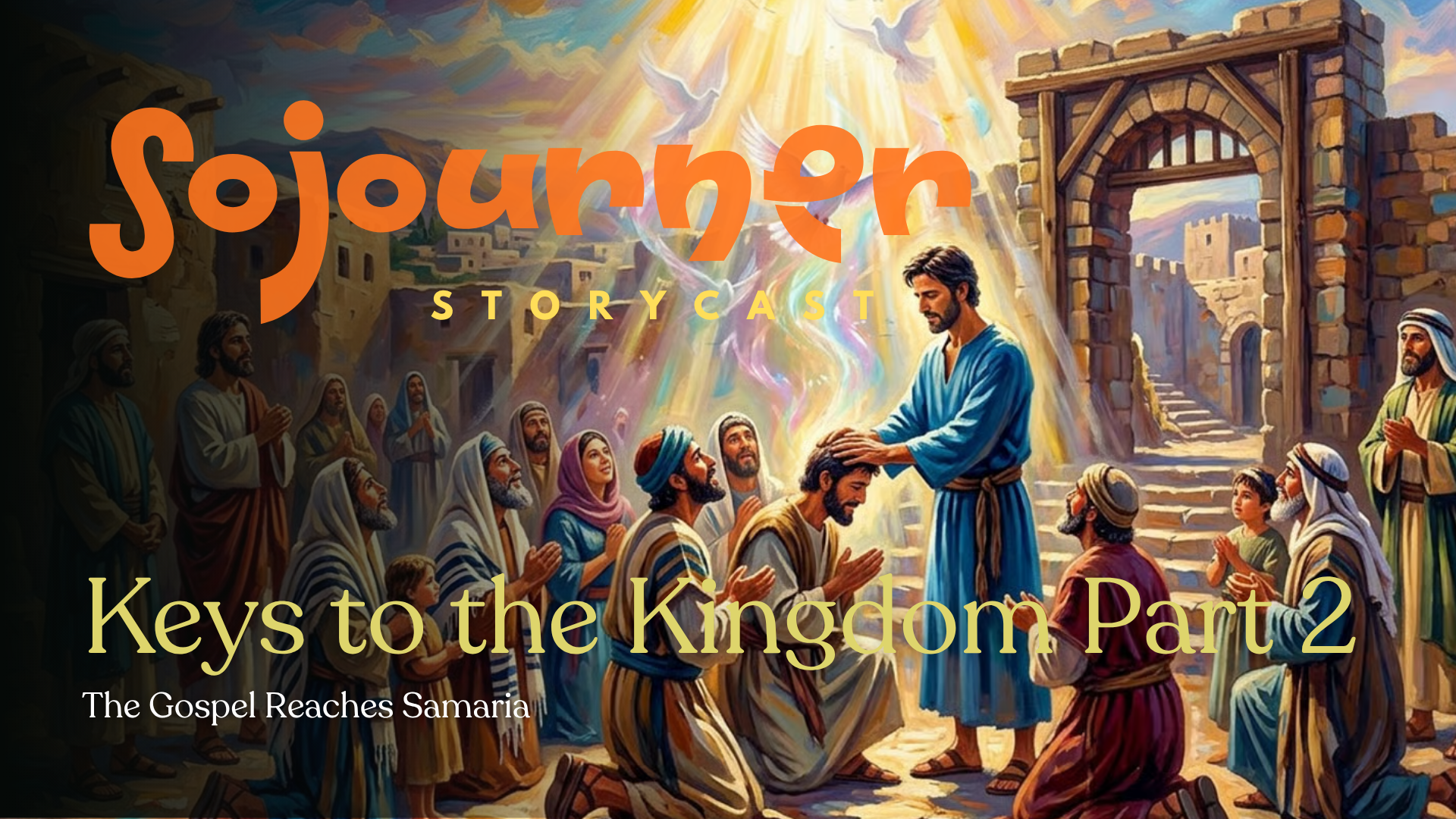
Peter and John prayed for the new believers, and they placed their hands on them — and just like the believers in Jerusalem, they too received the Holy Spirit.
This is incredible.
Let’s think about what is happening here.
For hundreds of years, there had been separation. Two groups of people who both claimed to know God — but who had lived divided, worshiping in different places, carrying different histories, and looking at each other through layers of suspicion and hurt.
And now… in one moment… the same Holy Spirit who came upon the believers in Jerusalem is falling on the Samaritans.
Not a different Spirit but the same Spirit.
This means something huge: God was not building two churches. He was building one family.
And Peter was there to witness it. If you remember our last episode, we talked about how Jesus told Peter something significant — that he would be given “the keys of the kingdom of heaven.” Peter would become an eyewitness to how God was opening the way for people to enter His kingdom through Jesus.
So when Peter arrives in Samaria, he is not just visiting new believers… He is witnessing God opening the door to the people in Samaria so that they can be part of His family.
The boundaries people had built over centuries came down.
Jews and Samaritans are being brought into the same story and into one people of God in Christ.
And if the kingdom can open here… then no one is outside the reach of the gospel.
What began in Jerusalem is now reaching Samaria — and it doesn’t stop there.
Because in our next episode, we’ll see how this same gospel continues to move outward… all the way to the Gentiles.
Key Scripture
In Genesis 50:20 it says: “You meant evil against me, but God meant it for good.”
What looked like a disaster — the persecution in Jerusalem, the arrest of believers, even the death of Stephen — was actually used by God to spread the gospel further than anyone could have planned.
That’s what we’re seeing this this story.
People meant harm. The church was being scattered. It looked like everything was falling apart.
But God was turning it into something beautiful.
Because when the believers were forced to leave Jerusalem, they didn’t stop following Jesus — they carried the message with them wherever they went. And that’s how the gospel reached places like Samaria.
So here’s something for us to remember:
Sometimes in life, things happen that don’t make sense. Things that feel painful, confusing, or unfair. But that doesn’t mean God is absent.
God is still working, even in the hard moments.
And just like He did in the early church, He can take what feels broken and use it to bring something good out of it — something we may not see right away.
So when life feels messy, hard, or confusing, we can remember this: God never wastes what happens. Even when things hurt, God can still use it for something good and meaningful.
One Family in Christ
The story of the Jews and Samaritans also teaches us something really important about people and relationships.
These two groups had been divided for hundreds of years and it didn’t seem possible for them to ever be one family again. But the gospel of Jesus tears down that separating wall.
Through Jesus’ death, resurrection, and the coming of the Holy Spirit, what was once divided is brought together. The message of the gospel reaches both Jews and Samaritans, showing that they are now part of the same family of God.
So what does that mean for us?
It means the gospel doesn’t just change our relationship with God — it also changes how we see each other. In Jesus, the walls that separate people are broken down.
A simple way to live this out is choosing to be kind to someone you might normally avoid or overlook — someone different from you, or someone you don’t usually talk to.
And even for people who don’t yet know Jesus, we love them with an open heart, always pointing them toward the invitation of God’s family, always ready to welcome them in.
If the story of the Samaritans being brought into God’s family encouraged you today, share this episode with a friend so they too can be reminded that God still brings people together and His story is still reaching hearts today.
And remember—no matter how deep the divide, the keys of the gospel are still opening the doors to His kingdom, bringing hope, healing, and new life to everyone God calls into His family through Jesus.
Links to podcast: