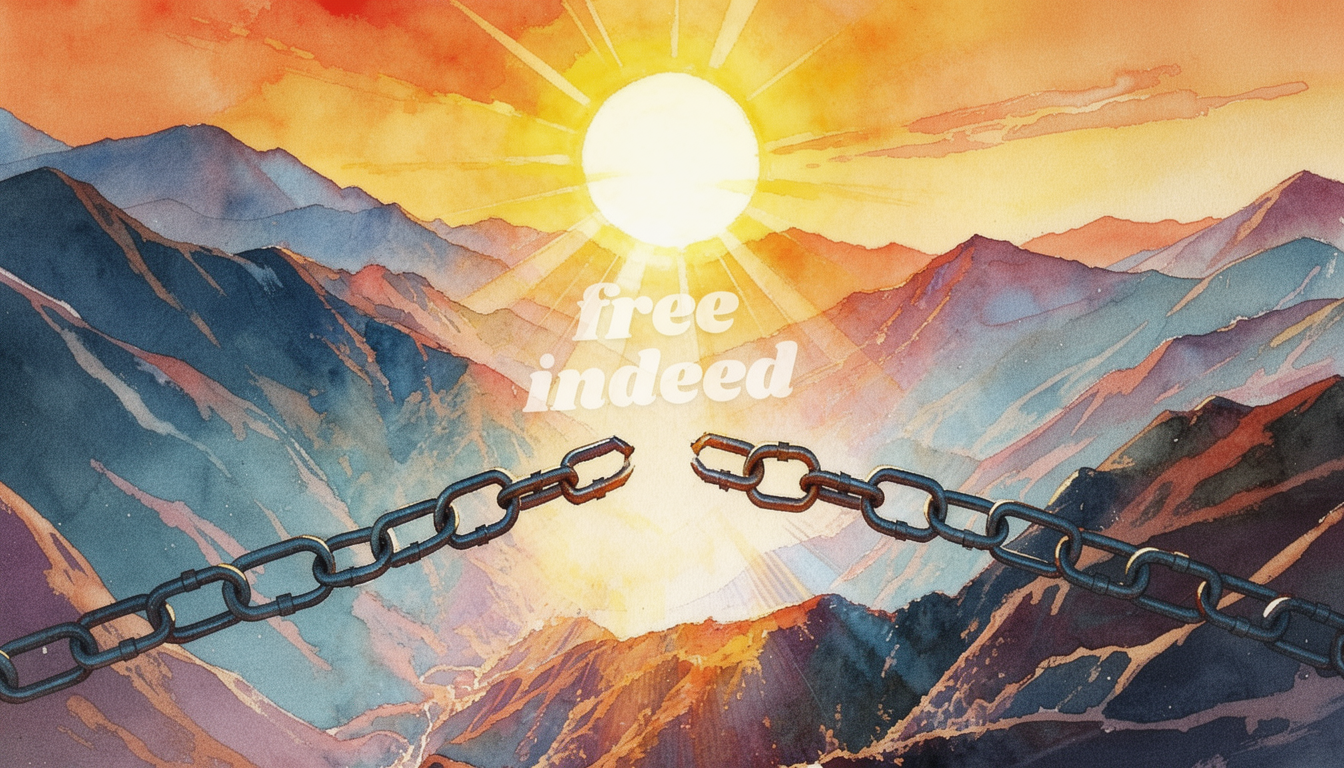
“So if the Son sets you free, you will be free indeed.” (John 8:36)
It’s been quite a journey and I really can’t pinpoint when it started or how long exactly it took for me to get here. But I do remember one pivotal afternoon when I asked myself a question.
It was a sunny day, the kind that traps you in a convection oven, and maybe it was the heat, because I was stunned that I couldn’t remember a single thing from yesterday. Or the day before. Or the week—or even much of that year. Days had blurred into months, months into years, and looking back on my life felt like staring at one long, indistinct blur.
I tried to recall something lighthearted—something funny or amusing—but I couldn’t. I realized I didn’t remember the last time I had laughed, really laughed—the deep belly kind. And then a fearful thought hit me: I don’t know who I am anymore.
I wasn’t unhappy in the obvious sense. My life looked full from the outside. I was busy—always something to do, places to be, people to talk to. It was boisterous, even meaningful on paper. But inside, I felt hollow. Empty. As if something—or someone—had been slowly erasing me, layer by layer, until there was very little left.
I wasn’t living; I was performing. Moving. Enduring. Running through the motions of what a faithful life was supposed to look like, while quietly disappearing inside it. How did I get here? And more importantly, is this what faithfulness is supposed to look like?
I’ve been sitting with that question for a long time and here’s a glimpse into what I’ve learned on this journey toward freedom in Christ.
There’s a pattern in how faith is often taught and lived today. Somewhere along the way, sacrifice came first. Endurance was praised. Freedom was postponed. And identity—the very thing Scripture says God gives us—had quietly slipped to the end.
But if we look to Scripture, we see that God works the other way around like this:
Identity in Christ → freedom → love → sacrifice
The order matters. When it’s reversed, the consequences are dire.
1. Identity in Christ: Who You Are
Everything begins with identity. Before Jesus ever calls anyone to do anything, He tells them who they are: beloved, known, called, no longer slaves. (Matthew 3:17, Galatians 4:9, 2 Timothy 1:9, Galatians 4:7) “See what kind of love the Father has given to us, that we should be called children of God; and so we are.” (1 John 3:1)
If your identity is not settled in Christ, then love becomes a way to earn worth and sacrifice becomes a way to prove that you matter. That’s not discipleship—that’s survival. A person who doesn’t know they are already loved will confuse being needed with being faithful.
2. Freedom: How You Stand
From identity flows freedom—not autonomy, but liberation. This freedom is freedom to tell the truth, to say yes or no, to obey God rather than appease people, and freedom from coercion, fear, and shame. Without freedom, obedience is forced and sacrifice is extracted not offered. God does not produce love through captivity. This is why Paul says we are no longer slaves—even to “good” things like religious expectations. (Galatians 4:3–7)
3. Love: How You Relate
Only free people can actually love. Why? Because love in Scripture is chosen, not compelled. “There is no fear in love.” (1 John 4:18) If someone must stay in a situation because leaving would mean: guilt, shame, spiritual condemnation, loss of belonging then what’s happening may look like love—but it isn’t love in the biblical sense. It’s fear wearing a holy costume. Christlike love: speaks truth, honors boundaries, seeks the good of the other and the self, does not require the annihilation of the self.
4. Sacrifice: What You Give
Sacrifice comes last, not first. Jesus sacrifices Himself freely, consciously, without coercion, and without losing His identity. “No one takes my life from me, but I lay it down of my own accord.” (John 10:18) That sentence alone dismantles a lot of misuse of “take up your cross.” Sacrifice that is demanded, guilt-driven, required to maintain peace and necessary to avoid punishment or shame is not Christlike sacrifice—it’s exploitation. True sacrifice is an offering, not a requirement.
So what happens when the order gets reversed like many Christians are taught?
Sacrifice → love → freedom → identity (no longer guaranteed)
In a reversed system, the unspoken message is that if you sacrifice enough, endure long enough, and submit well enough, then maybe you’ll be seen as loving, maybe you’ll eventually feel free, and maybe you’ll be secure in who you are before God. But maybe not. Identity becomes something you hope to earn, not something you live from.
When someone is taught—explicitly or implicitly—that faithfulness starts with sacrifice:
- Sacrifice becomes proof of worth
- Love becomes performance (“I’m loving if I stay”)
- Freedom is postponed (“I’ll be free later, in heaven, or when this is over”)
- Identity is fragile and conditional (“Am I faithful enough? Am I selfish?”)
That’s where people begin to disappear and lose their identity. They don’t stop believing in God—but they stop believing they matter. And when someone inevitably reaches their limit, the conclusion is: “I must not have been faithful enough.” It’s a slow death. That’s the cruelty of the reversed order.
Israel’s exodus from Egypt gives us the clearest and most foundational picture of the correct order. Before God ever gives a single command, He establishes identity and freedom: “I am the LORD your God, who brought you out of the land of Egypt, out of the house of slavery” (Exod. 20:2). Identity comes first—I am your God. Freedom comes next—I brought you out of slavery. Only then does God dwell among His people, form them in relationship, and eventually give the Law. Obedience is not a pathway to liberation; it flows from it. Israel is never told to earn deliverance through sacrifice or endurance. God does not demand faithfulness while they remain enslaved. This order alone dismantles the idea that staying in bondage is somehow proof of devotion or spiritual maturity.
Jesus Himself embodies this order. At His baptism, before He has preached, healed, or performed a single public miracle, the Father declares His identity: “You are my beloved Son; with you I am well pleased” (Mark 1:11). Nothing has been earned; nothing has been proven. From that secure identity, Jesus enters the wilderness and His ministry then flows with love and compassion. Only at the end comes sacrifice. The cross is not the starting point of Jesus’ identity but the culmination of a life lived in freedom and love. He does not prove He is the Son by going to the cross; He goes to the cross because He already is.
Paul is also relentless about preserving the proper order of identity, freedom, and obedience. In Romans, he begins not with commands but with assurance: “There is therefore now no condemnation for those who are in Christ Jesus” (Rom. 8:1). Identity is secured first. He follows this by emphasizing freedom, reminding believers, “You did not receive the spirit of slavery to fall back into fear” (Rom. 8:15). Only after eight chapters devoted to who believers are and what they have been freed from does Paul finally turn to sacrifice: “Therefore… present your bodies as a living sacrifice” (Rom. 12:1). Obedience is not a prerequisite for belonging; it is a response to it. Sacrifice comes after identity is settled, not before.
The tension lies in the confusion between self-denial for love and self-erasure to keep peace. Jesus calls us to the first. He never calls us to the second. But for so many years I could not tell the difference and here are some of the things I or others I saw struggled with.
“Take up your cross” — sanctifying suffering
Jesus’ call to “take up your cross” is frequently lifted out of context and used to spiritualize suffering that God never asked someone to endure. In Scripture, the cross is not a metaphor for staying in damaging relationships or tolerating mistreatment; it is a symbol of persecution for allegiance to Christ in a hostile world. When this verse is misused, suffering itself becomes the measure of discipleship, and personal agency is recast as selfishness. Identity erodes as people learn to equate holiness with disappearance.
“Deny yourself” — erasing the self God created
Similarly, “deny yourself” is often interpreted as a command to erase one’s needs, voice, or personhood. But Jesus is not denying the existence or worth of the self; He is reordering allegiance. Scripture consistently assumes a self worth —“love your neighbor as yourself.” When self-denial is distorted into self-negation, healthy boundaries are labeled pride, self-awareness is treated as unspiritual, and people are taught to distrust the very humanity God declared good.
“Submit to governing authorities” — tolerating injustice
Romans 13 has a long history of being used to demand compliance with unjust systems. It has been invoked to silence protest, justify slavery, discourage resistance to corruption, and equate obedience to power with obedience to God. What is often ignored is that Paul himself repeatedly disobeys authorities when they act unjustly, and that Scripture consistently portrays God opposing rulers who misuse power. Romans 13 assumes authorities are fulfilling their role of restraining evil, not perpetuating it. When this passage is misapplied, moral conscience is suppressed and identity is reduced to passive compliance.
“Wives, submit to your husbands”
Few passages have been more frequently weaponized than Ephesians 5, often by ignoring where Paul actually begins: “Submit to one another out of reverence for Christ” (Eph. 5:21). Mutual submission is the framework. Within that, Paul radically redefines power by calling husbands to die, not dominate, and by portraying headship as self-giving love rather than control: “Husbands, love your wives, as Christ loved the church and gave himself up for her.” This assumes a relationship grounded in Christ rather than fear. Paul never commands a woman to remain under manipulation, surrender her conscience, or endure spiritual diminishment. Submission without freedom is not submission at all—it is subjugation, which Scripture consistently condemns. When identity in Christ, freedom, love, and voluntary sacrifice are removed from the equation, this text is being misused.
“What God has joined together, let no one separate”
This is the most frequently cited passage in conversations about divorce, yet it is often lifted out of its context. The Pharisees ask Jesus, “Is it lawful to divorce one’s wife for any cause?”—a question rooted in male privilege and the disposability of women, not covenant faithfulness. Jesus responds by elevating the meaning of marriage, condemning casual abandonment, and protecting the vulnerable spouse. What He is not saying is that marriage must be preserved at any cost, that a person must remain even when the covenant has been hollowed out, or that endurance itself is righteousness. He is describing marriage as a one-flesh covenant, not a legal trap. A relationship marked by manipulation or coercion has already violated the one-flesh reality Jesus affirms. His teaching assumes mutual dignity and love freely given. Without that, the covenant is already broken, even if it remains legally intact.
Across all of these examples Scripture is rearranged so that sacrifice comes first, freedom is postponed, obedience is coerced, and identity becomes conditional. A good question to ask yourself is: Does this interpretation increase a person’s freedom to love God and others—or does it require them to disappear in order to be faithful? Scripture never asks people to become less human in order to be holy. God’s words are not being honored in these interpretations—they are being used. And the result is always the same: people are asked to become less human in order to be faithful.
How did we get here? In the early church, Christians had no cultural power and conversion was costly. Martyrdom was voluntary and suffering was freely embraced from a clear identity that Jesus is Lord.
However, once Christianity became socially dominant in the latter half of the Roman Empire, things shifted. The church had to regulate marriage, preserve social order, govern entire populations, not just disciples. Obedience was emphasized because it preserved order. Endurance was praised because it kept families intact. Slowly the message drifted from: “Christ has set you free, therefore love and serve” to “Endure faithfully, and that will prove you belong.”
Over time, suffering was seen as sanctifying. Patience became a primary virtue even if it was detached from justice, truth, or love. Holiness was associated with silence and submission. The problem wasn’t valuing sacrifice, it was disconnecting sacrifice from freedom. Jesus’ “No one takes my life from me” quietly faded into the background.
The Reformation powerfully corrected part of this drift by restoring identity rooted in Christ rather than works—justification by faith and freedom of conscience before God. And yet, culturally, household structures and social roles were often left largely untouched. Marriage, authority, and power dynamics were rarely examined with the same rigor as salvation itself. The result was a lingering tension: a gospel that proclaimed freedom, but relationships that did not always reflect it. Grace was recovered theologically, but not always fully embodied in daily life.
Today, we still feel that tension. In many churches, the instinct to preserve order remains strong, and faithfulness is still often framed as staying, enduring, submitting—and trusting that God will be pleased. At the same time, there has been a swing in the opposite direction, where freedom is emphasized without formation, authenticity without repentance, and grace without any language of sin or sacrifice. Neither extreme reflects the heart of the gospel. One erases freedom in the name of holiness; the other avoids transformation in the name of freedom. The way of Christ holds both together—rooting us first in identity and freedom, so that love and sacrifice can emerge rightly, willingly, and beautifully.
Paul’s life shows us that joy and freedom in suffering are not achieved by suppressing pain or glorifying hardship, but by living from a settled identity in Christ. He does not rejoice in suffering as an end in itself; he rejoices in God while suffering remains present. Again and again, Paul anchors himself in what cannot be taken from him: “I have been crucified with Christ… the life I now live I live by faith in the Son of God, who loved me and gave himself for me” (Gal. 2:20). Because his identity is secure, trials do not define him. Because his freedom is rooted in Christ, hardship cannot enslave him. This is why he can say, even from prison, “Rejoice in the Lord always” (Phil. 4:4)—not as denial, but as defiance.
Living this out today begins with learning to tell the difference between chosen obedience and coerced endurance. Paul’s joy did not come from staying in situations that erased him; it came from knowing who he belonged to and acting from that place of freedom. For a modern person, this means regularly asking honest questions before calling something “faithfulness”: Am I choosing this freely, or am I afraid of the consequences if I don’t? Does this draw me closer to Christ, or does it require me to silence my conscience, intuition, or voice? Paul’s freedom was internal, but it always expressed itself outwardly—in truth-telling, boundary-setting, and refusing to be owned by guilt or human pressure. Living this way today looks like obeying God even when it disappoints people, stepping away from situations that rely on shame to keep you compliant, and trusting that God’s approval is not fragile. Joy grows not by seeking suffering, but by staying anchored in identity—returning again and again to the truth that nothing you give up in obedience to Christ is taken from you without your consent.
Back to that fateful afternoon, I eventually realized that I hadn’t been serving God for the right reasons. And by His grace, God led me out of that situation. Slowly, I began to find my identity in Christ through the gospel, and with it came a freedom and joy I had never known before.
Strangely enough, I could have carried bitterness about so many things—but when the love of God fully touched me, I found that there was no room for resentment. It was gone, replaced with peace. Now, I choose to serve, even when it means being misunderstood by those I once felt I had to please or impress. I give because I am free, not because I’m afraid or trying to earn approval. I love because I am loved.
When identity, freedom, and love come first, sacrifice isn’t a heavy demand—it becomes a natural overflow. Laying down our lives for others doesn’t diminish us; it flows freely from the life God has already given. It’s a joy, not a burden. This, I think, is what it truly means to be free indeed.