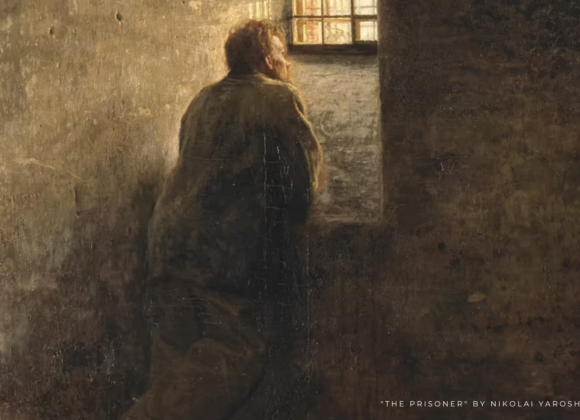

Read Leo Tolstoy’s jolting short story, God Sees the Truth, But Waits, here: https://faithsteadjourney.com/god-sees-the-truth-but-waits/
This story haunts. It hovers over you like a slimy fog that won’t lift until you surrender under its weight and allow yourself to wallow in its grime. Ugh.
What do I make of this story? It’s one you have to marinate in. Stew in it for a while. The longer the better. After all, the main character, Aksyónof, sat in prison for a crime he didn’t commit for twenty-six years. And perhaps that is one of the things the story understands so well about life: you never really know what life is all about until you reach the end of it.
The story begins with a young and free-spirited Aksyónof embarking on a journey to the fair to sell his wares. His wife tries to dissuade him from going because she has had a dream—perhaps even an omen—that when he returns, his hair will be gray. He brushes it off, bids his family farewell, and sets off.
Halfway through his journey, he is framed for murder. The evidence points to him, and he is sentenced, flogged, and sent to the mines of Siberia.
His wife gets one last chance to visit him before he is taken away for good, and she asks him if he really was guilty.
Stricken that even his own wife suspects him, Aksyónof gives up all hope of ever convincing anyone that he is innocent and turns his eyes upward in prayer to God:
“It seems that only God can know the truth, it is to Him alone we must appeal, and from Him alone expect mercy.”
This is the beginning of his spiritual transformation. He ceases to need to convince anyone of his innocence because he knows that God knows the truth.
There is a moment here that parallels the story of Joseph in the Bible. When Joseph was in prison and interpreted the cupbearer’s dream, he asked him not to forget him when he was restored to his position. But the cupbearer forgot him. Ugh.
I don’t even know why moments like this surprise me anymore, because God seems to so often work through the places where every human hope has run out. Joseph had to wait. Aksyónof had to wait. Neither man could force his own deliverance.
And ironically, his wife’s doubt becomes the very thing that pushes Aksyónof away from dependence on human vindication and toward dependence on God. Her suspicion is wrong, but God uses even this painful moment to redirect his heart.
For twenty-six years, Aksyónof lives as a convict. His youth, mirth, and good looks are chiseled away by time, sorrow, and labor. His hair turns completely white. He becomes bent over, rarely speaks, and often prays. He becomes a religious man, and his meekness wins him the respect of the prison authorities and prisoners alike. They call him “Grandfather” or “the Saint” and highly respect his opinions and advice.
Again, I can’t help but think of Joseph.
There is a small moment in the story that struck me even more deeply. Some new convicts ask Aksyónof how he came to be in prison. He only sighs and says, “For my sins I have been in prison these twenty-six years.” When they press him to explain what sins he committed, he simply replies, “I must have deserved it!” And he says no more.
I think on the Christian walk we can have the head knowledge that we are sinners and still have very little understanding of what that actually entails. When suffering comes, we instinctively try to spiritualize it, not that it’s wrong. Aksyónof knows the theology. He knows he is a sinner before God and so anything God allows to happen to him must be in His will. But knowing that we are sinners is not the same thing as understanding what it means to surrender ourselves to God. Well, he’s about to learn.
Among the new convicts is a man from Aksyónof’s hometown named Makár. As Aksyónof gets to know him, he becomes almost certain that Makár was the one who framed him.
That night, the past comes rushing back.
He sees his wife and children. He remembers the clothes they wore. He sees himself young and handsome again, playing his guitar just before his arrest. Then comes the arrest. The accusations. The beating. The prison. The years of injustice. It is all too much. And he is livid.
And when he thinks about how much of this was Makár’s doing, the hunger for vengeance threatens to consume him. His endless prayers do not seem to bring peace. The anguish burns within him night after night, and he is at a loss for what to do.
Have you ever felt this way?
Just imagine. You were wrongfully accused of murder. No one believed you—not even the person closest to you, your wife. You were punished for something you didn’t do, beaten, imprisoned, and sent to a labor camp in the brutal climate of Siberia. You lived there for another half of your life. And now, after twenty-six years, the man responsible is sitting right in front of you. And suddenly you have a chance to vindicate yourself.
I can only imagine Aksyónof is about to explode from all the turmoil that has been brewing inside of him.
Finally, the day comes when he has the opportunity to let Makár pay for his evil deeds. Makár had been planning an escape, and if caught, the penalty would be death. When the Governor questions Aksyónof about who has been planning the escape, Aksyónof replies: “It is not my will to tell.” He leaves the matter in God’s hands.
And this is where something changes. Aksyónof has spent twenty-six years wanting someone to tell the truth about him. Now that he has the truth about someone else—he refuses to use it for his own vindication.
Crushed beneath a guilt he never experienced, Makár finally confesses his crime to Aksyónof. All the harsh punishments inflicted upon him had failed to break through his hardened heart, but one small act of mercy finally did. He was the murderer. He was the one who had framed Aksyónof and ruined his life. Pleading for forgiveness, Makár promises to confess so that Aksyónof can finally be freed and return home.
When Aksyónof hears him sobbing, he begins to weep too.
And this is his turning point.
“God will forgive you!” he says. “Maybe I am a hundred times worse than you.” At these words his heart grew light, and the longing for home left him.
There is something almost startling about the power of this moment. It took twenty-six years of suffering, waiting, and God’s patient work to form this response in Aksyónof. And now, when the moment finally comes, the weapon he reaches for is not revenge, but mercy.
And perhaps that is because mercy demands something far more costly than revenge. Revenge can make a man fear the one who has power over him; mercy and love can make him see the evil within himself. And here we see a faint echo of the cross: evil is overcome not through retaliation, but through sacrificial love.
What is even more beautiful is that Aksyónof’s mercy frees both men. Makár is freed from the prison of his guilt, while Aksyónof is freed from the longing for vindication and home. That’s why Tolstoy’s line, “his heart grew light,” is so extraordinary. The confession appears to be about Makár setting Aksyónof free, but in a deeper sense, Aksyónof’s willingness to forgive is what sets them both free.
This time, when Aksyónof calls himself a sinner—“a hundred times worse” than Makár—it carries an understanding that was not there before.
Earlier, he knew he was a sinner in the abstract. But he was still clinging to another kind of righteousness: I may be a sinner, but I am innocent of this. I have been wronged. I deserve to go home. I deserve to have my name cleared.
And he did. He really was innocent. But now something deeper has happened inside him. He no longer needs his innocence to be the source of his peace.
For twenty-six years, Aksyónof has lost nearly everything this world could give him: his freedom, his youth, his reputation, his family, his home. And yet, in the end, he discovers that the things he thought he needed restored to him were never the things that mattered most.
He had spent years wanting to be released from prison. Now he is released from something deeper. He is released from the need to be vindicated on this side of heaven.
That is why, when Makár offers to confess so that Aksyónof can go home, Aksyónof says that his wife is dead and his children have forgotten him. He has no earthly home to return to. And strangely enough, he no longer longs for one.
The opening of the story suddenly comes back into focus. His wife dreamed that Aksyónof would return with gray hair. The dream was true—but she didn’t understand it. He really would return with gray hair, but he would not return as the same man who left.
The young man who left home wanted freedom, prosperity, pleasure, and the good opinion of others. In the beginning, Aksyónof needed everyone to know that he was innocent. By the middle, he had learned that God knew the truth. And by the end, twenty-six years of waiting had changed him so deeply that he understood what he really needed was not vindication, but reconciliation with God. Wanting justice for himself was no longer more important than becoming a man capable of giving mercy to someone else.
Perhaps that was the greater work God was doing in all those years of waiting. We think we’re waiting for God, but sometimes God is patiently allowing His work in us to unfold. He doesn’t tear open the chrysalis before the butterfly is ready. There is a work being done in the waiting that cannot be rushed.
The apostle Paul knew something of this kind of waiting. Writing to the Galatians, he cried, “My little children, for whom I am again in the anguish of childbirth until Christ is formed in you!” And to the Colossians, he spoke of rejoicing in his sufferings for the sake of making known this mystery, “which is Christ in you, the hope of glory.”
We often think waiting is hardest when we are the ones waiting for something to change. But Scripture gives us another picture of waiting: the patient longing of someone watching and waiting for a work to be completed in another. Not because anything is difficult for God, but because He is patient and long-suffering. He does not rush the work He is doing in us.
Aksyónof thought he was waiting for his freedom, waiting for his name to be cleared, waiting to go home. But God was doing something deeper. He was teaching Aksyónof to trust Him with the truth, to leave justice in His hands, and to discover a freedom that could only come when he was able to show mercy to the man who had destroyed his life. God was teaching him how to come home.
God sees the truth, and waits.
“You meant evil against me, but God meant it for good.” — Joseph