The apostle Paul writes in 2 Corinthians 3:16–18 that when one turns to the Lord, the veil is removed. We behold the glory of the Lord “with unveiled face.”
That image shapes the way we read Scripture. We don’t read the Bible as a closed book, a rule manual, or a collection of disconnected moral stories. We read it as people whose eyes have been opened by Jesus Christ. The veil has been lifted.
The Bible is one unified story—God redeeming a people for His glory. And according to Jesus Himself, that story has always been about Him.
On the road to Emmaus (see Luke 24), the risen Christ told His confused disciples that everything written about Him in “Moses and all the Prophets” must be fulfilled. “Moses” there doesn’t just mean one moment in Exodus—it refers to the Pentateuch, the first five books traditionally credited to Moses. In other words, from Genesis forward, the Scriptures have been pointing to Christ.
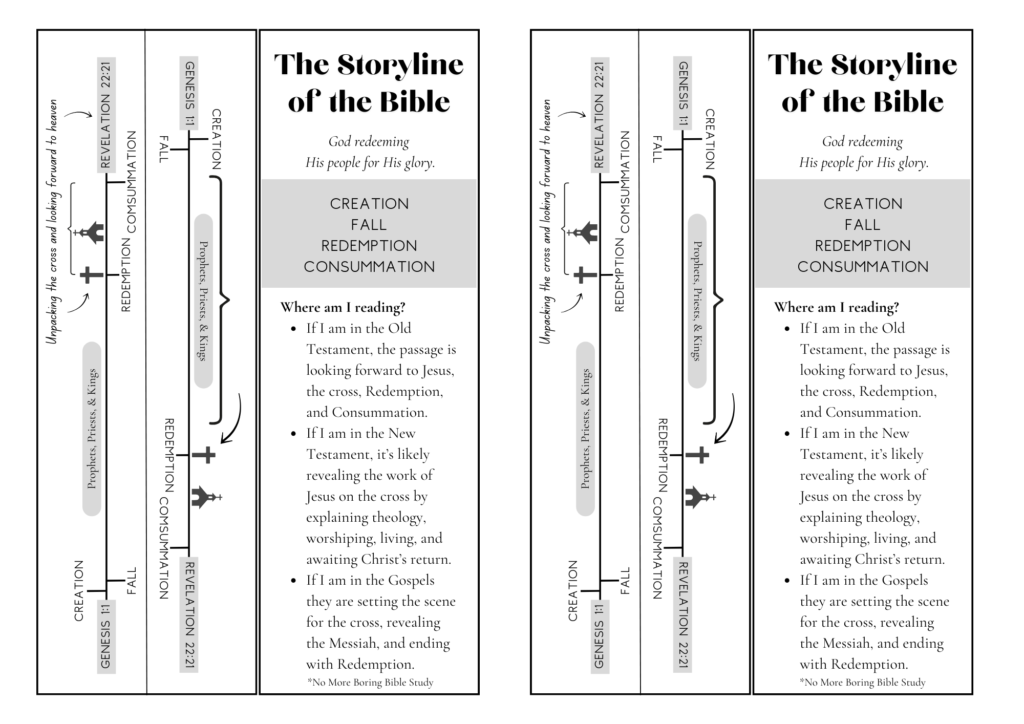
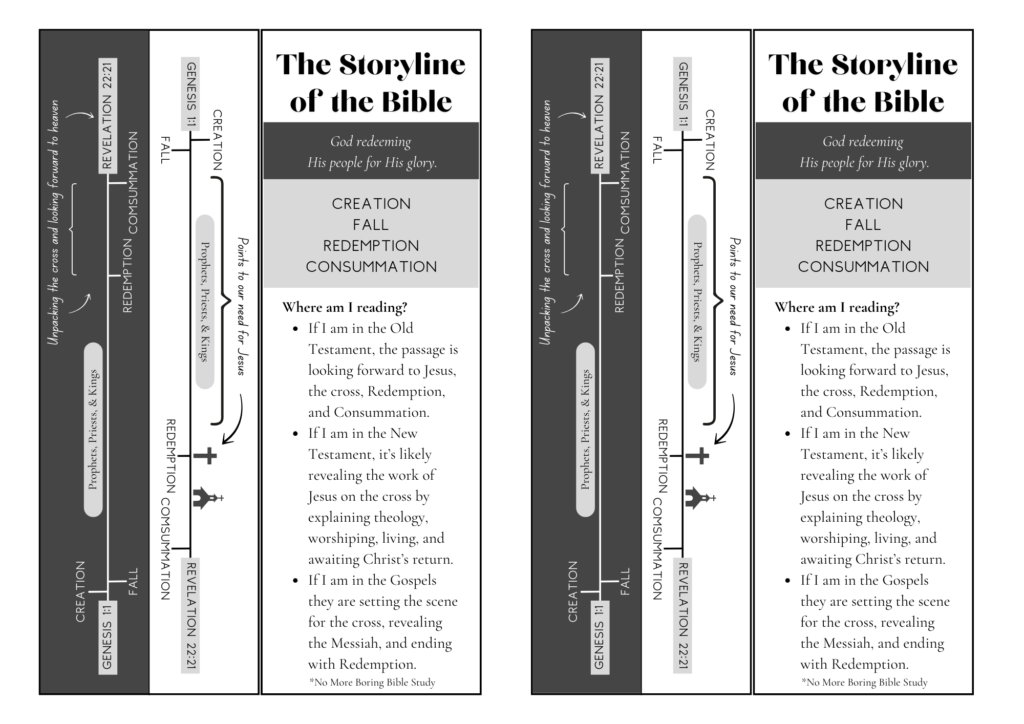
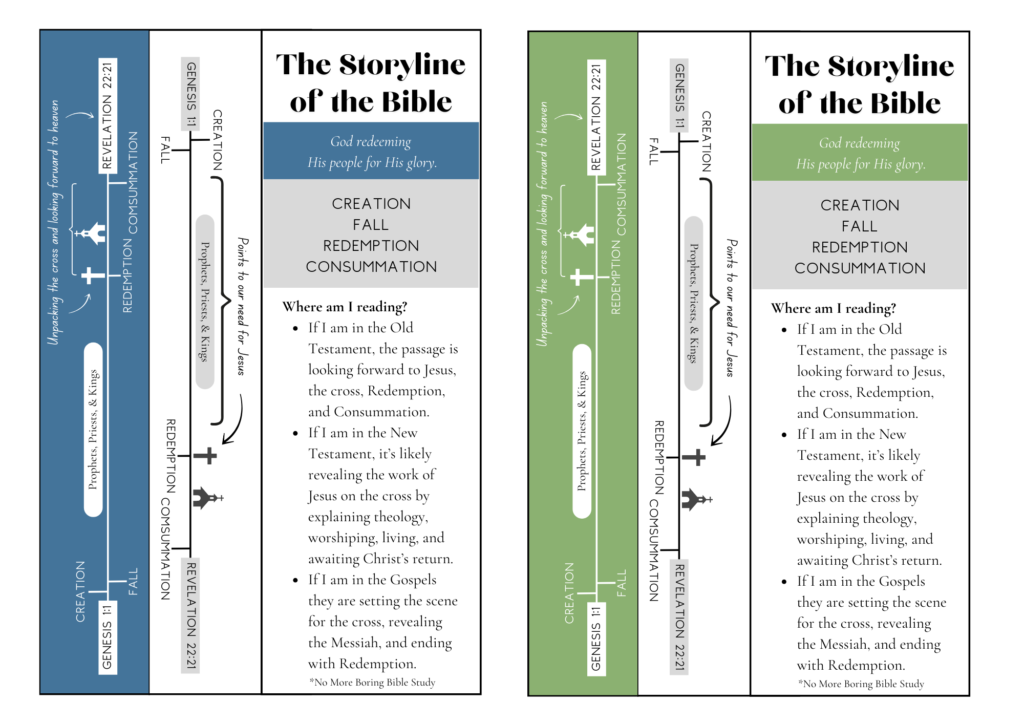
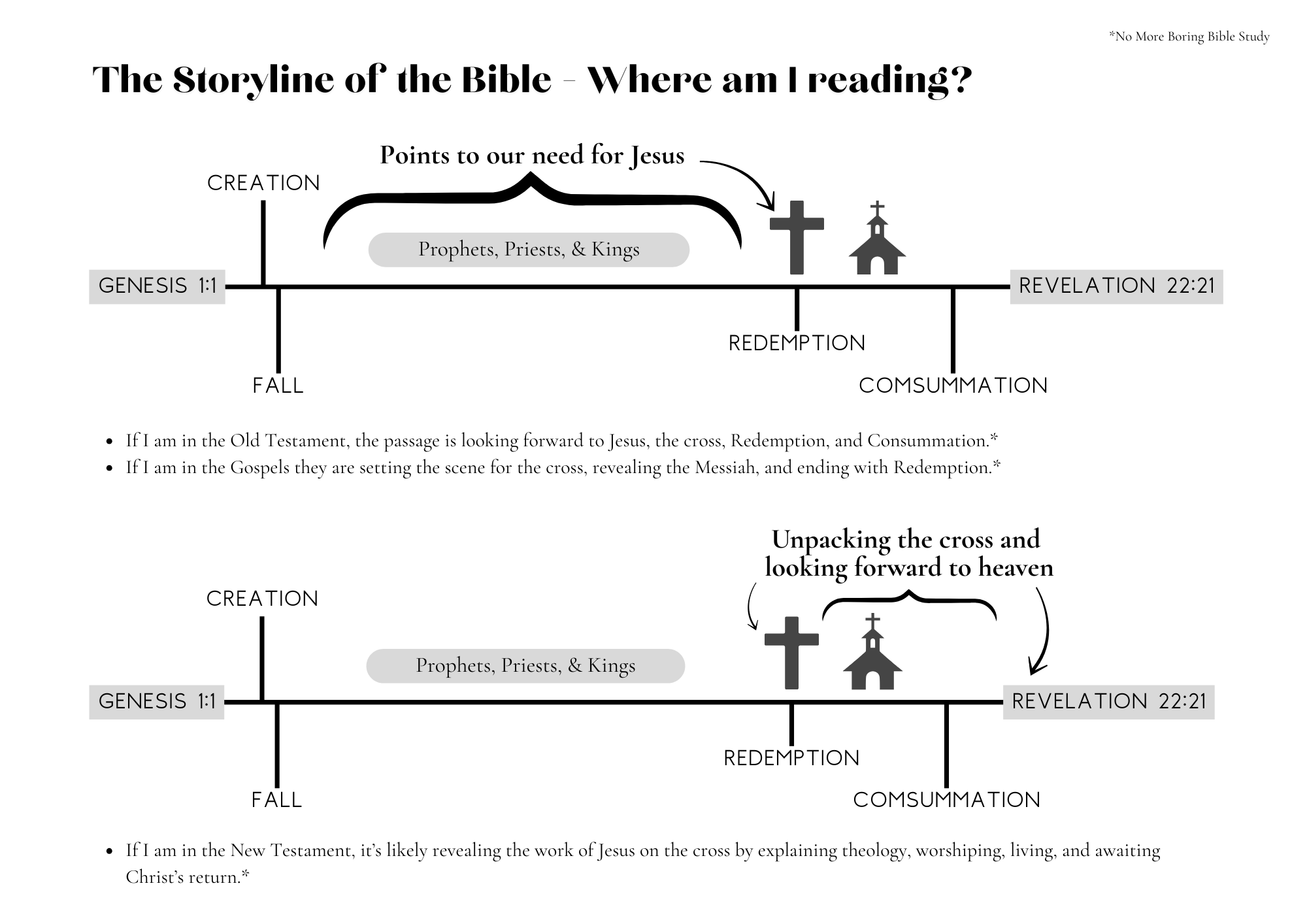
To understand that, we need a framework. The storyline of the Bible unfolds in four great movements:
Creation. Fall. Redemption. Consummation.
1. Creation: The World as It Was Meant to Be
The story begins in Genesis 1–2.
God was before all things.
God created all things.
God ordered all things.
And then He rested.
So often we open these chapters to debate the age of the earth or the mechanics of creation. While those questions matter, they are not the primary point. These chapters show us who God is and who we are.
Creation reveals:
- God’s sovereignty and wisdom
- The goodness of His design
- Humanity made in His image
- Intimate, unbroken fellowship between God and man
Adam and Eve walked with God in the garden. There was no shame, no fear, no striving. That garden was not merely a location—it was the picture of peace, wholeness, and communion with God.
And here is why Creation still matters to us today:
The tension we feel in our bones—the ache, the restlessness, the longing—is evidence that we were made for more than this fractured world. We were made for Eden.
Throughout Scripture, the writers look back to Creation as a picture of what was lost and what God intends to restore. But the good news is that God is not simply taking us back to the garden. He is bringing us forward to something even greater.
2. The Fall: What Went Wrong
In Genesis 3, everything changes.
When Adam and Eve eat the forbidden fruit, sin enters the world. Death, sickness, suffering, shame—these are not natural features of God’s good design. They are the result of rebellion.
The Fall explains the undeniable reality of human experience:
- Why creation groans
- Why relationships fracture
- Why we hurt and are hurt
- Why we feel distance from God
The most tragic consequence of the Fall is not physical death—it is spiritual separation.
And the era of the Fall stretches from Eden all the way to the cross.
But even in judgment, God begins redemption.
When Adam and Eve sin, God kills an animal to clothe them. Blood is shed. Covering is provided. A promise is made. That thread of redemption begins immediately.
Throughout the Old Testament, we see:
- God making covenants
- God choosing unlikely people
- God keeping promises despite human failure
He promises Abraham a nation—and swears it by Himself while Abraham sleeps (Genesis 15).
He rescues Israel from Egypt before giving them the Law.
He establishes David’s throne despite David’s sin.
Again and again we see sinners being sinners—and God being God.
The Law given through Moses does not save; it exposes. It shows us the standard no one can keep and prepares us for the One who will.
Every prophet, priest, and king in the Old Testament leaves us longing:
- We need a better prophet.
- We need a perfect priest.
- We need a righteous king.
The Old Testament is not a random block of history where God was just “doing stuff.” It is a tapestry. Every thread is woven toward Christ.
3. Redemption: The Cross at the Center
Redemption means to ransom—to buy back.
What was the price?
The blood of Christ.
Where was the exchange made?
The cross.
The four Gospels move steadily toward that hill. Everything accelerates toward the crucifixion and resurrection. The cross is not an unfortunate ending—it is the centerpiece of history.
As Romans 5:18 explains, one act of righteousness results in justification and life.
Jesus:
- Fulfilled the Law we could not keep
- Lived the life Adam failed to live
- Died the death we deserved
- Rose to defeat the grave
And then He ascended, promising the Holy Spirit. Now, through the Spirit, believers experience something even closer than Eden—God dwelling not merely beside us, but within us.
We cannot understand the cross without Creation and the Fall. The cross only makes sense when we understand:
- What we were made for
- What we lost
- How helpless we were to restore it
Everything shifts at Redemption.
If we do not understand what Jesus fulfilled, we will not understand why He is “the way.” He is the way because He accomplished what the Law required, what the sacrifices symbolized, and what the covenants promised.
The Old Testament:
- Anticipates.
- Foreshadows.
- Prepares.
The New Testament:
- Reveals.
- Explains.
- Applies.
Jesus is the true Prophet, the final Priest, and the eternal King. He is everything the Old Testament proclaimed we needed.
When we grasp this, we are guarded against false doctrine. We stop reading isolated verses detached from the grand story. We interpret each passage in light of Christ’s finished work. He becomes the interpretive center.
4. Consummation: The Story’s Glorious End
The final movement is Consummation—the final righting of all wrongs.
We live in what theologians call the “already and not yet.” Christ has secured victory, but sin’s effects remain until He returns.
In Revelation 21–22, we see the new heaven and the new earth. Every tear wiped away. Death no more. Curse removed.
Notice how the Bible ends not in a garden lost—but in a garden-city restored and glorified.
The Consummation is not a random happy ending. It is the completion of everything set in motion at Creation and secured at the cross.
You cannot:
- Long for heaven without understanding the Fall.
- Celebrate the cross without understanding Creation.
- Understand Revelation without understanding redemption.
All four movements are inseparably connected.
How This Shapes the Way We Read the Bible
When we hold this framework—Creation, Fall, Redemption, Consummation—we read Scripture differently.
- If we are before Genesis 3, we are seeing God’s design.
- If we are between Genesis 3 and the cross, we are seeing humanity under the curse and God preparing redemption.
- In the Gospels, we are witnessing redemption accomplished.
- In the Epistles, we are learning what redemption means for doctrine, worship, suffering, and daily life.
- In Revelation, we are seeing redemption completed.
The Bible is the sweeping story of God redeeming His people for His glory.
The Old Testament deepens the New. The New Testament unveils the Old. Without the Old, we miss the weight of our need. Without the New, we miss the fulfillment of the promise.
From beginning to end, Scripture tells one unified story.
And when we read it with unveiled faces—through the lens of Jesus—we see Christ in all of Scripture.
If you’d like to explore this topic a little deeper—without wading into overly academic territory—No More Boring Bible Study by Faith Womack is a wonderful resource. It’s an approachable introduction to hermeneutics, the art of rightly interpreting Scripture.
In her book, she encourages readers to print the biblical storyline chart and turn it into a bookmark as a simple tool for reading the Bible with the big picture in view. I loved that idea, so I made one for myself.
I hope it blesses you as much as it has blessed me.