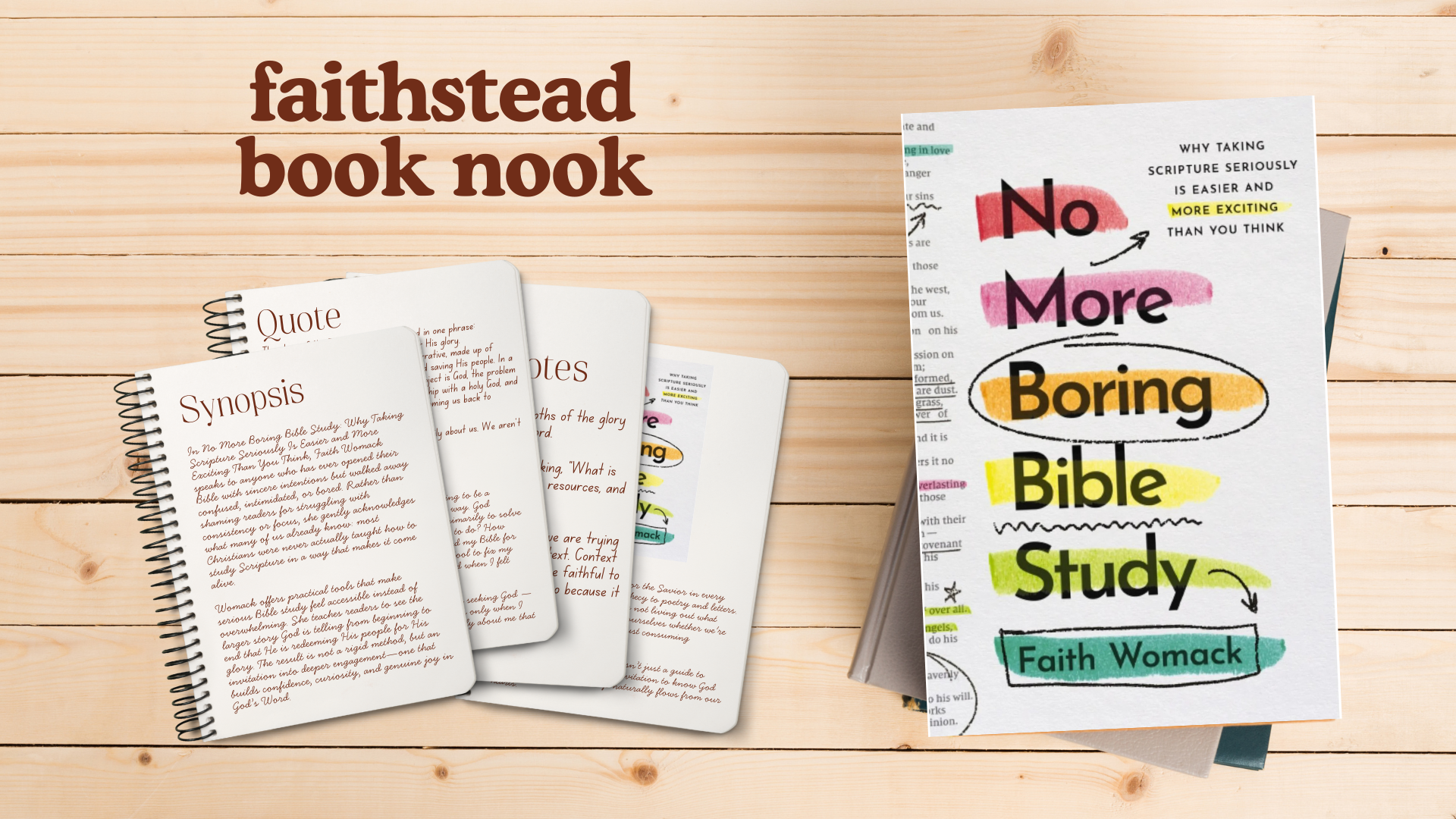
In No More Boring Bible Study: Why Taking Scripture Seriously Is Easier and More Exciting Than You Think, Faith Womack speaks to anyone who has ever opened their Bible with sincere intentions but walked away confused, intimidated, or bored. Rather than shaming readers for struggling with consistency or focus, she gently acknowledges what many of us already know: most Christians were never actually taught how to study Scripture in a way that makes it come alive.
Faith offers practical tools that make serious Bible study feel accessible instead of overwhelming. She teaches readers to see the larger story God is telling from beginning to end that He is redeeming His people for His glory. The result is not a rigid method, but an invitation into deeper engagement—one that builds confidence, curiosity, and genuine joy in God’s Word.
Quote:
Hermeneutics is a guardrail that keeps us in line with what the text is actually saying in Exodus 20, for example, so that we don’t misuse it and make it into a curse, like my dad did. Hermeneutics is what guides us as we listen to a sermon, helping us determine whether the preacher is being faithful to the text.
Hermeneutics is also what prevents us from hurting others and wrecking our own lives.
Reflection:
What makes this book especially powerful is Faith’s vulnerability. She shares how the misuse of Scripture deeply shaped her life, particularly as her father twisted biblical texts to justify harmful behavior. That misuse didn’t just create confusion—it caused real damage. Her story underscores a sobering truth: how we handle Scripture matters. If we truly believe the Bible is God’s Word, then faithfulness to the text is not optional. It is essential.
That theme resonated deeply with me. I, too, have experienced what it’s like to read Scripture the wrong way and to suffer under its misuse. While there is more than one right way to study and read Scripture, there are definitely many wrong ways to read Scripture as well. Womack’s book is not just about making Bible study more interesting; it’s about reclaiming the beauty and integrity of God’s Word. She reminds readers that studying the Bible carefully isn’t about becoming academic—it’s about honoring and worshiping God, protecting ourselves and others from distortion, and discovering the life-giving truth Scripture was always meant to offer.
Quote:
The story of the Bible can be summarized in one phrase: the story of God redeeming His people for His glory. When you look at the Bible as one big narrative, made up of smaller stories, you’ll see it is all about God saving His people. In a perfect three-act story structure, the subject is God, the problem is our sin that has corrupted our relationship with a holy God, and the story arc is of God rescuing and ransoming us back to himself.
Did you catch that? The Bible isn’t primarily about us. We aren’t the main characters.
Response:
This is such an important point. If the Bible is ultimately about God redeeming His people for His glory, then everything changes. When we place our faith in Him, our posture should become God-centered — not self-centered. Our lives begin to revolve around Him, not the other way around.
For much of my life, even while claiming to be a Christian, I lived in a very me-centric way. God revolved around me. I went to Him primarily to solve my problems: What does God want me to do? How should I handle this? I’ll pray. I’ll read my Bible for answers. I approached Scripture as a tool to fix my circumstances or calm my anxiety. And when I felt fine? I didn’t come to God at all.
Looking back, I see that I wasn’t really seeking God — I was seeking relief.
Similarly, the church I grew up in was deeply church-centric. Scripture was often used to validate our traditions, reinforce our leaders’ direction, or confirm what we already believed. The Bible functioned more as a stamp of approval than as a revelation of who God truly is.
It’s no wonder I didn’t have a genuine hunger to know God. I didn’t actually know Him. I didn’t understand that the Bible wasn’t given to comfort or confirm me, but to reveal Him — His character, His holiness, His mercy, His glory. It wasn’t primarily about finding myself in the story. It was about seeing Him rightly.
And ironically, it’s only when I began to see that the Bible isn’t primarily about me that my relationship with God became real. When God became the center of the story again, everything else finally started to fall into place.
Quote:
Some people tell me they don’t use resources in Bible study because the Holy Spirit is the only thing believers need to understand the Word, often misusing 1 John 2:27. While I believe in the perspicuity of Scripture (this is a term that means Scripture is clear enough for anyone to understand salvation), I am not going to act as if the Holy Spirit downloads information on the exile and imports it into my brain when I read Isaiah 50.
If we believe the Bible is true, we will engage joyfully in the studious “work” of making sure we are faithful to it.
Response:
I really appreciated her clarity on this because I’ve encountered people on both extremes.
On one end, some treat the Bible as if it contains hidden mysteries that ordinary believers simply can’t access. In that view, Scripture can only truly be understood through someone with special revelation, a higher calling, or unique spiritual authority. That approach quietly undermines the sufficiency and clarity of God’s Word.
On the other end are those who assume study itself is unnecessary — that the Holy Spirit will simply reveal whatever we need in the moment, apart from context, history, or careful reading. But that mindset can easily become an excuse for laziness or even subjective interpretation. The Spirit does guide us into truth, but He does not bypass the means God has given us — language, history, community, teachers, and thoughtful study.
What I appreciate about this quote is the balance. Yes, Scripture is clear enough to understand the gospel. Yes, we depend entirely on the Holy Spirit for illumination. But believing those truths should not make us passive. If anything, it should make us eager. If this really is God’s Word, then engaging deeply with it isn’t a burden — it’s a privilege.
Faithfulness requires effort. Not because God is hiding truth from us, but because He invites us to seek Him with our minds as well as our hearts. And that kind of study isn’t opposed to the Spirit — it’s empowered by Him.
Quote:
While many simplify the book of Jonah down to the general lesson of “Don’t disobey God,” there is so much more going on in the text.
Notice the similarities between Jonah and Christ; Both were from Galilee, both preached to Jews and gentiles, both slept in boats during a story, both had lots cast over them, both spent three days in a lowly place – Jonah in the belly of the fish and Jesus in a tomb, and both were called to prophesy truth.
Response:
When you read the Bible in a Christ-centered way, you begin to see that it is far more than a book of moral lessons. Jonah isn’t simply a warning about disobedience — it’s a story that exposes our hearts and ultimately points us to Christ.
Do we see ourselves in Jonah? As humans, we are deeply shaped by our upbringing, culture, and sense of justice. If you were in Jonah’s position and God told you to go preach repentance and extend mercy to a people who had brutally oppressed your nation in cruel and violent ways, would you go? Many of us struggle to forgive far smaller offenses from friends or family members.
Jonah’s reaction feels painfully human. In fact, it feels reasonable. From a purely moral standpoint, the Ninevites deserved justice. They were violent and wicked. They did not deserve mercy. If we assume we would have responded more righteously than Jonah, we may not fully understand the historical context — or the depth of human instinct for justice when wronged.
But the story doesn’t end with Jonah’s anger. It points beyond him.
Jonah is a shadow; Jesus is the greater Jonah. Where Jonah ran, Jesus came willingly. Where Jonah begrudged mercy, Jesus extended it freely. Jonah spent three days in the depths because of his disobedience, but Jesus spent three days in the grave because of ours — without grumbling and without reluctance. He did willingly what Jonah resisted, and He did it for the undeserving.
And here’s the humbling question: Are we only Jonah in the story, or are we also Nineveh? Do we recognize ourselves as those who did not deserve the salvation Christ went to such great lengths to accomplish?
When you truly see that, the story moves from moral instruction to worship. Justice was deserved — mercy was given. And that realization reshapes everything.
There were a lot of wonderful quotes in the book, here are just a few:
If we really believe that the Bible is true, we will want to be faithful to it, changed by it, and not misuse it.
Let’s feast on the depths of the living and active Word of God by studying it for what it says, not what we choose to read into it.
A good exegesis of the Bible will not lead us farther into our self-centeredness but inspire us to worship.
Historical narrative in the Bible is never just historical, because there is always a theological function. This means that all of these stories exist to inform the way we think and believe about God.
His dying is our living.
The Psalms are not mere poetry or songs, they are theological testimonies.
Our priorities reveal our idols. Our distractions reveal our doubts. Our goals reveal our worship. Our neglect reveals our disbelief.
We will never exhaust the depths of the glory of God in the Word.
Faithfully living to Jesus is asking, “What is faithful stewardship of my time, resources, and abilities today?
Context isn’t important because we are trying to be politically correct with the text. Context is important because we want to be faithful to the text (and not misuse it), but also because it adds so much depth.
Last Thoughts
Faith also teaches readers to see the Bible’s main storyline — Creation, Fall, Redemption, and Consummation — and to look for the Savior in every genre, from history and prophecy to poetry and letters. She reminds us that “if we are not living out what we’re reading, we have to ask ourselves whether we’re truly studying Scripture or just consuming information. God’s Word was never meant to stop at understanding – it’s meant to shape how we live.”
No More Boring Bible Study isn’t just a guide to reading Scripture — it’s an invitation to know God deeply enough that worship naturally flows from our hearts.