All Nations Will Be Blessed
Long ago, in the ancient city of Ur, where great ziggurats rose toward the heavens and incense drifted through temples devoted to many gods, there lived a man named Abraham.
It was after the time of Noah’s flood and the tower of Babel, and people were spreading across the earth—divided into nations and languages. Cities rose and fell, and kingdoms fought for glory.
And yet, into that fractured world, the voice of the one true God suddenly called out to Abraham:
“Go from your country, your people, and your father’s household to the land I will show you.”
It was not merely a command to travel. It was an invitation into a story.
Abraham was called to leave behind everything familiar—the land he knew, the gods of his people, and the security of his home—and walk toward a promise only God could fully see.
And then came the promise itself. A promise so vast that Abraham could scarcely have understood it at the time:
“I will make you into a great nation. I will bless you and make your name great, and you will be a blessing. I will bless those who bless you, and all the families of the earth will be blessed through you.”
Not only one nation. Not only one people.
But all the families of the earth.
From the very beginning, this was always God’s heart—to bless all the families of the earth through His promise.
Abraham’s family, which later became known as Israel, was never chosen because God stopped loving the rest of the world.
Rather, Israel was chosen as the covenant people through whom God would bring His promises—and ultimately the Messiah—into the world, so that blessing would reach every nation.
Through Abraham’s descendants would come prophets, covenants, promises—and ultimately, Jesus Christ.
Like rivers flowing outward from a spring, God’s plan of redemption was always moving toward the nations.
In a world filled with idols, violence, and false gods, God called Israel to be different.
He gave them laws and commandments that set them apart from the surrounding nations.
He taught them about what was clean and unclean, holy and common, pure and impure.
Even their food, worship, clothing, sacrifices, and daily lives were meant to remind them:
“You belong to the Lord.”
These commands were never meant to create pride or superiority.
They were meant to form a holy people who reflected God’s character in the world.
Israel was meant to be like a light shining in the darkness—distinct from the nations, yet pointing the nations toward the true God.
As centuries passed, the people of Israel became known as the Jews. And everyone outside this covenant family was known as the Gentiles.
The Gentiles were simply the nations beyond Israel—Romans, Greeks, Egyptians, Syrians, and many others across the world.
But by the time of Jesus and the apostles, that separation gradually became a dividing wall and the distance between Jew and Gentile felt enormous.
Since the Gentiles did not follow the laws God had given Moses, worshiped other gods, and ate foods that God had commanded Israel not to eat, many Jewish people tried to remain separate from them.
At first, it wasn’t about seeing Gentiles as “bad people.” It was more about trying to remain faithful to God’s commands and avoid becoming “unclean.”
And being “unclean” did not always mean someone had sinned or was bad.
It meant a person was not in a condition to participate in worship at the temple until they had been cleansed according to God’s law.
And God’s laws reminded Israel that they belonged to God and were called to live differently from the nations around them.
But over time, the people of Israel misunderstood God’s laws in ways He never intended.
What was meant to shape them into a humble, holy people began to harden into something else.
The separation God gave them was meant to protect their worship and keep them faithful. But instead of simply being set apart in how they lived, many began to think they were better than others.
So rather than being a light to draw the nations in, the separation became a wall that pushed people away.
Many began to avoid the Gentiles completely—they avoided sharing meals and entering each other’s homes.
And yet, beneath centuries of division, the ancient promise to Abraham was still alive:
“In you all the families of the earth shall be blessed.”
One day, somehow, the nations would be brought near.
And generations later, in a house belonging to a Roman centurion named Cornelius, that ancient promise would begin unfolding in a way that would change the world.
Keys to the Kingdom
Hi Sojourners! Welcome to Part 3 of our Keys to the Kingdom series.
In the last two episodes, we followed the gospel as the kingdom of God began spreading from Judea to Samaria and today we’re going to follow it as it spreads to the end of the earth.
When Jesus was still on earth, He said something remarkable to the Apostle Peter: “I will give you the keys to the kingdom of heaven. What you lock on earth will be locked in heaven. What you unlock on earth will be unlocked in heaven.”
Jesus was not telling Peter that he got to decide who could or could not enter the kingdom of heaven.
Rather, Peter was being entrusted with a special role in the opening moments of the church — He would be a witness and servant through whom God would publicly open the doors of the kingdom through the preaching of the gospel.
Peter was there on the day of Pentecost when the Holy Spirit came upon the believers in Jerusalem among the Jews.
Peter was also there when the Holy Spirit came upon the Samaritans in Samaria.
And now, in this final episode of our series, we will see Peter standing there once again as the Holy Spirit is poured out upon the Gentiles—the nations extending to the ends of the earth.
The kingdom doors are opening wider and wider, just as Jesus promised they would.
An Angel Speaks to Cornelius
Our story today begins in a city by the sea called Caesarea.
There lived a Roman centurion named Cornelius.
A centurion was an officer in the Roman army who commanded about one hundred soldiers.
Rome ruled over much of the world at that time, including the land of Israel, so centurions were powerful men and symbols of the Roman Empire itself.
And yet, this Roman soldier was about to become part of a story far greater than the empire he served.
Cornelius was not a Jew and he had no covenant lineage from Abraham. No, he was a Gentile, an outsider.
And yet, something was stirring in his heart.
Cornelius feared the God of Israel.
He prayed often and gave generously to those in need.
And one afternoon, while he was praying…
Heaven interrupted his story.
An angel of God appeared before him.
Cornelius stared in fear as the messenger called his name.
Your prayers and gifts to poor people are like an offering to God. So He has remembered you.
Then the angel gave him a strange instruction:
Now send men to Joppa. Have them bring back a man named Simon. He is also called Peter. He is staying with another Simon, a man who works with leather. His house is by the sea.
Cornelius did not yet understand what God was about to do.
But immediately, he obeyed.
He called two of his servants. He also called a godly soldier who was one of his attendants. He told them everything that had happened. Then he sent them to Joppa.
And while these men traveled down the dusty roads between Caesarea and Joppa, God was already preparing Peter for their arrival.
Peter’s Vision
The next day, around noon, Peter climbed to the rooftop of the house where he was staying to pray.
The sun hung high over the sea.
The wind carried the smell of salt through the city streets below.
As Peter prayed, he became hungry while the meal below was being prepared.
Then suddenly, heaven opened and Peter saw a vision.
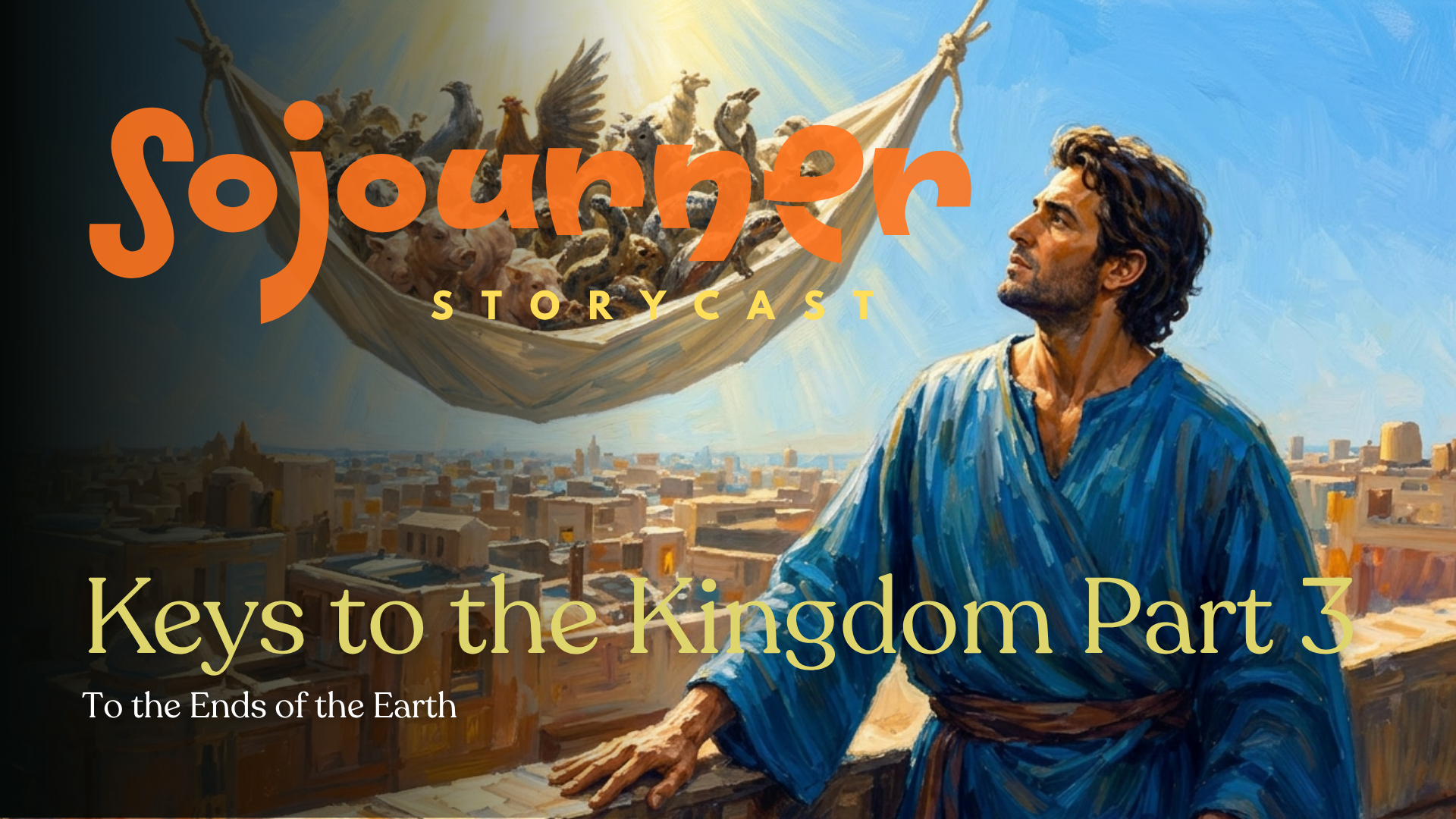
There he saw something that looked like a large sheet. It was being let down to earth by its four corners. It had all kinds of four-footed animals in it. It also had reptiles and birds in it. The Bible doesn’t describe what kind of animals he saw, but they may have been spitting camels, squealing pigs, monitor lizards crawling across the cloth, and bats and hawks flapping their wings overhead.
And then a voice told him:
“Get up, Peter. Kill and eat.”
Peter was shocked. These animals were called “unclean” in God’s Law and Jewish people had never been allowed to eat them.
“No, Lord! I will not!” Peter replied. “I have never eaten anything that is not pure and clean.”
But the voice spoke again:
“What God has made clean, do not call unclean.”
Three times the vision came. Three times the command was repeated. And then the sheet was taken back into heaven.
Peter sat there in wonder, trying to understand what the vision could possibly mean.
But downstairs, at that very moment, the messengers from Cornelius were standing at the gate.
Then the Holy Spirit spoke to Peter: Three men are looking for you. Get up and go downstairs. Don’t let anything keep you from going with them. I have sent them.”
So Peter rose and went down to the gate. There stood the servants of Cornelius, dusty from their journey and they explained everything:
the prayers of Cornelius,
the angel’s appearance,
and the invitation to come to Caesarea.
Peter must have felt the weight of it all settling slowly upon him.
They were Gentiles.
Roman Gentiles.
And yet the Spirit had said:
“Go with them.”
So Peter welcomed the men inside and gave them lodging for the night.
Even this small act was unusual.
The dividing wall was already beginning to crack.
The Gentiles Receive the Holy Spirit
The next morning, Peter set out with them toward Caesarea, accompanied by several Jewish believers from Joppa.
The road stretched north along the coast of the Great Sea.
And with every step, Peter walked closer to something generations of Jewish people could scarcely have imagined.
Back in Caesarea, Cornelius waited eagerly. He had gathered his relatives and close friends inside the house, filling the rooms with expectation and whispered questions.
What would this man Peter say? Why had God sent for him?
Then at last, Peter arrived.
The door opened.
A Jewish apostle stood at the entrance of a Gentile home.
It may have seemed like a small moment to the outside world.
But history itself was turning on its hinge.
As a sign of respect, he fell at Peter’s feet. But Peter made him get up. “Stand up,” he said. “I am only a man myself.”
Then Peter looked around at the gathered Gentiles and said, “You know that it is against our law for a Jew to enter a Gentile home. A Jew shouldn’t have any close contact with a Gentile. But God has shown me that I should not say anyone is not pure and clean.”
At last, Peter was beginning to understand the vision.
The sheet from heaven had never merely been about animals.
God was speaking about people.
The ancient dividing wall between Jew and Gentile was beginning to fall.
Peter then said, ‘“I now realize how true it is that God treats everyone the same. He accepts people from every nation. He accepts anyone who has respect for him and does what is right.”
And there, inside the home of Cornelius, Peter began to preach the good news about Jesus Christ:
how He lived,
how He died upon the cross,
how God raised Him from the dead,
and how forgiveness of sins is offered to all who believe in His name.
And while Peter was still speaking…something astonishing happened.
The Holy Spirit came on all who heard the message. The Jewish believers that had come with Peter were amazed because the gift of the Holy Spirit had been poured out even on the Gentiles just like it had on the day of Pentecost in Jerusalem. They heard them speaking in languages they had not known before. They also heard them praising God.
God had given His Holy Spirit to Gentiles too.
Not because they had first become Jewish.
Not because they had earned it.
But because they believed in Jesus.
In that moment, Peter finally understood the meaning of the vision God had shown him on the rooftop. He was showing Peter that the good news of Jesus was for every kind of person. The kingdom of God was bigger than Peter had imagined.
It was not only for people from Jerusalem.
Not only for the people of Israel.
But for every nation,
every language,
every background,
and every person who would trust in Jesus Christ.
Then Peter said to the believers with him,
“Surely no one can keep these people from being baptized with water. They have received the Holy Spirit just as we have.”
And so Cornelius, his family, and many others were baptized in the name of Jesus Christ. Then they asked Peter to stay with them for a few days.
Jesus Breaks the Dividing Wall
Sojourners, do you realize how huge this moment was?!
For a very long time, the Jewish people had been set apart by God. They had special laws, special promises, and special signs that reminded them they belonged to Him.
But those laws were always pointing toward something greater — a time when people would no longer be made clean by food rules or outward rituals, but by Jesus Christ Himself, who would take away sin once and for all and make hearts truly clean before God.
You see, the laws were like a picture book God gave His people. Every sacrifice, every washing, every rule about clean and unclean was teaching them something important: “You need cleansing that you cannot do for yourself.”
Hands could be washed, but hearts could not. Clean clothes could be worn, but sin still remained inside. So the laws kept pointing forward like arrows, saying, “Look ahead… God is going to provide a true and final way to make people clean.”
That “way” is Jesus.
When Jesus came, He didn’t just teach about God’s forgiveness — He became the sacrifice that brings forgiveness. On the cross, He took the sin of the world onto Himself. And when He rose again, He showed that sin and death had been defeated for good.
That is why what happened in Cornelius’s house was so amazing.
The Holy Spirit did not wait for the Gentiles to become Jewish first.
God did not tell them,
“First learn all the Jewish customs.”
“First follow all the ceremonial laws.”
“First become a Jew.”
No.
They simply believed the good news about Jesus.
And God welcomed them.
The moment they trusted in Christ, God gave them the same Holy Spirit He had given the Jewish believers.
That was God’s way of announcing to everyone:
“These people belong to Me too.”
This was not Peter’s idea.
This was God’s idea.
God Himself showed Peter that the dividing wall between Jew and Gentile was coming down because of Jesus.
Key Scripture
Ephesians 2:14-16 says: “For he himself is our peace, who has made us both one and has broken down in his flesh the dividing wall of hostilityby abolishing the law of commandments expressed in ordinances, that he might create in himself one new man in place of the two, so making peace,and might reconcile us both to God in one body through the cross, thereby killing the hostility.”
This passage is saying something amazing about what Jesus did.
For a long time, Jews and Gentiles were separated. There were laws and customs that made them feel far apart from each other. It was like there was an invisible wall between them.
You see, sin had separated all people from God and sin also separated people from each other:
Jews and Gentiles,
rich and poor,
powerful and weak.
When Jesus died on the cross, He didn’t just forgive sins — He also broke down the “wall” that divided people. He made a way for both Jews and Gentiles to come to God the same way: through Him.
That’s why the Bible says Jesus is “our peace.” He is the One who brings people back to God and brings people together as one family.
And when He rose from the dead, He opened the door for anyone who believes in Him to become part of God’s family, not separated anymore, but united because of Jesus.
So what does this mean for us?
It means no one is too far away for God.
No one is “too unclean” for Jesus to forgive.
And no one is outside the reach of His love.
If you have trusted in Jesus, you are part of God’s family — not because of where you came from, but because of what Jesus has done for you.
Peter saw something he would never forget: God does not show favoritism. He accepts people from every nation.
Peter witnessed the door open in Jerusalem, when Jewish believers received the gift Holy Spirit.
He witnessed the door open in Samaria, when the Samaritans received the same gift of the Holy Spirit.
And now, in Cornelius’ house, he witnessed the door open to the Gentiles who also received the gift of the Holy Spirit
From Jerusalem, to Judea, to Samaria, to the ends of the earth — they all received the same gift. One gospel. One Spirit. One family.
If this story encouraged you, share it with a friend so they can hear that Jesus welcomes everyone who comes to Him in faith.
And remember: Peter saw it clearly—when God opens a door, no one can shut it.
Links to podcast: