Welcome to an early morning rambling where I need to visualize my thoughts in writing. And I thought, why not bring you along for the journey? After all, talking to someone is much better than talking to yourself.
I’m a few chapters into reading an allegory called, Hind’s Feet on High Places, and so far it’s been quite thought-provoking. I just finished reading the first volume of The Pilgrim’s Progress with my kids and we’re starting on Christiana’s story in the second volume. We have reaped so many treasures from that. I cannot recommend The Pilgrim’s Progress enough! It really is the second book you should have on your bookshelf after the Bible.
That being said, I’ll admit that I sometimes find allegories quite cheesy. But Hind’s Feet on High Places has been interesting and this particular passage has given me a lot to think about.
Shepherd: No one is allowed to dwell in the Kingdom of Love, unless they have the flower of Love already blooming in their hearts. Has Love been planted in your heart?
Much-Afraid: I think that what is growing there is a great longing to experience the joy of natural, human love and to learn to love supremely one person who will love me in return. But perhaps that desire, natural and right as it seems, is not the Love of which you are speaking?
Shepherd: Then will you let me plant the seed of true love there now?
Much-Afraid: I am afraid. I have been told that if you really love someone you give that loved one the power to hurt and pain you in a way nothing else can.
Shepherd: That is true. To love does mean to put yourself into the power of the loved one and to become very vulnerable to pain, and you are very Much-Afraid of pain, are you not?
Much-Afraid: Yes, very much afraid of it.
Shepherd: But it is so happy to love. It is happy to love even if you are not loved in return, there is pain too, certainly, but Love does not think that very significant.
Much-Afraid: Please, plant Love in my heart now.
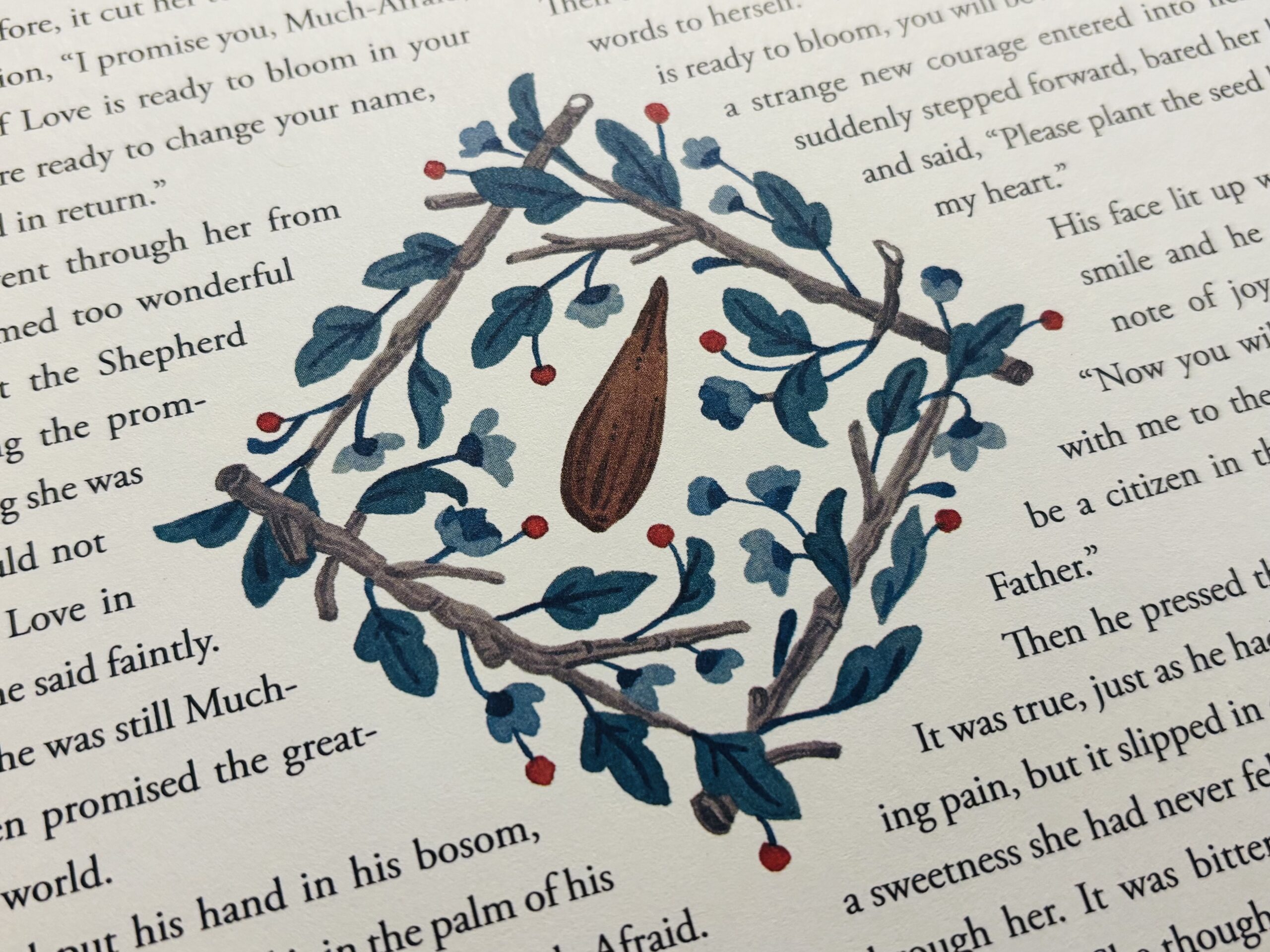
The Shepherd put his hand in his bosom, drew something forth, and laid it in the palm of his hand.
Shepherd: Here is the seed of love.
She bent forward to look, then gave a startled little cry and drew back. There was indeed a seed lying in the palm of his hand, but it was shaped exactly like a long, sharply-pointed thorn. Much-Afraid had often noticed that the Shepherd’s hands were scarred and wound, but now she saw that the scar in the palm of the hand held out to her was the exact shape and size of the seed of Love lying beside it.
Much-Afraid: The seed looks very sharp. Won’t it hurt if you put it into my heart?
Shepherd: It is so sharp that it slips in very quickly. But, Much-Afraid, I have already warned you that Love and Pain go together, for a time at least. If you would know Love, you must know pain too.
I had to pause there for a moment.
To me, the seed of Love is the seed of the gospel. And ever since I heard the gospel—that God so loved the world that He gave His one and only Son, that whoever believes in Him should not perish but have eternal life (John 3:16)—I have felt the effects of that seed taking root and growing within me.
I wouldn’t say that I didn’t love anyone in the past. But if I’m being honest, much of what I called love was really a selfish, self-serving kind of love. It was a love that needed to be loved back in return or else… kind of love.
I loved my husband when he pleased me. I loved my children when they made me look good. I loved my friends when they loved me back. Everything I did in the name of love seemed to require some kind of return on my investment. I might have called it sacrifice, generosity, or devotion, but somewhere beneath it all was the question: What am I getting out of this?
And perhaps worse of all, I loved God because I wanted to be a good person and go to heaven. Even my religion became a transaction. If I did the right things, obeyed the rules, and tried hard enough, surely, I would receive the reward I was after.
Do you see the problem? My love was centered on me. It was a selfish love if there’s even such a thing, for the very nature of love is selfless.
I once attended a talk by Pastor Norm Wakefield, author of Live to Love, in which he shared how the birth of his child with Down syndrome confronted him with the selfishness in his own heart. As I remember his account, he came to recognize how much of what he had called love depended on what another person could give him in return. Here was a child who could not meet those expectations in the ways he had unconsciously come to expect from others, and the experience forced him to reconsider what it really meant to love.
This story has really stayed with me because it exposes something I would rather not admit: we can spend years believing ourselves to be loving people without ever seriously questioning what motivates our love.
It’s easy to love people who make us feel good about ourselves. We can love people who affirm our opinions, appreciate our sacrifices, and make our lives easier. We can even love people who share our faith, provided they fit comfortably within our expectations.
But what happens when they don’t? What happens when our husbands disappoint us, our children embarrass us, our friends misunderstand us, or when people fail to appreciate us? What happens when love costs us something that offers no immediate rewards?
Perhaps this is when the thorn begins to make itself felt. We tend to think of love as something soft and sentimental. We associate it with warm feelings, pleasant relationships, and the happiness of being understood. And those things are certainly a part of love. But love runs much deeper than that. It bares itself vulnerable and gives without demanding payment. Love doesn’t make another person’s worth dependent on what they can offer in return.
This is the love we see displayed on the cross. A love that neither excruciating pain nor the depths of Sheol could extinguish. God’s love for us doesn’t begin with our goodness, obedience, or spiritual achievements. In fact, the truth is quite the opposite. The One who deserved all honor willingly endured humiliation and suffering to save those who had rebelled against Him. While we were still sinners, Christ died for us (Romans 5:8). We were the undeserving recipients of a love we could never earn, a love that reached down into the depts of our sin and death to bring us life.
And there a beautiful a beautiful biblical truth in this. The love that transforms us is a love we receive before we can ever give it rightly to others. John 4:19 tells us, “We love because he first loved us.” That little word because matters. Our love is a response, not a payment. It flows from what we have received, not from an attempt to earn what we lack. As we come to understand more deeply the love of Christ, our own hearts begin to change. We become freer to love others without making them responsible for satisfying every longing in us.
That’s why it’s impossible to manufacture this love by trying harder to become less selfish. We need something deeper than a new resolution or a better set of habits. We need new hearts transformed by the love of Christ.
Am I trying to become a more loving person, or am I learning to live as someone who has been loved by Christ? These two things may sound almost identical, but I think there is a world of difference between them. I think the question isn’t whether we want to love. Most of us do. The question is whether we are willing to receive the kind of love that changes us and whether we are willing to let that love change the way we love the people right in front of us.
Because the seed of true love doesn’t remain a seed forever. It grows. And yet, even this growth is not something we can take credit for. As Paul reminds us, “I planted, Apollos watered, but God gave the growth” (1 Corinthians 3:6). The love that God plants in our hearts, He also cultivates by His grace, until, little by little, our lives begin to bear the fruit of love we have received.
And I could have ended my musings here and we could all go home warm and fuzzy, but I think it’s important to press on a step further. But tread with caution, you might be offended.
If the love of Christ is the only love that can truly transform us, what do we make of the extraordinary acts of self-sacrifice we see in people who do not know Him? What about the mother who, in the desperation of famine, would rather suffer herself than watch her children starve? What about the nonbeliever who wrestles the hijacker to the ground and saves the people around them? What about the countless stories of courage, compassion, and sacrificial love found throughout history, among people of every nation, culture, and religious background?
Scripture itself acknowledges that people who do not know God as they ought can still do things that are good and commendable in the eyes of the world. Jesus says that even sinners love those who love them (Luke 6:32–34). Paul speaks of Gentiles who, though they do not possess the law, sometimes do what the law requires (Romans 2:14–15). Human beings, created in the image of God, retain the capacity to recognize and do genuine good, even in a world deeply marred by sin.
Christians obviously do not have a monopoly on kindness and often times unbelievers seem more loving than believers. But here’s another question: If human beings can produce genuinely good, selfless love independently of God, then in what sense do we need God to transform our hearts? And if someone can be truly good without Him, why would it be just for God to condemn that person for rejecting Him?
I remember hearing about a notorious mobster who was finally arrested. People were relieved, even celebrating, because he had been responsible for so many horrific crimes. Yet as he was taken away to prison, his wife and children wept. Why? Everyone else was cheering, so why were they crying? Because to them, he was a good husband and father. They had experienced his kindness, even while others suffered at his hands.
Do you see the problem? We can be good to the people in our own little world while remaining blind to the harm we do beyond it. We can love our families, be generous to our friends, and even make great sacrifices for people we don’t even know, all while disregarding the One to whom we owe our very lives. We can convince ourselves that we are good people because we measure our goodness by how we live up to our ideals. But what about our relationship with God? What about the love, worship, and obedience we owe our Creator? We may do many admirable things in the eyes of the world, yet none of them can make up for our rejection of Him.
We often imagine that we are the authors of our own moral convictions, that we simply look within ourselves and instinctively know what is right. Yet so much of what we consider good, honorable, or noble is shaped by the moral framework of the culture in which we were raised. What one society celebrates as courage, another may condemn as cruelty. What one generation regards as virtuous, another may recognize as deeply unjust. If our highest authority is ultimately our own understanding of what is good, then we are still living on our own terms. We have decided for ourselves what deserves our devotion, rather than submitting our hearts and lives to the One who made us. We have mistaken goodness on our own terms for righteousness before God.
And this is why we cannot simply weigh our good deeds against our bad ones and hope the good will outweigh the bad. Our problem is not a deficit of good works that we can eventually make up through enough kindness or sacrifice. Our problem is that we have sinned against the God who gave us life and to whom our whole lives belong. No amount of generosity toward our neighbors can undo our rebellion against Him or reconcile us to Him.
The greatest commandment is to love the Lord our God with all our heart, soul, mind, and strength (Matthew 22:37–38). To reject Him is not a small oversight that can be compensated for by being kind to other people. It is a failure at the very center of what we were created to be.
And this is why we need Jesus. He did not come merely to teach selfish people how to become more generous. He came to reconcile sinners to God. He lived the life of perfect love and obedience that we have failed to live, bore the judgment our sins deserve, and rose again so that we might have life in Him. Our good deeds cannot accomplish this. Our moral achievements cannot erase our guilt. We need a righteousness that we cannot produce for ourselves, a forgiveness we cannot earn, and a love that we cannot manufacture.
Only when we are reconciled to God can our seed of love be planted and begin to grow. We no longer have to build our identity around our goodness or prove our worth through our sacrifices. We can love because we have first been loved. We can serve without making our service a means of justifying ourselves. And we can do good not to establish our own righteousness, but out of gratitude to the One who has shown us grace.
That, to me, is the difference between merely trying to be a good person and being transformed by the love of Christ. The gospel does not tell us that our good deeds are enough. It tells us that even our best deeds cannot save us—and then points us to the One who can.
And when we begin to grasp the depth of His love for us, something begins to change. His love is not merely an example for us to imitate or a command we must strive harder to obey. It is a love that overwhelms us, fills us, and overflows from us. The more we come to understand how deeply we have been loved by God, the less we need others to earn our love in return.
And this is where love and pain meet. When our love is rooted in Christ, we can love and still be rejected, give and still be disappointed, open our hearts and still be wounded. The pain does not magically disappear, but neither does it have the final word. Our love is no longer dependent on how another person responds to us, because its source is not found in them. It flows from the inexhaustible love of God. We do not have to manufacture it, bargain for it, or muster enough strength to keep it going. We return to the One who first loved us, and His love overflows again.
Perhaps this is what the Shepherd was teaching Much-Afraid through that little thorn-shaped seed: the love that grows in us through Christ is a love that carries the possibility of pain, yet cannot be extinguished by it. Not because we are strong enough to keep loving, but because we are being filled by a love greater than our own. And as His love takes deeper root in our hearts, we begin to love others not according to what they give us, but out of the abundance of what we have received from Him.
Just some thoughts…