Therefore
The one word that appears again and again throughout Hebrews is: therefore. In Greek, several different words can be translated this way, but they all carry the idea of drawing a conclusion from what has just been said. One of the most common is oun, meaning therefore, then, so, or consequently. In other words: because this is true, this follows. However, the “therefore” that begins Hebrews 3:1 is a different Greek word: othen, but it also means from which, for which reason, or therefore.
And that is one of the defining patterns of Hebrews. The author continually moves from what is true about Christtohow we should therefore respond to Christ. The word “therefore” doesn’t just introduce information, it turns doctrine into action.
Let’s zoom out to the big picture and review what we’ve learned about Jesus so far so we can understand what the word therefore in chapter 3 is taking us.
In chapter 1 we learned that Jesus is:
- God’s Son
- Heir of all things
- Creator the world
- Sustainer of all things
- One who made purification for sins
- Exalted above the angels
Therefore, chapter 2 warns us that we:
- Must pay much closer attention
- Must not drift away
- Must not neglect such a great salvation
Chapter 2 continues to teach us that Jesus:
- Became our brother
- Suffered and died
- Destroyed the power of death
- Became our merciful and faithful High Priest
Then the author draws the conclusion in the beginning of chapter 3:
Therefore, consider Jesus.
The “therefore” is the bridge between truth and response. What we believe about Christ is never merely information. Because these things are true about Jesus, something must follow in the way we think, believe, persevere, and live. And that’s why I’m taking the time to list out all of Jesus’ attributes and highlight the word therefore, because every time we learn something, we must ask what difference this truth makes. If Jesus is truly better, greater, and more glorious than anyone or anything else, then we cannot simply admire those truths and move on. Truth demands a response.
The question Hebrews keeps putting before us is not simply, “Do you know this is true?” but “If this is true, how should you respond?” The goal is not to manufacture the right response through our own effort, but to let the truth about Christ take root in us so that, by faith and through the work of the Holy Spirit, our lives increasingly reflect what we believe.
If you’d like to slow down and work through The Therefore Trail for yourself, I’ve created a four-page PDF to help you trace the pattern through Hebrews 3–4.

Faithful in the House
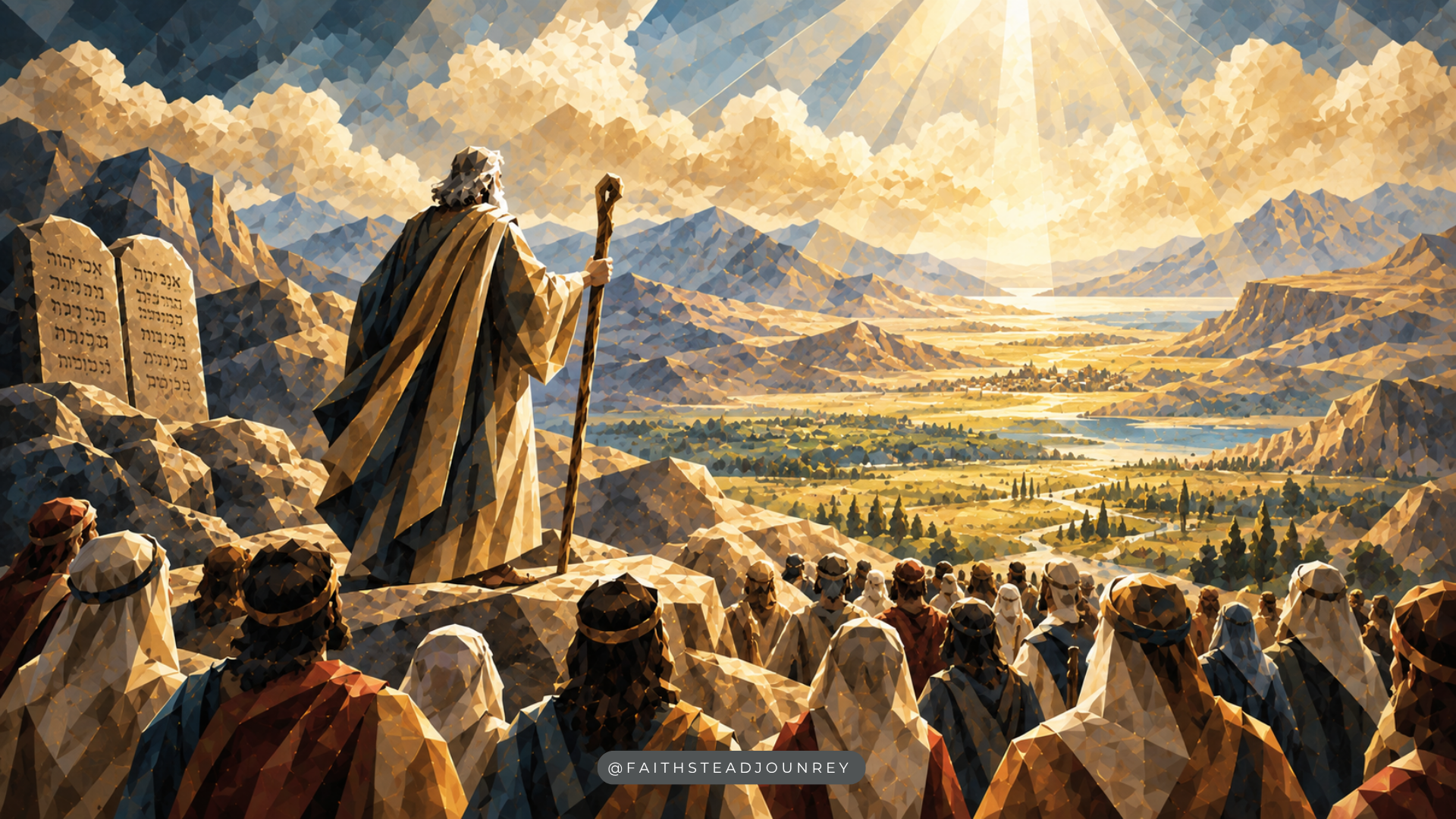
Hebrews now turns to someone much closer to home for these Jewish believers: Moses.
Moses was not a bad leader whom Jesus came to replace. He was one of the most faithful servants in the history of God’s people. Hebrews goes out of its way to say so:
“Moses also was faithful in all God’s house.” — Hebrews 3:2
The author is not creating a contrast between a faithless Moses and a faithful Jesus. Both were faithful. The difference is in who they were and what position they held within God’s house.
Hebrews gives us two pictures:
Moses was faithful in God’s house as a servant.
Christ is faithful over God’s house as a Son.
Moses = servant
Christ = Son
The author then gives us a simple illustration:
“For Jesus has been counted worthy of more glory than Moses—as much more glory as the builder of a house has more honor than the house itself.” — Hebrews 3:3
I remember visiting one of Frank Lloyd Wright’s homes and being struck by the way the rooms seemed to flow naturally into one another and how the house itself seemed to blend into its natural surroundings. As we walked through, we admired the craftsmanship—the lines, the contours, the way every detail seemed thoughtfully placed.
But our greatest admiration wasn’t directed toward the house itself. We praised the architect. The beauty of the house revealed the brilliance of the one who designed it. Every detail gave us another reason to appreciate the mind behind it. The house is evidence of the builder.
In the same way, Moses was a faithful part of God’s household, but he was never the builder of that household. Jesus is.
And Hebrews goes even further:
“For every house is built by someone, but the builder of all things is God.” — Hebrews 3:4
The point is not merely that Jesus outranks Moses on a leadership chart. The point is that Jesus belongs on the Creator side of the distinction, while Moses belongs on the creature side.
A Servant Who Pointed Forward
But there is another beautiful detail here. Moses’ faithfulness was not pointless or temporary. Hebrews says that Moses served:
“to testify to the things that were to be spoken later.” — Hebrews 3:5
Moses’ ministry was pointing beyond himself. The tabernacle, priesthood, sacrifices, covenant, and even the wilderness journey belonged to a larger story. Moses was serving within that story, but he was not the destination. Moses was a servant bearing witness to what was coming. Christ is the Son who fulfills what Moses anticipated.
That changes the way we should read the Old Testament. We don’t have to choose between Moses and Jesus, as though honoring Christ means dismissing Moses. Moses was faithful because he faithfully pointed God’s people toward Christ. However, Moses’s testimony finds its fulfillment in the Son.
And We Are His House
“But Christ is faithful over God’s house as a son. And we are his house…” — Hebrews 3:6a
This is where the passage becomes personal. The house is no longer primarily a building or a physical structure. God’s people are His house. And notice the order. We do not become God’s house because we have managed to prove ourselves worthy. We belong to Christ because Christ is the faithful Son over God’s house.
Our confidence is not in our own faithfulness. It is in His. But Hebrews does give us a mark of genuine faith:
“if indeed we hold fast our confidence and our boasting in our hope.” — Hebrews 3:6b
So what exactly are we holding fast to?
Our confidence is in Jesus Christ and what He has already done. Our hope is in Jesus Christ and what He will yet do.
Our confidence rests on the finished work of Christ—His perfect obedience, His sacrifice for our sins, and His victory over death. We don’t have to manufacture our own righteousness or wonder whether we have done enough. Christ has done what we could never do.
And our hope looks forward to what Christ has promised to finish. The story is not over. The Son who came once will come again, and He will bring His people into the glory He has promised.
So our confidence looks backward to the finished work of Christ, while our hope looks forward to the completion of His promises. Both are fixed on the same Person.
Jesus is our confidence. Jesus is our hope. Hold fast to Jesus.
The Wilderness Warning
“Therefore, as the Holy Spirit says,
‘Today, if you hear his voice,
do not harden your hearts as in the rebellion,
on the day of testing in the wilderness,
where your fathers put me to the test
and saw my works for forty years.
Therefore I was provoked with that generation,
and said, “They always go astray in their heart;
they have not known my ways.”
As I swore in my wrath,
“They shall not enter my rest.”’”
—Hebrews 3:7–11
Sometimes I’m a bit slow, and it took me a while to see the connection the author was making here. He has just spent the first part of the chapter telling us that Jesus is greater than Moses, and then suddenly he begins talking about the Israelites in the wilderness. At first, I wondered, What does this have to do with Jesus being better than Moses?
But then I saw it. Moses was a faithful servant who led God’s people, yet those who refused to trust God under his leadership faced dire consequences and did not enter His rest. How much more, then, should we who have received the fullness of God’s revelation in Christ hold fast to Christ, the faithful Son over God’s house.
When I was younger, I remember thinking, If I had actually seen the Red Sea part with my own eyes, I would never doubt God. Then I grew up and realized something rather humbling: I’m just as fickle as the Israelites. In fact, unbelief seems to be the default setting of the human heart. We can see God’s faithfulness and still doubt Him when circumstances become frightening or difficult.
The Israelites had experienced God’s faithfulness in extraordinary ways. They had witnessed His power in Egypt. They had walked through the Red Sea on dry ground. They had watched Him provide manna from heaven and bring water from a rock. They had every reason to trust Him. And yet, when difficulty came, they complained and doubted the very God who had already proven Himself faithful.
Their problem wasn’t a lack of evidence. They had seen enough. Their problem was that they hardened their hearts. They heard God’s voice, but they refused to trust what He said.
Today, the same warning still rings loud and clear to us. We can hear God’s Word week after week. We can know the stories. We can understand the doctrine. We can even experience God’s faithfulness in our own lives. And yet our hearts can remain harden towards Him.
A Hardened Heart
A hardened heart doesn’t necessarily begin with open rebellion. Sometimes it begins with a quiet refusal to believe God when obedience becomes costly.
We know what God has said, but then circumstances become frightening, obedience becomes difficult, or trusting Him means giving up something we desperately want. And in that moment, we begin to reason with ourselves: Surely God doesn’t mean this. Surely I need to protect myself. Surely I can’t trust Him with this.
Israel’s unbelief began in much the same way. They had seen God’s faithfulness, but when trusting Him meant moving forward into a land filled with powerful enemies, they allowed what they saw to become greater than what God had promised.
That’s the danger of unbelief. It doesn’t always announce itself by saying, I don’t believe God. Sometimes it simply says, I don’t think I can trust Him here. And that quiet refusal, if left unchecked, can slowly harden the heart.
The Danger of Unbelief
And that is why Hebrews is so concerned with the heart. When the author tells us to hold fast, he isn’t telling us that if we don’t try hard enough, we might lose our salvation. Rather, he calls us to examine the evidence of our faith. Is our life producing the fruit that accompanies faith, or are we producing the “thorns and thistles” of unbelief? (Hebrews 6:7–8; Galatians 5:22–23)
This is what Scripture means when it tells us to “work out” our salvation (Philippians 2:12) and to “examine yourselves, to see whether you are in the faith” (2 Corinthians 13:5). We aren’t working for our salvation, as though Christ’s finished work were insufficient. We are living out what God has already worked in us. As Paul explains, “for it is God who works in you, both to will and to work for his good pleasure” (Philippians 2:13).
God already knows our hearts and knows who His sheep are. We often don’t. And the warnings of Hebrews are one of God’s gracious ways of helping us see ourselves honestly. When we repeatedly resist God’s voice, justify our disobedience, and harden ourselves against His truth, we aren’t simply accumulating a list of bad decisions. We are revealing what we truly believe—or don’t believe.
Perseverance doesn’t earn our salvation; it reveals the reality of our faith. A heart that continually turns away from Christ is showing that it does not truly trust Him. That’s why Hebrews keeps calling us to hold fast—not because we are desperately trying to keep ourselves saved, but because continuing to trust Christ is the evidence of a faith that is genuinely resting in Him.
Encourage One Another Today
“But exhort one another every day, as long as it is called ‘today,’ that none of you may be hardened by the deceitfulness of sin.” —Hebrews 3:13
Earlier, we established that those who are truly in Christ cannot ultimately lose their salvation, because our salvation rests not on the strength of our grip on Christ, but on God’s promise and power to save and preserve His people. Yet perseverance does not mean that genuine Christians are incapable of wandering, becoming hardened by sin, or falling into grievous disobedience. True believers can still displease God, grieve the Holy Spirit, and suffer real consequences from sin—not only in their own lives, but in the lives of those around them. And this is one reason God has given us the church.
God did not intend for Christians to walk the pilgrimage alone. He has placed us in a community of believers who are called to encourage, exhort, warn, and care for one another. Sin is deceitful, and one of the most dangerous things about deception is that we often cannot see it clearly while we are being deceived. We may not recognize the hardening taking place in our own hearts. Sometimes we need a brother or sister beside us who can see what we cannot yet see and lovingly call us back to the truth.
God uses these means—the Word, the warnings of Scripture, and the faithful encouragement of His people—to preserve His children to the end.
Notice the word Hebrews uses: exhort.
To exhort can mean to encourage—to come alongside someone, strengthen them, cheer them on, and remind them of what is true when they are weary. But it can also mean something harder: to warn someone, to urge them to stop, and to call them back when they are beginning to wander. We need both.
We live in a culture where almost any kind of correction can feel unloving. We all want to be affirmed, loved, and connected and those aren’t bad things. We need encouragement and friendship. But we also need people who love us enough to tell us things we don’t necessarily want to hear. Truth without love is not biblical love, but love without truth is not biblical love either. We need someone who will ask the uncomfortable question, remind us of what God’s Word actually says, and help us recognize when our feelings, circumstances, or desires are pulling us away from the truth.
So I encourage you to find a solid church and Christians in your life who can exhort you in both ways. Find people who will encourage you when you’re weary and lovingly warn you when you’re wandering. And become that kind of friend to someone else. And do it every day!!!
The Wilderness as a Picture of Our Journey
“For we have come to share in Christ, if indeed we hold our original confidence firm to the end. As it is said,
‘Today, if you hear his voice,
do not harden your hearts as in the rebellion.’
For who were those who heard and yet rebelled? Was it not all those who left Egypt led by Moses? And with whom was he provoked for forty years? Was it not with those who sinned, whose bodies fell in the wilderness? And to whom did he swear that they would not enter his rest, but to those who were disobedient? So we see that they were unable to enter because of unbelief.” —Hebrews 3:14–19
At this point, I think we can step back and see why Hebrews keeps bringing us back to the wilderness. The author isn’t simply telling us, Don’t be like those people. He wants us to recognize something about our own journey of faith.
The story of Israel gives us a picture of the journey God’s people are still walking today. God rescued Israel from slavery in Egypt by His mighty hand. They could not save themselves. God delivered them. And in the same way, God saves us from slavery to sin through Jesus Christ. Our salvation begins with God’s rescue, not our own ability to get ourselves out of bondage.
But Israel’s deliverance from Egypt was not the end of their journey. After God rescued them, He brought them to Sinai and gave them His law. He taught them who He was and how His people were to live in relationship with Him. We see something similar in the Christian life. God doesn’t simply save us and leave us without direction. He gives us His Word so that we might know Him, understand what is true, and learn how His redeemed people are called to live.
But then comes the wilderness. The Israelites had been saved from Egypt, but they had not yet entered the Promised Land. They were God’s people, but they were still traveling toward the place God had promised them. And isn’t that where we find ourselves? Christ has rescued us from sin, but we are still living in a broken world. We have been given new life, but we are still waiting for the fullness of what God has promised. We belong to Christ, but we are still pilgrims on the way to our final rest.
The wilderness was therefore a time of testing. And this is where we need to be careful about what we mean by testing. Their circumstances became a test—not of whether they could survive by their own strength, but of whether they actually believed in God. And that helps us understand the Christian life as well.
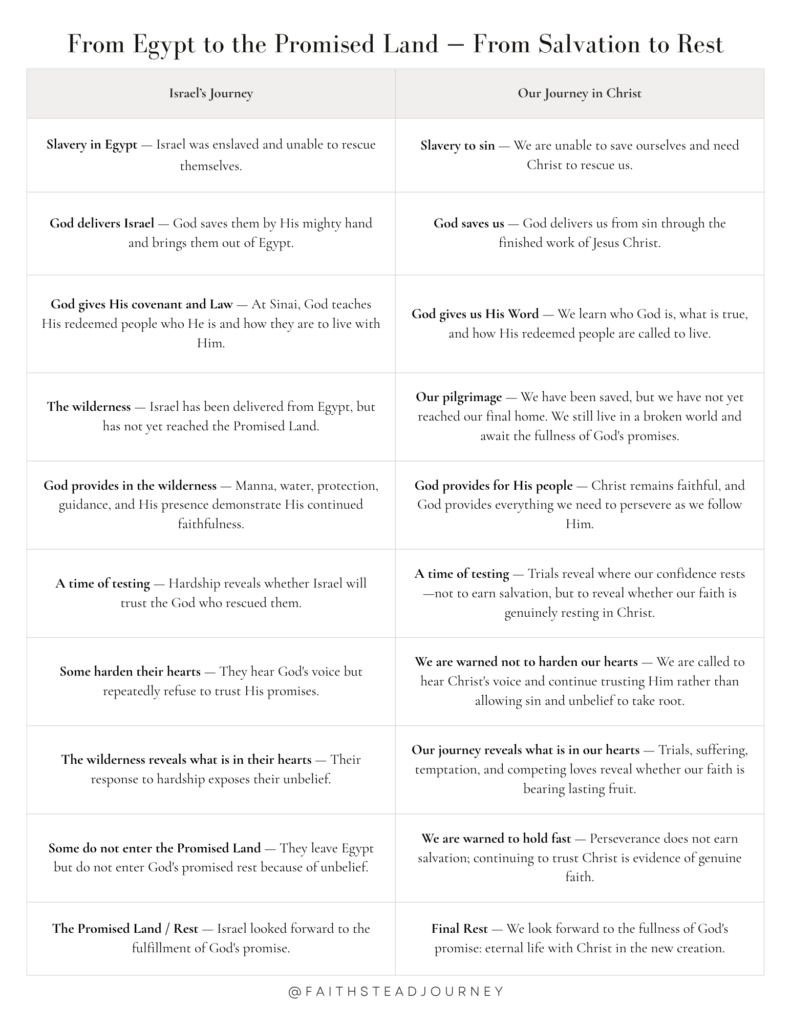
Our trials do not earn our salvation, and they don’t prove that we are strong Christians because we managed to endure them perfectly. Rather, trials often reveal where our confidence really lies.
This is why the parable of the sower is such a helpful parallel. Jesus describes people who hear the Word and initially receive it with joy, but when trouble comes, their faith does not endure (Matthew 13:20–21). The seed sprouted, but it had no deep root. It was unable to endure and bear fruit.
But Jesus gives us another picture as well: the seed that falls among the thorns. It grows, but the cares of the world and the deceitfulness of riches choke the Word, and it becomes unfruitful (Matthew 13:22).
In both cases, there is an initial response to the Word, but the passage of time and the pressures of life reveal what is really happening beneath the surface. One is tested by suffering, as Israel was tested through the hardships of the wilderness. The other is choked by competing loves, as Israel repeatedly longed for what they had left behind. Neither bears the fruit that accompanies genuine faith; instead, their response reveals what is truly in their hearts—unbelief.
Jesus’ parable of the wheat and the weeds (tares) gives us another helpful picture. For a time, the wheat and weeds grow together and may be difficult to distinguish, but the harvest ultimately reveals the difference (Matthew 13:24–30, 36–43). The wilderness generation contained both the redeemed community and those whose unbelief was eventually exposed. Outwardly belonging among God’s people is not necessarily the same as truly belonging to Christ.
Time reveals what trials expose. That doesn’t mean Hebrews calls us to live in constant uncertainty about our salvation. Quite the opposite. The warnings call us to keep trusting Christ and to examine the fruit of our faith. As we see God producing perseverance, repentance, love, and growing trust in Christ, we gain greater assurance that our faith is genuine.
So we keep walking—not trusting ourselves to make it home, but trusting the faithful Son who will bring His people safely to their promised rest.
The Better Rest
Hebrews 4:1–10 continues the warning of Psalm 95: “Today, if you hear his voice, do not harden your hearts.” Israel had been delivered from Egypt, brought through the wilderness, and promised a place of rest. Yet many of them never entered it because they refused to trust the God who had already saved them.
Now the author tells us that the promise of entering God’s rest still stands. But what exactly is this “rest”?
The word can be confusing because Hebrews 4 moves through several different layers of rests.
Creation → Canaan → Sabbath → Christ → Final Rest
Each rest reveals something about God’s greater purpose, but each one points beyond itself.
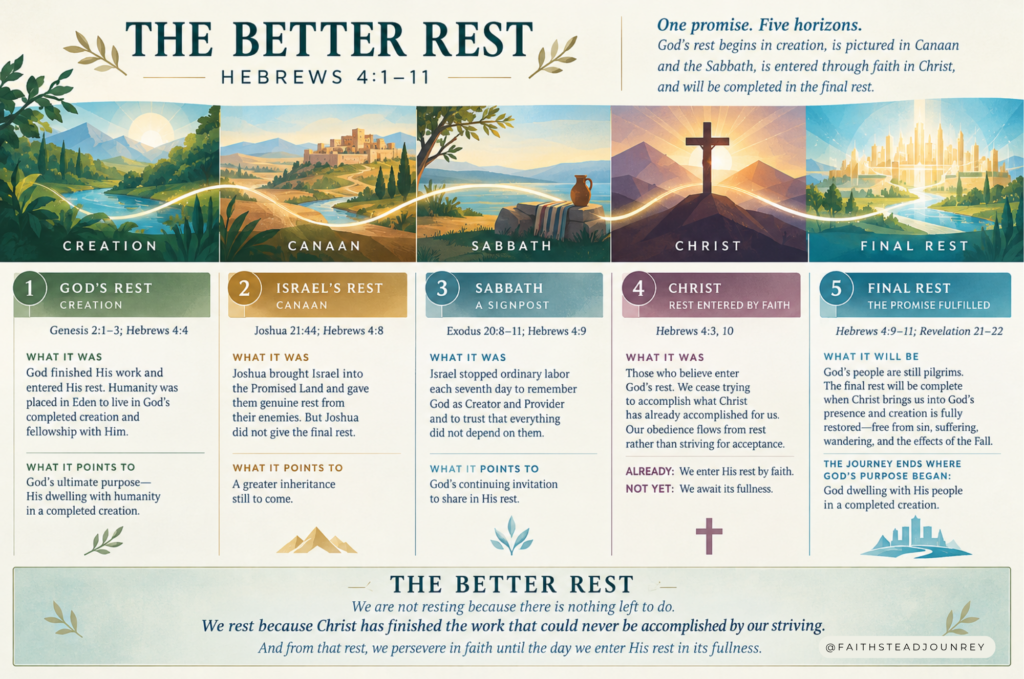
1. God’s Rest — Creation
Hebrews first points us all the way back to God’s own rest at creation. On the seventh day, God “rested from all his works” (Heb. 4:4). But what was God resting for?
He had finished creating a world that was complete, ordered, and good—and He placed humanity in Eden, where He could dwell with them. Creation was not merely a place for humans to live; it was God’s dwelling place with humanity. His work was complete, and His rest was the enjoyment of that completed creation in fellowship with the people He had made.
There is even an interesting detail in Genesis: after each of the first six days, we read, “there was evening and there was morning,” but that formula is noticeably absent from the seventh day. The seventh day is left open-ended, giving us a picture of a rest that continues.
Wait, but how can God be resting? Isn’t He still working in the world today?
Yes, God is resting, but resting doesn’t mean inactivity. God continues to work within His creation, to sustain, govern, rescue, and carryout His purposes. As Jesus said, “My Father is working until now, and I am working” (John 5:17).
And this is where our idea of Sabbath work becomes important. The Sabbath was never meant to prohibit doing good. Jesus pointed out that if a child or ox fell into a well on the Sabbath, you wouldn’t simply leave it there because it was the Sabbath—you would rescue it. How much more, Jesus argued, is it right to do good and to save life on the Sabbath.
So God’s work in the world does not contradict His rest. He is working from within His rest. God’s work of rescuing His people can be understood as Sabbath work—the work of restoring creation and bringing His people back into the rest from which sin expelled us.
2. Israel’s Rest — Canaan
Israel had been rescued from Egypt, but they were traveling toward a promised inheritance—the land of Canaan. The land was described as a place where God would give them rest from their enemies. Joshua eventually led Israel into that land.
So did Israel enter God’s rest? Yes—and no.
They truly entered the land. God’s promise was not imaginary. Joshua really did give them a measure of rest. But Hebrews makes a striking observation:
“For if Joshua had given them rest, God would not have spoken of another day later on.” — Hebrews 4:8
That “another day” is the key. Canaan was a real rest, but it was not the final rest. Joshua brought Israel into the land, but that rest was only a foreshadow of the greater rest to come.
3. Sabbath Rest — A Signpost
If you are new to the Bible, the Sabbath was the seventh day of the week, when God commanded Israel to stop their normal work and rest. It was a weekly reminder that God had created the world, rescued His people, and was the One who provided for them.
A lot of people think Sabbath simply means “do nothing.” But that misses the point. Sabbath was about stopping our ordinary labor to remember God, worship Him, and trust Him. We can rest because everything does not depend on us. God is the One who sustains us.
That is why Hebrews says:
“So then, there remains a Sabbath rest for the people of God.” — Hebrews 4:9
The Sabbath rest here points back to God’s rest at creation, when God finished His work and dwelt with humanity in Eden. And it points forward to the final rest, when God will once again dwell with His people forever in the new creation.
4. The Rest We Enter Through Christ
“For we who have believed enter that rest…” — Hebrews 4:3
In Christ, we enter God’s rest now—not by ceasing from all work, but by ceasing from the work of trying to earn what Christ has already accomplished. From that place of rest, our lives become works of love, worship, and obedience rather than the labor of slaves trying to earn their freedom. We have the spiritual reality now, but we await the fullness of that rest when Christ brings us home.
5. The Final Rest
“Let us therefore strive to enter that rest…” — Hebrews 4:11
The final rest is the rest that still awaits us. Hebrews has taken us from God’s rest at creation, through the rest offered to Israel in the Promised Land, and into the present rest we enter by faith in Christ. But the author makes it clear that God’s people have not yet reached the final destination.
There remains a Sabbath rest for the people of God. We have entered His rest now, but we have not yet entered it in its fullness. We will experience its fullness when our pilgrimage is finished—when we are finally brought into the presence of God, free from sin, suffering, wandering, and every consequence of the Fall. The final rest is the completion of God’s work in us and the fulfillment of everything He has promised.
Strive to Enter That Rest
“Let us therefore strive to enter that rest, so that no one may fall by the same sort of disobedience.” — Hebrews 4:11
At first, this sounds like a contradiction. What do you mean we need to strive to enter that rest? Aren’t we already supposed to be resting when we come to faith in Christ? If salvation is by grace through faith and Christ has already accomplished everything necessary for our salvation, why is the author now telling us to strive?
The answer is that Hebrews is speaking about two realities at once.
When we come to Christ, we enter His rest because we cease trying to establish our own righteousness and trust in the finished work of Christ. Our salvation is not something we earn through our effort. Christ has accomplished what we could never accomplish for ourselves.
But Hebrews is also looking ahead to the final rest—the fullness of God’s promised rest that awaits His people. We are still pilgrims on the journey. We have not yet reached the destination.
So the command to “strive to enter that rest” is not a command to work for our salvation, but to work out the salvation God has already given us. It is a call to persevere in faith—to keep believing God’s Word, keep holding fast to Christ, and keep trusting Him when the journey becomes difficult. It means pursuing holiness, putting sin to death, and walking in obedience as God conforms us to the image of Christ.
And here is where we encounter a beautiful biblical tension: God is sovereign over our salvation, and yet we are genuinely responsible for how we respond to Him. These truths do not compete with one another.
In fact, Scripture puts them together in the same breath:
“Therefore, my beloved, as you have always obeyed… work out your own salvation with fear and trembling, for it is God who works in you, both to will and to work for his good pleasure.” — Philippians 2:12–13
We really do strive. We really do choose. We really do obey. We really are called to pursue holiness and persevere in faith. But underneath all of it is the gracious work of God. He not only gives us the salvation we could never earn; He works in us so that we want Him, trust Him, and walk in His ways.
Our striving, then, is not an independent contribution to God’s work of salvation. It is the fruit of God’s work within us. God preserves His people, and one of the ways He preserves us is by enabling and commanding us to persevere.
This is why there is no contradiction between resting in Christ and striving to enter His rest. Rest is not inactivity, and striving is not self-salvation. The Christian life is a strange paradox—we rest in Christ’s finished work while actively following Him toward the final rest He has promised.
The Word That Searches Us
“For the word of God is living and active, sharper than any two-edged sword, piercing to the division of soul and of spirit, of joints and of marrow, and discerning the thoughts and intentions of the heart. And no creature is hidden from his sight, but all are naked and exposed to the eyes of him to whom we must give account.” — Hebrews 4:12–13
At first, this may seem like a sudden change of subject. Why does the author move from striving to enter God’s rest to talking about the Word of God performing surgery?
But it actually follows perfectly. Hebrews has been warning us not to repeat Israel’s example. They heard God’s promise, but they did not combine what they heard with faith. Their outward journey through the wilderness eventually revealed what was happening in their hearts. They claimed to belong to God’s people, yet their unbelief showed itself through disobedience.
So how do we know what is really happening in our own hearts? The Word of God exposes it.
The Word is described as “living and active.” It is not merely an ancient message preserved on a page. God’s Word speaks into the present. The warning that was given to Israel becomes a warning to us: “Today, if you hear his voice, do not harden your hearts.” The promise of God’s rest is also still held out to us.
God’s Word does something to us. It searches us, confronts us, corrects us, encourages us, and reveals what is actually happening beneath the surface.
And notice how deeply it reaches. It is “sharper than any two-edged sword,” piercing through all our outward appearances and reaching into the places that even we cannot fully see. It “discerns the thoughts and intentions of the heart.”
That matters because sin is deceptive. We can become hardened without realizing it. We can convince ourselves that we are trusting God when, underneath the surface, we are beginning to doubt His goodness. We can appear faithful on the outside while pride, unbelief, bitterness, or disobedience is quietly taking root within us.
However, God’s Word cuts through our self-deception. It exposes our excuses. It reveals our motives. It shows us not simply what we have done, but why we have done it. It reaches beneath our behavior and exposes the desires and beliefs that are driving us.
And then the language of verse 13 becomes even more striking: “No creature is hidden from his sight, but all are naked and exposed.” The Word exposes us because God Himself sees us completely.
The language of being “naked and exposed” seems to echo the opening chapters of Genesis. Before sin entered the world, Adam and Eve were “naked and were not ashamed” (Genesis 2:25). There was nothing to hide because there was nothing to be ashamed of. They were at peace with God, with themselves, and with the world He had made.
Tragically, everything changed when they turned away from God. After their disobedience, Adam and Eve suddenly became aware of their nakedness and hid themselves from God (Genesis 3:7–10). Their problem was not simply that they were physically naked. Their nakedness now exposed their guilt. They were no longer at peace with God, and their instinct was to hide and cover themselves.
And isn’t that what sinners still do? We hide. We cover. We manage our appearance. We construct excuses. We compare ourselves with people who seem worse than we are. We try to convince ourselves—and sometimes God—that we are better than we really are.
But the Word of God pulls away the coverings. It brings us to a place where we can no longer pretend that we are righteous in ourselves. It exposes our spiritual nakedness and shows us our desperate need for something outside of ourselves. And that is precisely why these verses belong in a passage about rest.
We will never experience the deep rest God offers while we are still trying to hide from Him or establish our own righteousness. As long as we are trying to be our own savior, we can never truly rest. We will always have something to prove, something to protect, or something to hide. The Word strips away our false coverings so that we can stop pretending and come honestly before God.
But there is something even more sobering here. Verse 13 doesn’t merely say that we are exposed. It says that we are exposed before the One “to whom we must give account.”
We are not simply being examined by an impersonal force. We stand before the holy God who sees everything and judges perfectly. Nothing can ultimately be hidden from Him—not our actions, our thoughts, our motives, or the secret places of our hearts. And that means Hebrews 4:12–13 is not merely comforting. It is terrifying. The Word reveals us, and God sees us, and one day we will give an account.
So where is the rest? The answer is in what comes next: “Since then we have a great high priest…” That transition is crucial.
The author does not leave us naked before God. He exposes our sin and then points us to Christ.
The God before whom we stand completely exposed has provided a High Priest who understands our weakness and invites us to “draw near to the throne of grace” (Hebrews 4:16). The gospel does not tell us to hide our nakedness better. It tells us to bring our nakedness, our guilt, and our weakness into the presence of Christ.
Our hope is not that God’s Word will discover that we are better than we thought. Our hope is that Christ is better than we could ever be.
We do not need to construct our own covering because Christ provides the righteousness we lack. The One who was Himself stripped and exposed on the cross bore the judgment our sin deserved, so that those who belong to Him could be clothed in His righteousness.
The Word therefore does two things: it strips us and it sends us to Christ. It strips away our self-righteousness, our excuses, and our false coverings. And once we see ourselves honestly, it sends us running—not away from God like Adam in the garden, but toward God through Christ our High Priest.
This is why the command to strive to enter that rest is followed by the searching Word of God. We cannot persevere in faith by trusting our own assessment of ourselves. We need God’s Word to continually examine us, expose our unbelief, correct our wandering hearts, and point us back to Christ.
Rest is not found by hiding from God. It is found by being fully known by God and yet running back to Christ.