
The Supremacy of God’s Son
And the floodgates have opened. The author doesn’t waste a second! Before we’ve even had time to settle in, he’s already climbing—from the prophets, through the history of God’s revelation, to creation and the inheritance of all things—all to bring us to one breathtaking conclusion:
God has spoken to us through His Son.
This brings us to what theologians sometimes jokingly call “nosebleed Christology.” Hebrews takes us to such a high altitude of Christology that you might get a nosebleed! In other words, it is a breathtakingly high view of who Christ is—emphasizing His divine nature, eternal glory, authority, and supremacy over everything else. The author doesn’t slowly work his way up to telling us who Jesus is. He starts at the summit.
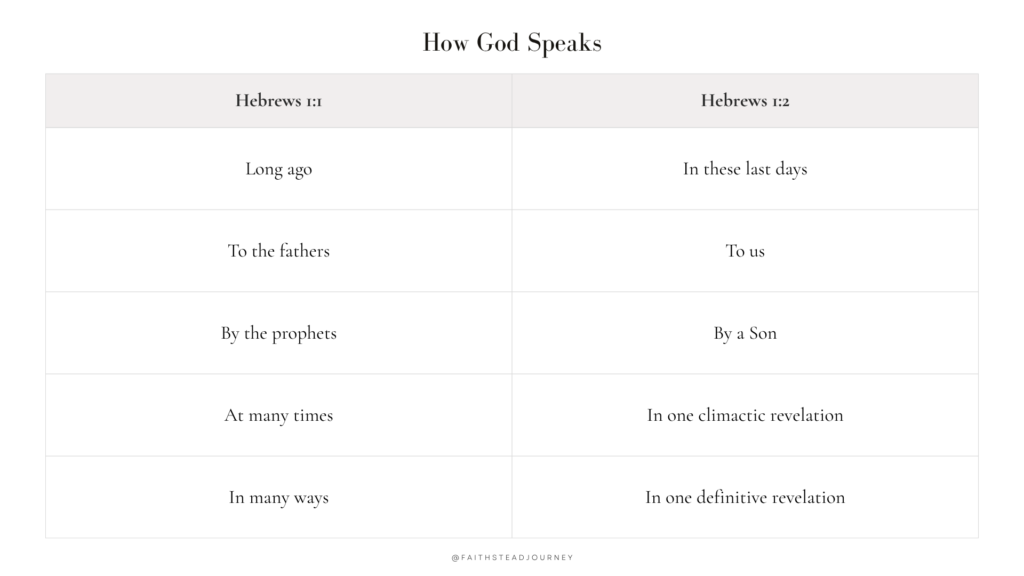
But before we climb any higher, let’s pause and take a closer look at what the author has packed into these opening verses. Let’s put the first two verses side by side and watch the contrast unfold.
“Long ago, at many times and in many ways, God spoke to our fathers by the prophets, but in these last days he has spoken to us by his Son,” – Hebrews 1:1-2
The author is drawing our attention to something remarkable: God has always been a speaking God, but the way He has spoken has now reached its fullest and final expression in His Son.
A God Who Speaks
First, I’m amazed by the simple fact that we have a God who speaks to us. He is not distant, silent, or unknowable. He makes Himself known because He desires to be known by us. From Eden to Revelation, the story of Scripture is the story of God drawing near to His people: I will be your God, and you will be My people. He wants to dwell with us.
If you’ve ever been the parent of a teenager, you may understand something of this longing. Sometimes you want to talk to your kids far more than they want to talk to you. You ask questions, you try to start a conversation, and you’re met with a one-word answer—or nothing at all. And yet you keep reaching out because you love them and want a relationship with them.
That makes the scene in Eden all the more remarkable. After Adam and Eve sinned, God came into the garden and called, “Where are you?” He wasn’t asking because He didn’t know where Adam was. He was calling Adam into conversation. Even in the moment of humanity’s rebellion, God was the One who came seeking His people.
This is the heart of the God who speaks. He does not leave us to wonder who He is or what He desires. He speaks because He wants us to know Him. And Hebrews begins by reminding us that this God who has always spoken has now spoken to us in the fullest and clearest way possible—in His Son.
Second, Hebrews tells us there is something else we need to understand about the way God has spoken. The words translated “at many times and in many ways” come from the Greek polymeros and polytropos. The idea is that God’s revelation came in portions and through many different means. Through Moses, the prophets, the psalmists, the promises, the sacrifices, the ceremonies, and the stories, God progressively revealed more of Himself and His redemptive plan. Each revelation was true and authoritative, but together they were pointing toward something greater that was still to come. The Old Testament was not a collection of disconnected messages; it was a progressive unfolding of God’s redemptive purposes that ultimately find their fulfillment in Christ.
Then Hebrews says, “but in these last days he has spoken to us by his Son.” Jesus is not simply the next piece of information God gives us. He is the culmination of everything God has been revealing. In Christ, God has given us His fullest and final revelation of Himself. There is no greater revelation waiting around the corner and no future messenger who will arrive with a fuller version of God.
The prophets said, “Thus says the LORD.”
Jesus said, “Truly, truly, I say to you.”
Do you see the difference?
The prophets spoke as God’s commissioned messengers. Jesus speaks as the Son. He isn’t simply another messenger in the lineup. He is the One the messengers were pointing to.
This is important because Christianity isn’t waiting for someone to come along with a newer revelation from God. Jesus is the final and fullest Word from God. As John tells us, “the Word became flesh” (John 1:14). God’s Word has come to us in a Person!
And this distinction gives us an important safeguard against false teaching. I’ve heard preachers argue that because Jesus is no longer physically present on earth, God now speaks through the Holy Spirit to His apostles, pointing to Acts 1:2, where Jesus gives commands to His chosen apostles through the Holy Spirit. From there, the argument can be extended: if we want to hear God’s voice today, we need to listen to the apostles God has chosen to speak through.
But Hebrews gives us a different framework. The apostles’ authority was received and commissioned; it was derivative, not independent. They did not become a new source of revelation after Jesus ascended. Their authority came from Jesus, and their mission was to bear witness to Him and faithfully transmit His teaching. Just as the prophets pointed forward to Christ, the apostles pointed back to Christ. They did not replace Christ.
That distinction matters enormously. Jesus is the final revelation of God. The apostles were His authorized witnesses, not His successors. The Holy Spirit empowered them to testify to Christ and to make His teaching known, but their authority did not exist apart from Him.
So when someone claims, “God is speaking through me,” the question is not simply whether they claim to have the Holy Spirit. The question is whether what they are saying agrees with the revelation God has already given us in Christ and His Word.
We don’t measure God’s Word by the teacher; we measure the teacher’s words by God’s Word.
Christ is the revelation.
The apostles bear witness to Him.
The Holy Spirit illuminates His Word.
Teachers explain it.
But no one gets to add to it.
And that makes Hebrews 2:1 especially significant: “Therefore we must pay much closer attention to what we have heard.” The emphasis is not on waiting for the next revelation. It is on holding fast to the revelation we have already received.
The Challenge of the Final Word
And this is where something wonderfully comforting becomes deeply challenging. We can rejoice that God wants a relationship with us, but a relationship with God also means surrendering our independence. We naturally want to negotiate. We want to decide which parts of God’s Word we will accept, which commands we will reinterpret, and which truths we will set aside when they interfere with the lives we want to live. We want a God we can relate to—but not necessarily a God who gets to define reality for us.
But you cannot have a genuine relationship with God while remaining the final authority in your own life. God has finalities—unchangeable realities about who He is, what is true, what sin is, what salvation is, and what He requires of us. The Christian life begins when we stop asking God to conform Himself to us and begin allowing His truth to reshape us.
And yet the gospel gives us a breathtaking paradox: God condescended to us first.
The infinite, eternal God entered His own creation. He took on human flesh. He stepped into time. He became vulnerable. And He went all the way to the cross to bear the judgment our sin deserved. The One who calls us to surrender our independence first surrendered Himself for us.
When we begin to grasp that, something changes. The God who asks us to build our lives around His final Word is the same God who, in love, came down to meet us in our weakness. He did not merely demand that we come up to Him. He came down to us.
And when we see that the infinite God has already bent low in love for us, our instinct to negotiate with Him begins to melt. We can finally stop trying to make God fit into our lives—and begin building our lives around Him.
The Author’s Seven-fold Witness for Christ
“…whom he appointed the heir of all things, through whom also he created the world. He is the radiance of the glory of God and the exact imprint of his nature, and he upholds the universe by the word of his power. After making purification for sins, he sat down at the right hand of the Majesty on high,” – Hebrews 1:2-3
And now, after opening the letter by telling us that God has spoken through His Son, the author begins to tell us who this Son actually is.
And he doesn’t exactly ease us into it!
In just a few verses, Hebrews gives us seven striking description of Jesus. Biblically speaking, the number seven symbolizes perfection. It’s almost as if the author keeps adding another facet to the diamond, each one revealing something more astonishing about Jesus to give us a complete picture of who He is.
Let’s slow down and look at them one at a time.
1. He is the heir of all things.
An heir receives what belongs to his father. But this isn’t talking about Jesus eventually receiving a few possessions or a particular kingdom. All things belong to Him. Everything that exists ultimately falls under His rightful authority. He isn’t merely part of creation. He is the rightful Lord over it.
2. He is the Creator of all things.
The One who inherits all things is also the One through whom all things came into being. That means Jesus isn’t a creature standing somewhere within the universe. He stands on the Creator side of the Creator-creature distinction.
And suddenly, “God has spoken to us by His Son” sounds a whole lot bigger than we might have realized.
3. He is the radiance of God’s glory.
The glory of God shines forth through the Son. When we look at Christ, we aren’t getting a distant description of what God is like. We are seeing God’s glory revealed in the Son. Without the Son, we could never truly see or know the Father. Jesus doesn’t merely tell us about God; He makes the Father known to us. The invisible God has made Himself known through the Son.
4. He is the exact imprint of God’s nature.
The word translated “exact imprint” carries the idea of an exact impression made by a seal in wax. The impression bears the same image as the seal.
Hebrews isn’t saying that Jesus is a reflection of God, but the full expression possessing the very nature of God. He is not a copy of God or a close resemblance. He is the exact imprint of God’s nature.
This is why Jesus could say, “Whoever has seen me has seen the Father.” (John 14:9)
5. He upholds all things by His powerful word.
Jesus didn’t create the universe and then step away from it. The One who spoke creation into existence continues to sustain it. Every star, every planet, every atom, every breath exists because He upholds it.
Tim Keller once told about an illustration he heard from Barbara Boyd, a woman who had a profound influence on his early Christian life. She asked her students to imagine that the 92 million miles between the earth and the sun were represented by the thickness of a single sheet of paper. At that scale, the distance to the nearest star would be a stack of paper about 70 feet high, and the diameter of our galaxy would be a stack of paper about 310 miles high. And our galaxy itself is only a tiny speck in the vastness of the universe.
Then she brought them back to Hebrews 1:3: Jesus upholds all of this by the word of His power.
And she asked, in essence, “Is this the kind of person you ask into your life to be your personal assistant?”
We can so easily shrink Jesus down to the size of our problems and think of Him as someone we call when we need a little help. But the Jesus Hebrews is describing is not our cosmic assistant. He is the One who holds the universe together.
And yet this same Jesus invites us to come to Him. The One who needs nothing from us is the One who willingly gave Himself for us. That is the kind of Savior we are dealing with here. He doesn’t simply belong somewhere in our lives. He is Lord over all of it.
6. He made purification for sins.
And now, after taking us all the way out to the vastness of the universe, the author suddenly brings us back home.
The One who created all things.
The One who radiates the glory of God.
The One who perfectly bears the nature of God.
The One who upholds the universe by the word of His power.
He came to deal with our sin.
This is where the glory of Christ becomes deeply personal. The Creator of the universe didn’t merely reveal Himself to us from a distance. He came down to do something about the very thing that separated us from God.
And notice the wording: He made purification for sins.
He didn’t merely teach us how to become better people. He didn’t simply show us a better way to live. He dealt with our guilt and uncleanness through His own sacrifice.
This is the great mystery and wonder of the gospel: the One who needs nothing from us came to do for us what we could never do for ourselves. The One who upholds the universe became the sacrifice for sinners.
7. He sat down at the right hand of the Majesty on high.
And finally, we see where this work leads:
He created.
He revealed God.
He sustained.
He purified.
And now He is enthroned.
And notice that He sat down.
That little detail becomes enormously important in Hebrews. The priests under the old covenant continually stood to perform their ministry because their work was never finished. But Jesus offered the perfect sacrifice and sat down at God’s right hand.
A Superior and Excellent Name
“Having become as much superior to angels as the name he has inherited is more excellent than theirs.” — Hebrews 1:4
If you’re using Jen Wilkin’s study, I love how she contrasts her own name with the name of Jesus. We probably all know a few Jennifers in our lives. Wilkin points out that when she was born, Jennifer was the most popular baby girl name in the United States—and it remained the most popular name for 15 years (1970-1984). She jokingly calls it the “Jennifer Epidemic.”
But then she makes the point that brings us back to Hebrews: the name Jennifer is common. But the name of the Lord is above all other names. In Scripture, God’s name represents the sum total of His character—who He is, what He is like, and all that is true about Him. And that makes Hebrews 1:4 even more breathtaking.
The angels have names, but their names do not carry the same weight, because they do not carry the same identity or authority. The angels are servants of God; Jesus is the Son. And the seven descriptions we’ve just been given have shown us why His name is more excellent than theirs.
Verse 4 serves as the bridge into the seven Old Testament quotations that follow, each one piling evidence upon evidence that the Son occupies a category entirely His own.
Notice what the author has done. He hasn’t simply said, “Jesus is better than angels.” He has shown us who Jesus is.
He is heir.
He is Creator.
He is God’s glory revealed.
He is the exact imprint of God’s nature.
He is Sustainer.
He is Redeemer.
He is King.
With each description, the Son’s identity and work unfold in a progression: creation, revelation, sustaining, redemption, and finally enthronement. And in just these first four verses, the author has already shown us Christ in the three great offices of Scripture:
Prophet, through whom God has spoken
King, who is seated at the right hand of Majesty.
Priest, who made purification for sins
But don’t just take his word for it.
The Old Testament’s Seven-fold Witness for Christ
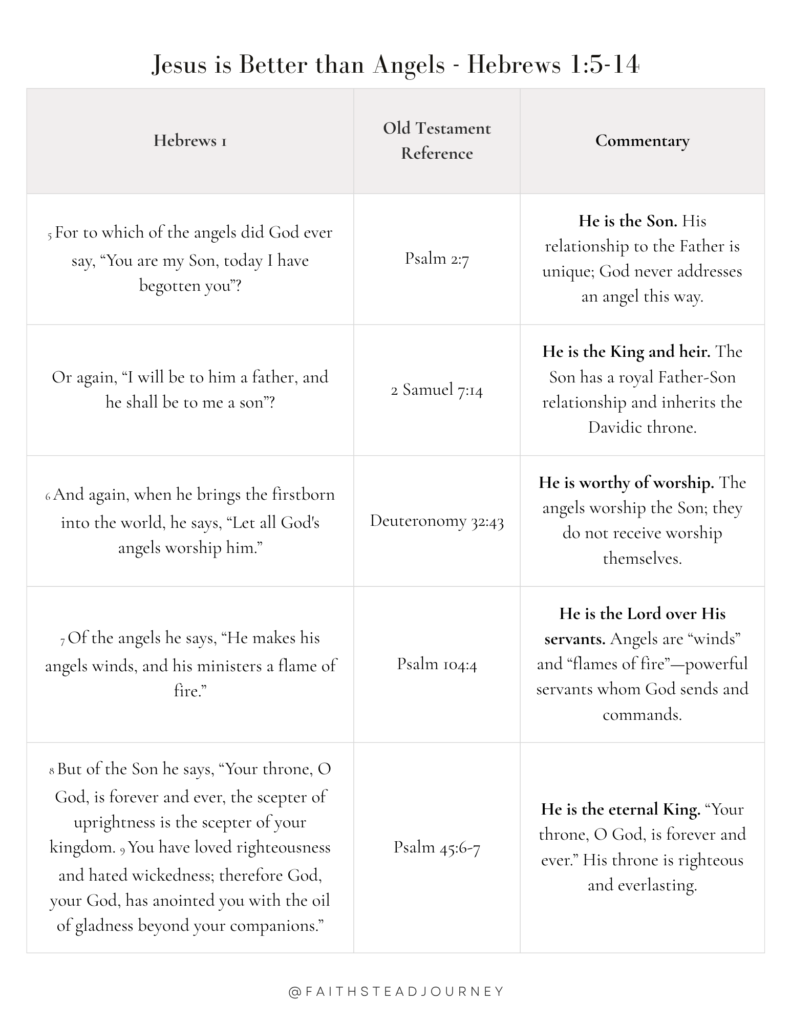
Beginning in verse 5, Hebrews turns to the Old Testament Scriptures to prove what he has just declared. Seven witnesses will testify that the Son is greater than the angels. And each witness adds another dimension to the identity of the Son.
The rest of chapter 1 is essentially answering one question: Why is the Son superior to the angels?
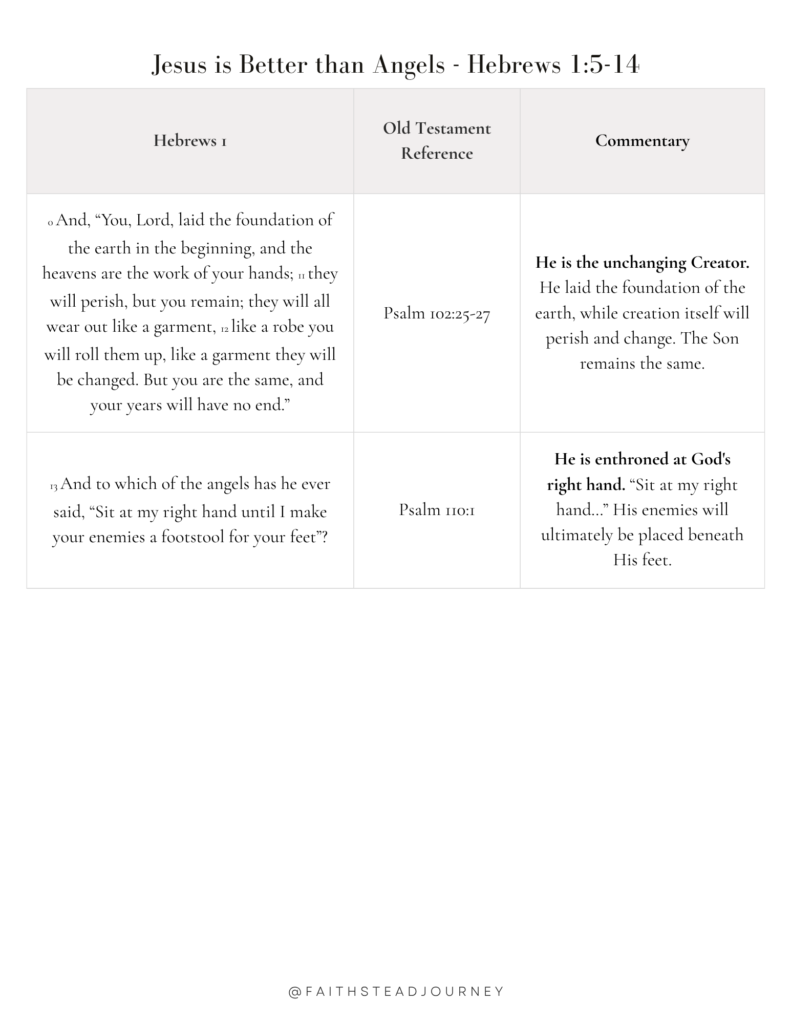
I think this is where it gets really beautiful:
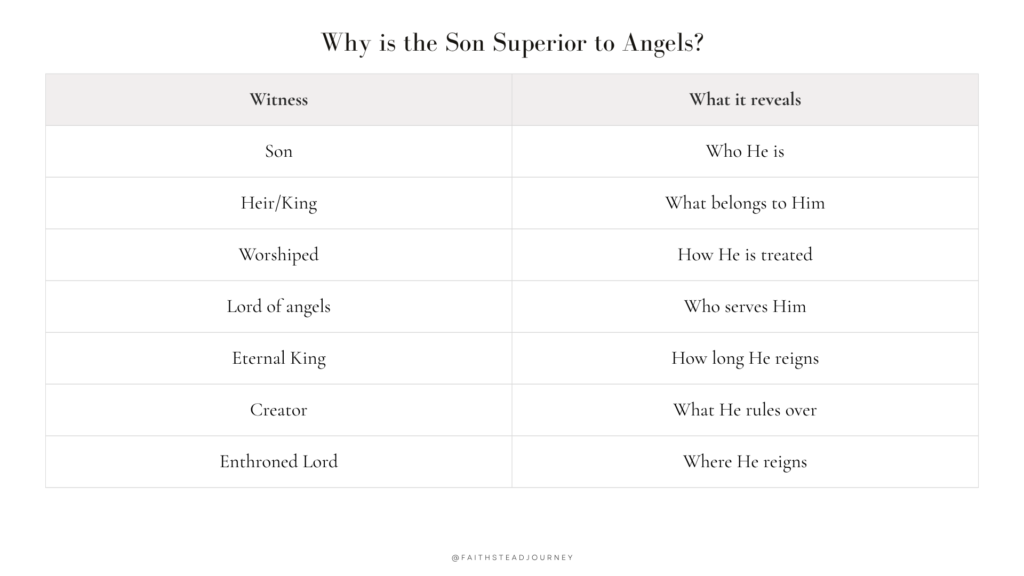
And the conclusion is:
Angels = Servants
Jesus = Son
“Are they not all ministering spirits sent out to serve for the sake of those who are to inherit salvation?” – Hebrews 1:14
Jesus isn’t merely superior to angels in rank. Scripture reveals that the Son has a name, position, relationship, authority, and kingship that the angels do not possess. Jesus is not simply a greater messenger. He belongs to an entirely different category.
And guess what? Angels are also sent out to serve those who are to inherit salvation. Think about the dignity of that statement. These glorious heavenly beings whom we have just spent fourteen verses talking about are servants of God, and God sends them to serve His people. The point isn’t to make us fascinated with angels, but to make us marvel at the grace of God. The One whom the angels worship has made us His children and heirs. The angels serve the King—and by His grace, they serve those who belong to Him.
Why Angels?
But why does the author spend so much time comparing Jesus to angels?
To us, angels can feel like a strange choice for comparison. In modern Western culture, we don’t typically spend much time thinking about angels. But to the original Jewish audience, angels were not sentimental Christmas-card figures or the cute, chubby babies with wings we see in Renaissance paintings. They appeared throughout the Old Testament as God’s heavenly servants and messengers, involved in revelation, worship, judgment, protection, and even the giving of God’s law.
And interestingly, when angels appeared to people in Scripture, one of their first words was often, “Do not be afraid.” There was a real sense of awe surrounding them. They represented the unseen world—the supernatural realm that stood beyond ordinary human experience and pointed toward the glory and holiness of God.
So imagine what the author is saying.
You are impressed by angels? Look at Jesus.
You revere the supernatural? Look at Jesus.
You want to hear from heaven? Look at Jesus.
Because even the most glorious beings in heaven are only servants. Jesus is the Son.
And that is where this becomes more than an ancient argument about angels. The temptation may look different today, but the heart of it is the same.
We may not be tempted to put angels above Jesus—but we are constantly tempted to elevate something created above the Creator. We can become fascinated with the supernatural. We can chase spiritual experiences, signs, omens, prophecies, mystical encounters, or the next person who claims to have a special word from God. We can become so captivated by the messenger that we lose sight of the One the messenger is supposed to point us toward.
Hebrews reorients us. Don’t worship the messenger. Worship the Son.
Don’t build your faith on an experience when God has given you His Son. Don’t measure truth by how supernatural it feels. Don’t elevate a teacher because he claims special access to God. Don’t be distracted by what is impressive, mysterious, or otherworldly.
The question is not, How close to heaven can I get?
The question is, Have I listened to the Son?
The angels serve, but the Son reigns.
And if the most glorious servants of God bow before Christ, then we should be very careful about giving anyone—or anything—an authority that belongs to Him alone.
Pay Much Closer Attention
“Therefore we must pay much closer attention to what we have heard, lest we drift away from it.” — Hebrews 2:1
The word “therefore” is an important connecting word. It takes everything we have just read in chapter 1 and brings it to a conclusion: because Jesus is the Son through whom God has spoken, we must pay much closer attention to what He has said. We must heed Him.
Notice that the author doesn’t simply say, “Pay attention.” He says “pay much closer attention.” He is writing to people who have already heard the message. They know about Jesus. They have heard the gospel. They are not being warned because they never listened at all. They are being warned because it is possible to hear God’s Word, even receive it with excitement, and still drift away from it.
This reminds me of Jesus’ parable of the sower. All four soils hear the Word of God, but their responses are very different.
The first soil hears but does not understand, and the Word is quickly snatched away. The second hears the Word and even receives it with joy, but when persecution comes, it falls away because it has no root. The third hears the Word, but the cares of the world and the deceitfulness of wealth choke it out, leaving it unfruitful. Only the fourth soil hears, understands, and bears fruit.
Jesus is showing us that hearing God’s Word is not the same thing as truly receiving it. You can hear it without understanding it. You can hear it and feel excited about it. You can hear it and even begin to follow it. But if the Word never takes root, it can be crowded out or abandoned.
That is why Hebrews says we must pay much closer attention to what we have heard. Paying close attention isn’t merely hearing, and it isn’t merely having an emotional response. It means receiving God’s Word deeply enough that you hold onto it and it bears fruit.
And that requires humility.
Think about a student sitting in a classroom who thinks he already knows everything the teacher is going to say. He may be physically present. He may even hear every word. But if he has already decided that he knows better, he isn’t really listening. His problem isn’t a lack of information. His problem is pride.
The same can happen when we come to God’s Word. We can read it while already deciding what we think it should say. We can listen to a sermon only for the parts that agree with us. We can explain away the commands that make us uncomfortable and hold tightly to the promises we like. We may hear God’s Word without ever allowing God’s Word to correct us.
Humility says, “I need to pay very close attention to every word God has spoken, because my life depends on it.”
And this is where the word “drift” becomes so important.
Imagine a boat safely moored in a harbor. As long as it remains securely tied to its mooring, it stays where it belongs. But cut the line, and the boat doesn’t have to work its way out to sea. It doesn’t have to turn on its engine. It doesn’t even have to make a decision. It simply drifts.
That is what makes drifting so dangerous. It doesn’t take effort. It takes almost nothing at all.
And spiritually, drifting isn’t necessarily the result of one dramatic decision to walk away from Christ. Sometimes it happens when we simply stop paying attention to Him. We stop listening carefully. We stop allowing His Word to correct us. We stop fixing our eyes on Him. Simply put, we stop abiding.
That is why this warning comes immediately after chapter 1. God has spoken through His Son. So keep listening to the Son. Keep your eyes on the Son. Hold fast to the Son. Abide!
How Shall We Escape?
And then Hebrews gives us the reason we should take this warning of drifting away so seriously:
“For since the message declared by angels proved to be reliable, and every transgression or disobedience received a just retribution, how shall we escape if we neglect such a great salvation? It was declared at first by the Lord, and it was attested to us by those who heard, while God also bore witness by signs and wonders and various miracles and by gifts of the Holy Spirit distributed according to his will.”
— Hebrews 2:2–4
The “message declared by angels” is understood as referring to the law given under the old covenant through angelic mediation. Acts 7:53 and Galatians 3:19 make the same connection between the law and angels. The point is that the message was reliable and binding. When God’s people disobeyed it, there were consequences.
So the author asks a sobering question: If the word delivered through angels was binding, how much more seriously should we take the salvation announced by the Son?
If God held people accountable for neglecting a message delivered through servants, how shall we escape if we neglect the salvation delivered by the Son Himself?
And notice the word Hebrews chooses: neglect.
He doesn’t say, “How shall we escape if we openly hate Christ?” Or “How shall we escape if we deliberately announce that Christianity is false?” He says, “if we neglect such a great salvation.”
That takes us right back to the image of drifting. You don’t have to make a dramatic decision to drift away. You can simply stop paying attention. You can become careless. You can hear the truth again and again without letting it take root. You can become so familiar with the gospel that it doesn’t change you and you never bear fruit. And that is what makes this warning so unsettling. The danger is not only rejecting salvation. It is neglecting salvation.
And this is where I think the word “neglect” gets especially interesting. We can know something is important and still neglect it. We can have the information in our heads without allowing the truth to reach our hearts.
We know prayer is important, but we don’t pray.
We know God’s Word is important, but we don’t open it.
We know repentance is necessary, but we make excuses for our sin.
We know fellowship with other believers matters, but we isolate ourselves.
We know the gospel is true, but we can begin living as though other things are more important.
And that exposes something about the difference between head knowledge and heart knowledge.
Head knowledge says, “I know this is true.”
Heart knowledge says, “Because I believe this is true, I am going to live accordingly.”
If I genuinely believe that something is important, eventually that belief will begin to shape my priorities, my decisions, my affections, and my actions. What we truly believe doesn’t remain merely theoretical. Our lives eventually reveal what we actually believe. That’s why neglect is so dangerous.
We don’t necessarily have to reject the gospel outright. We can simply live as though it isn’t important. We can say we believe salvation is the most precious thing in the world while spending our lives treating everything else as though it matters more. And that’s exactly why Hebrews connects hearing with heeding.
The problem isn’t that these people haven’t heard the message. They have. The problem is that they are in danger of hearing the greatest message ever proclaimed and then allowing it to drift into the background of their lives.
And then the author reminds us that this salvation did not arrive as an unsupported claim.
Look at the chain of testimony:
It was declared by the Lord.
Jesus Himself announced it.
It was attested by those who heard Him.
The apostles and other eyewitnesses bore witness to what they had seen and heard.
And God Himself bore witness to their testimony.
He confirmed their message through signs and wonders, various miracles, and gifts of the Holy Spirit, distributed according to His will.
There is a remarkable three-fold witness here:
The Lord spoke.
The witnesses testified.
God bore witness.
This is why Hebrews can say, in effect, You have every reason to listen. And notice one final detail: the gifts of the Holy Spirit were distributed “according to his will.”
Even here, the emphasis is not on human spiritual power or on chasing supernatural experiences. The Spirit is sovereign. He gives according to His will, in order to bear witness to God’s truth.
The point of the signs was never, “Look at the messenger.”
The point was, “Listen to the message.”
And what is the message and great salvation we must not neglect? Let’s continue reading on…
The Founder of Salvation
“For it was not to angels that God subjected the world to come, of which we are speaking.” — Hebrews 2:5
Wait, what does this have to do with angels? Everything.
The author has spent chapter 1 showing us that Jesus is greater than the angels. Now he wants us to understand something even more remarkable: the salvation Jesus came to accomplish is not about angels. It is about us.
And to explain that, he takes us back to Psalm 8:
“What is man, that you are mindful of him,
or the son of man, that you care for him?”
That is really the question Hebrews wants us to consider.
What is man? Why does God care so much about us? Why would the Creator of the universe set His affection on creatures who are so small, so fragile, and so prone to wander? The answer begins all the way back in Genesis.
Human beings were created in God’s image and given a remarkable calling. God crowned humanity with glory and honor and gave us dominion over His creation. We were made to rule under God, to cultivate His world, reflect His character, and exercise faithful dominion over what He had made.
Psalm 8 celebrates that incredible dignity. But then Hebrews makes an observation that we cannot miss:
“Now in putting everything in subjection to him, he left nothing outside his control. At present, we do not yet see everything in subjection to him.” – Hebrews 2:8
There is a gap between what humanity was created to beand what we currently see. We were made for glory, but we see shame. We were made for dominion, but we see disorder. We were made for life, but we see death. We were made to rule, but so often we find ourselves ruled by our own sinful desires. Something has gone terribly wrong. And Hebrews doesn’t pretend otherwise.
But then comes one of the most important phrases in this entire passage: “But we see Jesus.”
That is the key. Presently, we don’t yet see everything subjected to humanity. We don’t yet see creation restored to the glory God intended. We don’t yet see the world as it will one day be. But we can see Jesus. We see the One who was “for a little while made lower than the angels.”
This is the descent of the Son. Chapter 1 took us to the summit of Christ’s glory. Chapter 2 shows us what He did with that glory. He came down and entered our humanity. He took on flesh and blood and entered our suffering. He tasted death.
The author says that Jesus was crowned with glory and honor because of the suffering of death, so that “by the grace of God he might taste death for everyone.”
Notice the movement:
Humanity was made for glory.
Humanity fell into death.
Jesus entered death.
Jesus was crowned with glory.
And now He is bringing many sons to glory.
Jesus doesn’t simply rescue us from the consequences of the Fall. He comes to restore what humanity was created for. This is the message and great salvation Hebrews is talking about.
“…bringing many sons to glory, [God] should make the founder of their salvation perfect through suffering.” – Hebrews 2:10
The word translated “founder” can carry the idea of a pioneer, captain, leader, or one who opens the way. Jesus is the One who goes before His people into salvation. He doesn’t merely point toward the path. He walks it first. He goes where we could never go on our own. He enters suffering and death and defeats death! Then He emerges victorious and brings His people with Him.
That is why “made perfect through suffering” cannot mean that Jesus was morally imperfect and needed to become a better person. Rather, through suffering, Jesus was brought to the completion of His mission as our Savior. He was perfectly fitted, through His suffering and death, to accomplish the salvation He came to achieve.
The Brother Who Became Our Keeper
Then Hebrews says something almost shocking:
“For he who sanctifies and those who are sanctified all have one source. That is why he is not ashamed to call them brothers.” – Hebrews 2:11
The eternal Son calls redeemed sinners brothers. The One who is infinitely above the angels identifies Himself with us. Why? Because He has taken our humanity upon Himself.
That makes me think of Cain and Abel. After Cain murdered his brother, God asked him, “Where is Abel your brother?” Cain answered, “I do not know; am I my brother’s keeper?” Cain’s question was a refusal of responsibility.
Jesus does the opposite.
He doesn’t distance Himself from His brothers. He draws near. He doesn’t deny responsibility for us. He takes responsibility for us. He doesn’t stand outside our suffering and tell us to find our own way back to God. He enters our humanity, shares our flesh and blood, suffers with us, dies for us, and becomes our merciful and faithful High Priest.
Cain asked, “Am I my brother’s keeper?”
Jesus answered with His life: “I will be.”
The first brother refused to take responsibility for his brother. The greater Brother willingly laid down His life for His brothers. The Son became like us so that we could be brought to glory.
Destroying Death through Death
And now Hebrews gives us another reason the Son had to come down into our humanity. It wasn’t simply so that He could identify with us or show us what God is like. He came because we were facing an enemy we could never defeat on our own: death.
“Since therefore the children share in flesh and blood, he himself likewise partook of the same things, that through death he might destroy the one who has the power of death, that is, the devil, and deliver all those who through fear of death were subject to lifelong slavery.” — Hebrews 2:14–15
Notice the remarkable logic of the passage. We have flesh and blood, so He took on flesh and blood. Why? So that He could die. The eternal Son could not die according to His divine nature, but by taking on our humanity, He became capable of experiencing death. And through that very death, He defeated the devil and broke the slavery that fear of death had held over us.
This doesn’t mean that Satan is now nonexistent or that he has no activity in the world. Hebrews is saying that his power has been decisively broken. The devil does not have the final word over those who belong to Christ. The cross dealt with the sin and guilt that stood against us, and therefore the accusation that leads to condemnation can no longer have the last word. Christ defeated the enemy not by avoiding death, but by entering death and conquering it.
And that changes our relationship with death itself. Death is still an enemy. We still grieve. We still feel the weight of losing someone we love, and none of that is treated lightly in Scripture. But for the Christian, death is no longer the doorway into condemnation. Christ has already passed through it, and He came out the other side. The grave is no longer the end of the story.
That is why Hebrews says He came to “deliver” those who had been enslaved by the fear of death. Fear can control us. It can make us cling to comfort, avoid sacrifice, protect our reputation, pursue security, and live as though preserving this present life is our highest good. But when Christ has conquered death, death no longer gets to dictate how we live.
This is the gospel climax of the incarnation: He came down far enough to die, so that those He came to save could be brought all the way to glory.
The Priest Who Knows Us
“Therefore he had to be made like his brothers in every respect, so that he might become a merciful and faithful high priest…” – Hebrews 2:17
Jesus did not merely become human so that He could die for us. He became human so that He could be our merciful and faithful High Priest. He knows what it is to suffer. He knows what it is to be tempted. He knows what it is to experience weakness, sorrow, rejection, pain, and death. Not because He sinned—He did not—but because He entered fully into the human condition apart from sin.
“For because he himself has suffered when tempted, he is able to help those who are being tempted.” – Hebrews 2:18
That word help matters. The Jesus Hebrews presents is not a distant Savior. He is not merely the glorious King we worship from afar. He is the King who came down. He is the Founder who went before us. He is the Brother who is not ashamed of us. He is the High Priest who understands our weakness. And He is the Savior who brings His people to glory. This is why Hebrews keeps telling us to look at Jesus.
We might not see a world that looks like the world God promised right now, but we see Jesus who entered our humanity, passed through suffering and death, been crowned with glory and honor, and now He is bringing many sons and daughters to glory.
So when Hebrews tells us not to drift, it isn’t telling us to cling desperately to a set of religious ideas. It is telling us to keep looking at Jesus.