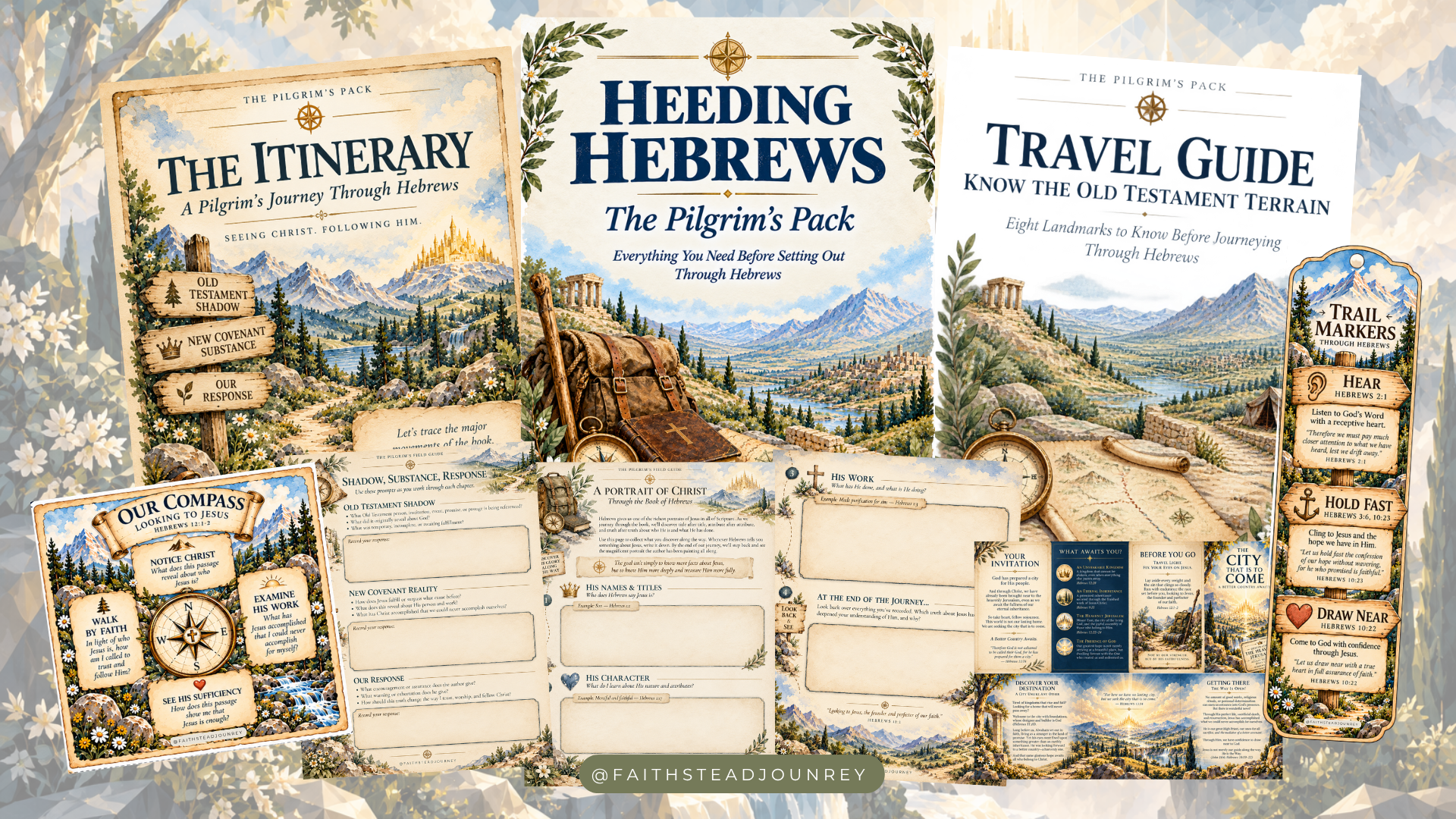
Okay, I got a little carried away and had some fun and this is the outcome of that.
Everything You Need Before Setting Out Through Hebrews
The book of Hebrews is, in many ways, a pilgrim’s journey. Just as the Israelites journeyed through the wilderness toward the Promised Land, we too are sojourners, living by faith and looking forward to a better country—a heavenly one (Hebrews 11:16).
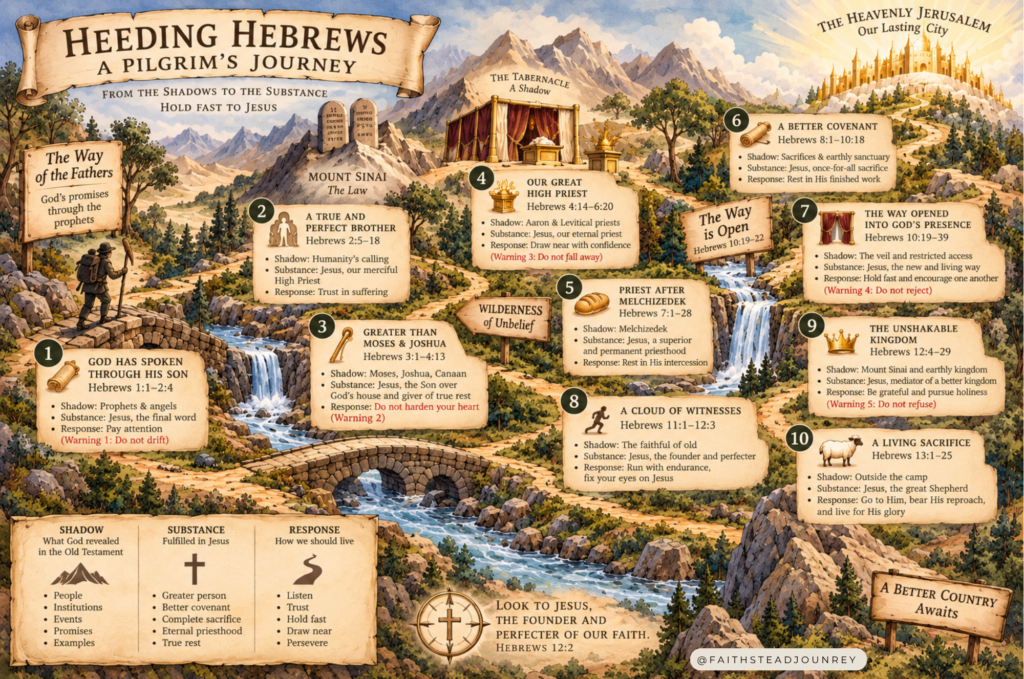
Packing for the Journey
Before setting out on any long journey, it helps to do a little preparation. We study the map, learn where we’re going, and pack the things we’ll need along the way. Our journey through Hebrews is no different. This book will take us across some very old terrain—from Mount Sinai and the wilderness to the tabernacle, the priesthood, the sacrifices, and finally toward the heavenly city that is to come. So before we begin walking verse by verse, let’s pack our bags! We’ll familiarize ourselves with the landscape of Hebrews, learn to recognize its recurring patterns, and gather a few simple tools that will help us follow the author’s argument all the way to Jesus.
Here’s a few things we’ll need:
Itinerary/Map — A Pilgrim’s Journey Through Hebrews
Where will Hebrews take us?
Travel Guide — Know the Old Testament Terrain
What Old Testament background should we know?
Field Guide — Shadow · Substance · Response
How do we study the patterns in Hebrews?
Trail Markers — Hear · Hold Fast · Draw Near/Portrait of Christ
What recurring exhortations should we watch for? And who exactly is Jesus?
Compass — Look to Jesus
Where should our eyes continually turn?
Destination Brochure — The City That Is to Come
What glorious hope lies before us?
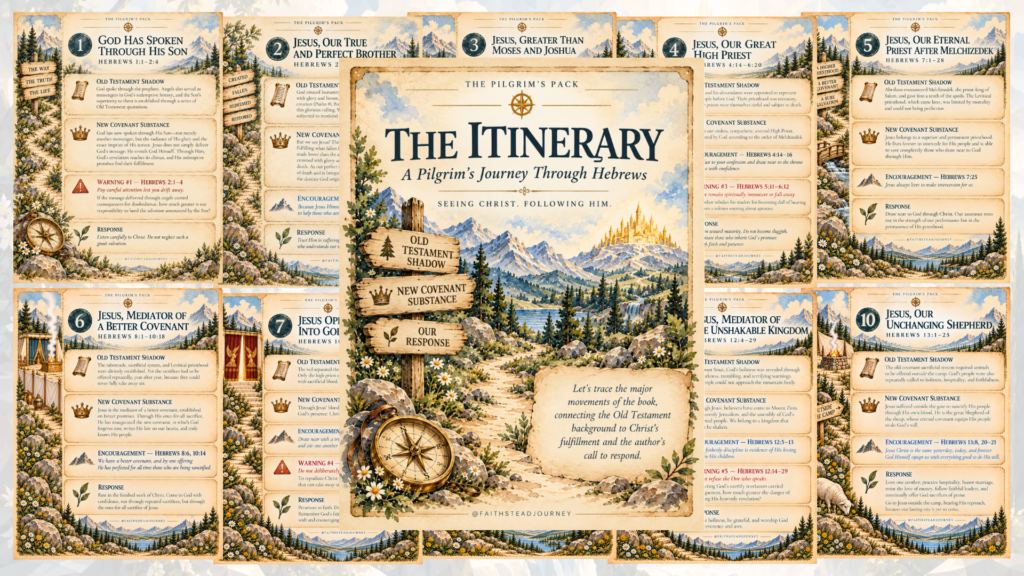
Itinerary/Map — A Pilgrim’s Journey Through Hebrews
Let’s trace the major movements of the book, connecting the Old Testament background to Christ’s fulfillment and the author’s call to respond.
1. God Has Spoken Through His Son – HEBREWS 1:1–2:4
Old Testament shadow: God spoke through the prophets. Angels also served as messengers in God’s redemptive history, and the Son’s superiority to them is established through a series of Old Testament quotations.
New Covenant substance: God has now spoken through His Son—not merely another messenger, but the radiance of His glory and the exact imprint of His nature. Jesus does not simply deliver God’s message; He reveals God Himself. Through Him, God’s revelation reaches its climax, and His redemptive promises find their fulfillment.
WARNING #1 — Hebrews 2:1–4
Pay careful attention lest you drift away.
If the message delivered through angels carried consequences for disobedience, how much greater is our responsibility to heed the salvation announced by the Son?
Response: Listen carefully to Christ. Do not neglect such a great salvation.
2. Jesus, Our True and Perfect Brother – HEBREWS 2:5–18
Old Testament shadow: God created humanity in His image and crowned mankind with glory and honor, giving them dominion over His creation (Psalm 8). But through sin, humanity fell short of this glorious calling. We do not yet see everything subjected to mankind as God originally intended.
New Covenant substance: But we see Jesus! The eternal Son became truly human, fulfilling what fallen humanity could not. Though He was made lower than the angels for a little while, He is now crowned with glory and honor through His suffering and death. As our perfect representative, He defeated the power of death and is bringing many sons to glory, restoring us to the destiny God originally intended for His people.
ENCOURAGEMENT — Hebrews 2:18
Because Jesus Himself suffered when tempted, He is able to help those who are being tempted.
Response: Trust Him in suffering and temptation. We have a Savior who understands our weakness.
3. Jesus, Greater Than Moses and Joshua – HEBREWS 3:1–4:13
Old Testament shadow: Moses faithfully served in God’s house. Joshua led Israel into Canaan, yet the wilderness generation had failed to enter because of unbelief. Even after Joshua, Psalm 95 continued to speak of another rest.
New Covenant substance: Jesus is the Son over God’s house, not merely a servant within it. He leads His people toward the greater rest that Canaan could only anticipate.
WARNING #2 — Hebrews 3:7–4:13
Today, if you hear His voice, do not harden your hearts.
Israel experienced God’s provision but failed to enter because of unbelief. Outward association with God’s people is not a substitute for genuine faith.
Response: Hold fast to Christ, encourage one another daily, and strive to enter God’s promised rest through persevering faith.
4. Jesus, Our Great High Priest – HEBREWS 4:14–6:20
Old Testament shadow: Aaron and his descendants were appointed to represent the people before God. Their priesthood was necessary, but the priests were themselves sinful and subject to death.
New Covenant substance: Jesus is our sinless, sympathetic, eternal High Priest, appointed by God according to the order of Melchizedek.
ENCOURAGEMENT — Hebrews 4:14–16
Hold fast to your confession and draw near to the throne of grace with confidence.
WARNING #3 — Hebrews 5:11–6:12
Do not remain spiritually immature or fall away.
The author rebukes his readers for becoming dull of hearing and gives a solemn warning about apostasy.
Response: Press on toward maturity. Do not become sluggish, but imitate those who inherit God’s promises through faith and patience.
5. Jesus, Our Eternal Priest After Melchizedek – HEBREWS 7:1–28
Old Testament shadow: Abraham encountered Melchizedek, the priest-king of Salem, and gave him a tenth of the spoils. The Levitical priesthood, which came later, was limited by mortality and could not bring perfection.
New Covenant substance: Jesus belongs to a superior and permanent priesthood. He lives forever to intercede for His people and is able to save completely those who draw near to God through Him.
ENCOURAGEMENT — Hebrews 7:25
Jesus always lives to make intercession for us.
Response: Draw near to God through Christ. Our assurance rests not in the strength of our performance but in the permanence of His priesthood.
6. Jesus, Mediator of a Better Covenant – HEBREWS 8:1–10:18
Old Testament shadow: The tabernacle, sacrificial system, and Levitical priesthood were divinely established. Yet the sacrifices were repeated, and access to the Most Holy Place remained restricted. Jeremiah 31 anticipated a new covenant.
New Covenant substance: Jesus ministers in the true heavenly sanctuary. Through His own blood, He has secured eternal redemption and inaugurated the promised new covenant. His sacrifice is once for all. He has sat down because His sacrificial work is complete.
ENCOURAGEMENT — Hebrews 10:14–18
Through Christ’s single offering, His people have been definitively consecrated to God, and He continues His sanctifying work in them. Their sins are forgiven, and no further sacrifice for sin is needed.
Response: Rest in Christ’s finished work rather than attempting to establish your own righteousness before God.
7. Jesus Opens the Way Into God’s Presence – HEBREWS 10:19–39
Old Testament shadow: The veil separated the people from the Most Holy Place. Only the high priest could enter, and only once a year, with sacrificial blood.
New Covenant substance: Through Jesus’ blood, believers have confidence to enter God’s presence. Christ has opened the new and living way.
ENCOURAGEMENT — Hebrews 10:19–25
Draw near with a true heart, hold fast to your confession, and stir one another up to love and good works.
WARNING #4 — Hebrews 10:26–39
Do not deliberately reject Christ’s sacrifice.
To repudiate Christ is to reject the only sacrifice that can take away sin.
Response: Persevere in faith. Do not throw away your confidence. Remember God’s faithfulness and continue gathering with and encouraging other believers.
8. Jesus, the Founder and Perfecter of Our Faith – HEBREWS 11:1–12:3
Old Testament shadow: Abel, Noah, Abraham, Sarah, Moses, and countless others lived by faith. They trusted God’s promises even when they did not receive their ultimate fulfillment during their earthly lives.
New Covenant substance: Jesus is the fulfillment of the promises toward which the faithful looked. He is also the supreme example of endurance, having suffered the cross and taken His seat at God’s right hand.
ENCOURAGEMENT — Hebrews 12:1–3
Run with endurance the race set before you, looking to Jesus, so that you may not grow weary or fainthearted.
Response: Lay aside sin and every hindrance. Endure by faith, remembering those who came before us and fixing our eyes on Christ.
9. Jesus, Mediator of the Unshakable Kingdom – HEBREWS 12:4–29
Old Testament shadow: At Mount Sinai, God’s holiness was revealed through fire, darkness, trembling, and terrifying warnings. The people could not approach the mountain freely.
New Covenant substance: Through Jesus, believers have come to Mount Zion, the heavenly Jerusalem, and the assembly of God’s redeemed people. We belong to a kingdom that cannot be shaken.
ENCOURAGEMENT — Hebrews 12:5–13
God’s fatherly discipline is evidence of His loving work in His children.
WARNING #5 — Hebrews 12:14–29
Do not refuse the One who speaks.
If rejecting God’s earthly revelation carried consequences, how much greater the danger of rejecting His heavenly revelation?
Response: Pursue holiness, be grateful, and worship God with reverence and awe.
10. Jesus, Our Unchanging Shepherd – HEBREWS 13:1–25
Old Testament shadow: The old covenant sacrificial system required animals to be offered outside the camp. God’s people were also repeatedly called to holiness, hospitality, and faithfulness.
New Covenant substance: Jesus suffered outside the gate to sanctify His people through His own blood. He is the great Shepherd of the sheep, whose eternal covenant equips His people to do God’s will.
ENCOURAGEMENT — Hebrews 13:8, 20–21
Jesus Christ is the same yesterday, today, and forever. God Himself equips us with everything good to do His will.
Response: Love one another, practice hospitality, honor marriage, resist the love of money, follow faithful leaders, and continually offer God sacrifices of praise.
Go to Jesus outside the camp, bearing His reproach, because our lasting city is yet to come.
So take up your map, fellow sojourner. Let us heed the warnings, hold fast to the promises, and keep our eyes fixed on Jesus. For here we have no lasting city, but we seek the city that is to come (Hebrews 13:14).
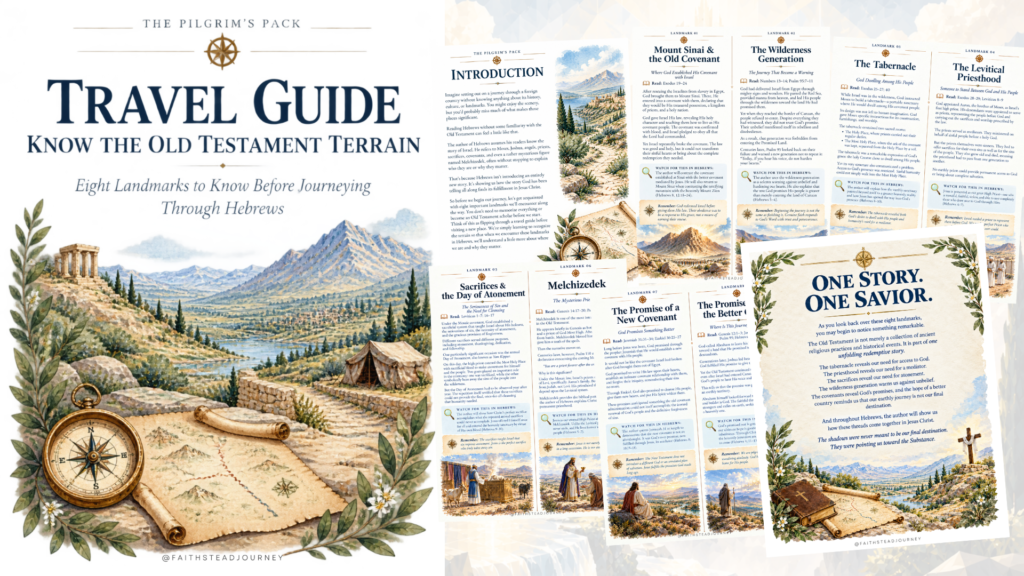
Travel Guide — Know the Old Testament Terrain
Eight Landmarks to Know Before Journeying Through Hebrews
Imagine setting out on a journey through a foreign country without knowing anything about its history, culture, or landmarks. You might enjoy the scenery, but you’d probably miss much of what makes those places significant.
Reading Hebrews without some familiarity with the Old Testament can feel a little like that.
The author of Hebrews assumes his readers know the story of Israel. He refers to Moses, Joshua, angels, priests, sacrifices, covenants, and even a rather mysterious figure named Melchizedek, often without stopping to explain who they are or why they matter.
That’s because Hebrews isn’t introducing an entirely new story. It’s showing us how the story God has been telling all along finds its fulfillment in Jesus Christ.
So before we begin our journey, let’s get acquainted with eight important landmarks we’ll encounter along the way. You don’t need to memorize everything or become an Old Testament scholar before we start. Think of this as flipping through a travel guide before visiting a new place. We’re simply learning to recognize the terrain so that when we encounter these landmarks in Hebrews, we’ll understand a little more about where we are and why they matter.
LANDMARK 01
Mount Sinai & the Old Covenant
Where God Established His Covenant with Israel
Read: Exodus 19–24
After rescuing the Israelites from slavery in Egypt, God brought them to Mount Sinai. There, He entered into a covenant with them, declaring that they would be His treasured possession, a kingdom of priests, and a holy nation.
God gave Israel His law, revealing His holy character and teaching them how to live as His covenant people. The covenant was confirmed with blood, and Israel pledged to obey all that the Lord had commanded.
Yet Israel repeatedly broke the covenant. The law was good and holy, but it could not transform their sinful hearts or bring about the complete redemption they needed.
Watch for this in Hebrews: The author will contrast the covenant established at Sinai with the better covenant mediated by Jesus. He will also return to Mount Sinai when contrasting the terrifying mountain with the heavenly Mount Zion (Hebrews 8; 12:18–24).
Remember: God redeemed Israel before giving them His law. Their obedience was to be a response to His grace, not a means of earning their rescue.
LANDMARK 02
The Wilderness Generation
The Journey That Became a Warning
Read: Numbers 13–14; Psalm 95:7–11
God had delivered Israel from Egypt through mighty signs and wonders. He parted the Red Sea, provided manna from heaven, and led His people through the wilderness toward the land He had promised them.
Yet when they reached the border of Canaan, the people refused to enter. Despite everything they had witnessed, they did not trust God’s promise. Their unbelief manifested itself in rebellion and disobedience.
As a result, that generation was forbidden from entering the Promised Land.
Centuries later, Psalm 95 looked back on their failure and warned a new generation not to repeat it: “Today, if you hear his voice, do not harden your hearts.”
Watch for this in Hebrews: The author uses the wilderness generation as a solemn warning against unbelief and hardening our hearts. He also explains that the rest God promises His people is greater than merely entering the land of Canaan (Hebrews 3–4).
Remember: Beginning the journey is not the same as finishing it. Genuine faith responds to God’s Word with trust and perseverance.
LANDMARK 03
The Tabernacle
God Dwelling Among His People
Read: Exodus 25–27; 40
While Israel was in the wilderness, God instructed Moses to build a tabernacle—a portable sanctuary where He would dwell among His covenant people.
Its design was not left to human imagination. God gave Moses specific instructions for its construction, furnishings, and worship.
The tabernacle contained two sacred rooms:
- The Holy Place, where priests carried out their regular duties.
- The Most Holy Place, where the ark of the covenant was kept, separated from the Holy Place by a veil.
The tabernacle was a remarkable expression of God’s grace: the holy Creator chose to dwell among His people.
Yet its very structure also communicated a problem. Access to God’s presence was restricted. Sinful humanity could not simply walk into the Most Holy Place.
Watch for this in Hebrews: The author will explain how the earthly sanctuary pointed beyond itself to a greater heavenly reality and how Jesus has opened the way into God’s presence (Hebrews 8–10).
Remember: The tabernacle revealed both God’s desire to dwell with His people and humanity’s need for a mediator.
LANDMARK 04
The Levitical Priesthood
Someone to Stand Between God and His People
Read: Exodus 28–29; Leviticus 8–9
God appointed Aaron, the brother of Moses, as Israel’s first high priest. His descendants were appointed to serve as priests, representing the people before God and carrying out the sacrifices and worship prescribed by the law.
The priests served as mediators. They ministered on behalf of sinful people before a holy God.
But the priests themselves were sinners. They had to offer sacrifices for their own sins as well as for the sins of the people. They also grew old and died, meaning the priesthood had to pass from one generation to another.
No earthly priest could provide permanent access to God or bring about complete salvation.
Watch for this in Hebrews: Jesus is presented as our great High Priest—one who is merciful, faithful, sinless, and able to save completely those who draw near to God through Him (Hebrews 4–7).
Remember: Israel needed a priest to represent them before God. We need a perfect Priest who can do what no earthly priest ever could.
LANDMARK 05
Sacrifices & the Day of Atonement
The Seriousness of Sin and the Need for Cleansing
Read: Leviticus 1–7; 16–17
Under the Mosaic covenant, God established a sacrificial system that taught Israel about His holiness, the seriousness of sin, the necessity of atonement, and the gracious provision of forgiveness.
Different sacrifices served different purposes, including atonement, thanksgiving, dedication, and fellowship.
One particularly significant occasion was the annual Day of Atonement, also known as Yom Kippur.
On this day, the high priest entered the Most Holy Place with sacrificial blood to make atonement for himself and the people. Two goats played an important role in the ceremony: one was sacrificed, while the other symbolically bore away the sins of the people into the wilderness.
But the Day of Atonement had to be observed year after year. The repetition itself testified that these sacrifices could not provide the final, once-for-all cleansing that humanity needed.
Watch for this in Hebrews: The author will show how Christ’s perfect sacrifice accomplishes what the repeated animal sacrifices could never accomplish. Jesus offered Himself once for all and entered the heavenly sanctuary by virtue of His own blood (Hebrews 9–10).
Remember: The sacrifices taught Israel that sin requires atonement. Jesus is the perfect sacrifice who truly takes away sin.
LANDMARK 06
Melchizedek
The Mysterious Priest-King
Read: Genesis 14:17–20; Psalm 110:4
Melchizedek is one of the most intriguing figures in the Old Testament.
He appears briefly in Genesis as both the king of Salem and a priest of God Most High. After Abraham returned from battle, Melchizedek blessed him, and Abraham gave him a tenth of the spoils.
Then the narrative moves on.
Centuries later, however, Psalm 110 makes a remarkable declaration concerning the coming Messianic King:
“You are a priest forever after the order of Melchizedek.”
Why is this significant?
Under the Mosaic law, Israel’s priests came from the tribe of Levi, specifically Aaron’s family. But Jesus descended from Judah, not Levi. His priesthood therefore does not depend upon the Levitical system.
Melchizedek provides the biblical pattern through which the author of Hebrews explains Christ’s greater and permanent priesthood.
Watch for this in Hebrews: Jesus is our eternal High Priest after the order of Melchizedek. Unlike the Levitical priests, His priesthood never ends, and He lives forever to intercede for His people (Hebrews 5–7).
Remember: Jesus is not merely another priest in a long succession. He is our eternal Priest-King.
LANDMARK 07
The Promise of a New Covenant
God Promises Something Better
Read: Jeremiah 31:31–34; Ezekiel 36:25–27
Long before Jesus was born, God promised through the prophet Jeremiah that He would establish a new covenant with His people.
It would not be like the covenant Israel had broken after God brought them out of Egypt.
God promised to write His law upon their hearts, establish an intimate covenant relationship with them, and forgive their iniquity, remembering their sins no more.
Through Ezekiel, God also promised to cleanse His people, give them new hearts, and put His Spirit within them.
These promises anticipated something the old covenant administration could not itself accomplish: the inward renewal of God’s people and the definitive forgiveness of sins.
Watch for this in Hebrews: The author quotes Jeremiah 31 at length to demonstrate that the new covenant is not an afterthought. It was God’s own promise, now fulfilled through Jesus, its mediator (Hebrews 8; 10:15–18).
Remember: The New Testament does not introduce a different God or an unrelated plan of salvation. Jesus fulfills the promises God made long ago.
LANDMARK 08
The Promised Rest & the Better Country
Where Is This Journey Taking Us?
Read: Genesis 12:1–3; Joshua 21:43–45; Psalm 95; Hebrews 11:8–16
God called Abraham to leave his homeland and journey toward a land that He promised to give him and his descendants.
Generations later, Joshua led Israel into Canaan, where God fulfilled His promise to give them the land.
Yet the Old Testament continued to speak of another rest, even after Israel had entered Canaan. Psalm 95 still called God’s people to hear His voice and enter His rest.
This tells us that the promise was pointing beyond an earthly territory.
Abraham himself looked forward to a city whose designer and builder is God. The faithful throughout history were strangers and exiles on earth, seeking a better country—a heavenly one.
Watch for this in Hebrews: God’s promised rest is greater than Canaan, and our ultimate hope is greater than any earthly inheritance. Through Christ, we look forward to the heavenly Jerusalem and the lasting city that is to come (Hebrews 4; 11–13).
Remember: We are pilgrims, but we are not wandering aimlessly. God has prepared a heavenly home for His people.
ONE STORY. ONE SAVIOR.
As you look back over these eight landmarks, you may begin to notice something remarkable.
The Old Testament is not merely a collection of ancient religious practices and historical events. It is part of one unfolding redemptive story.
The tabernacle reveals our need for access to God. The priesthood reveals our need for a mediator. The sacrifices reveal our need for atonement. The wilderness generation warns us against unbelief. The covenants reveal God’s promises, and the hope of a better country reminds us that our earthly journey is not our final destination.
And throughout Hebrews, the author will show us how these threads come together in Jesus Christ.
The shadows were never meant to be our final destination. They were pointing us toward the Substance.
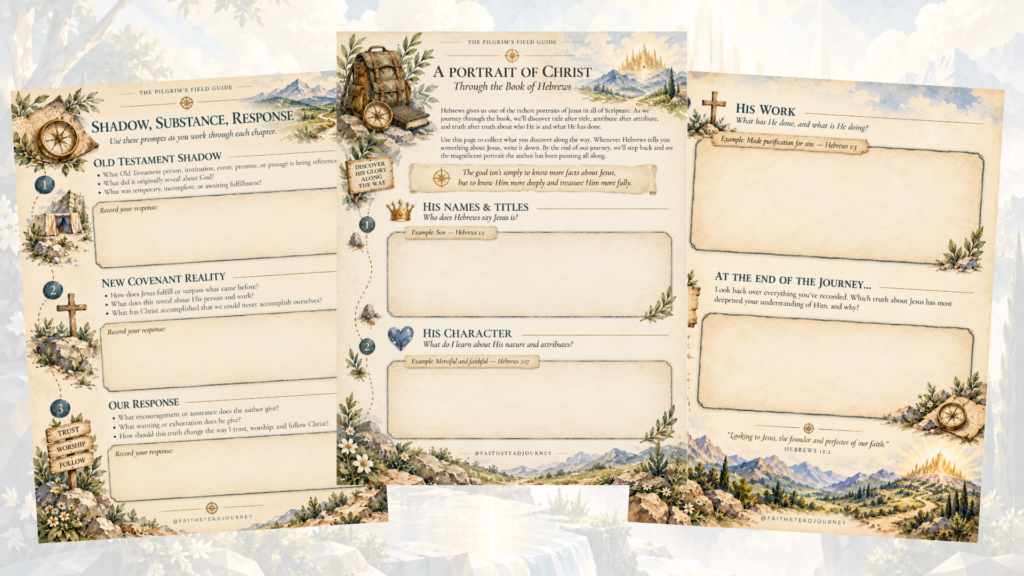
Field Guide
Shadow · Substance · Response
We’ll we encounter warnings, encouragements, trials, and temptations along the way. The author of Hebrews continually calls us to listen, to trust, to draw near, and to persevere—not by relying on our own strength, but by fixing our eyes on Jesus, the founder and perfecter of our faith.
As we journey through Hebrews, we’ll trace three recurring themes at each stop:
- The Old Testament shadow: What had God already revealed through His people, institutions, promises, and history?
- The New Covenant substance: How does Jesus fulfill, surpass, or bring that revelation to completion?
- Our response: In light of who Jesus is and what He has accomplished, how should we live? What encouragement or warning does the author give us?
This is not a rigid three-part outline imposed on every chapter. Rather, it is a recurring theological and literary movement throughout Hebrews. And the most beautiful part is that the author doesn’t merely tell us what to do. He first shows us who Jesus is, and our response flows from the revelation of Christ.
In John 14:6, Jesus tells His disciples, “I am the way, and the truth, and the life. No one comes to the Father except through me.” What a beautiful reminder for our pilgrim’s journey! The Way is a Person, and our destination is not merely a place, but the presence of a Person—our heavenly Father. Jesus is both the way to the Father and the One who brings us into His presence.
So when Hebrews calls us to persevere, hold fast, and run the race with endurance, it is not calling us to reach our heavenly destination through sheer determination or our own righteousness. It is calling us to remain in Christ, to abide in Him, and to continue trusting the One who has already opened the way.
The warnings in Hebrews do not mean that those who possess genuine saving faith can lose their salvation. Rather, they are among the means God uses to preserve His people, calling us to examine our faith and continue trusting in Christ. Our assurance rests not in the strength of our grip on Him, but in the faithfulness of the One who holds us fast (John 10:28–29; Philippians 1:6).
We persevere because God preserves us. And we reach the Father because Jesus Himself is the Way. That is the heart of our journey through Hebrews: not striving to earn our way into God’s presence, but learning to trust, treasure, and abide in the One who has already brought us near.
A Portrait of Christ
Who is Jesus? Hebrews gives us one of the richest portraits of Jesus in all of Scripture. As we journey through the book, we’ll discover title after title, attribute after attribute, and truth after truth about who He is and what He has done and we’ll build a portfolio of who Jesus is.
Whenever Hebrews tells you something about Jesus, write it down. By the end of our journey, we’ll step back and see the magnificent portrait the author has been painting all along. The goal isn’t simply to know more facts about Jesus, but to know Him more deeply and treasure Him more fully.
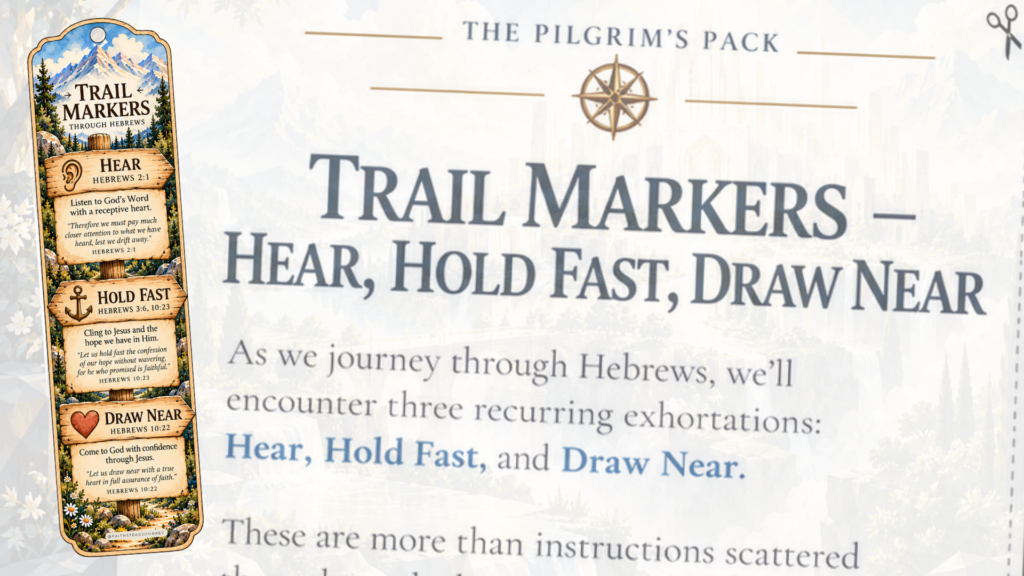
Trail Markers — Hear · Hold Fast · Draw Near
Every journey needs trail markers to keep us headed in the right direction. Throughout Hebrews, the author repeatedly calls us to hear, hold fast, and draw near. As you study, watch for these recurring exhortations and mark them in your notes. They remind us that our response to seeing Christ more clearly is to listen to His Word, hold fast to our hope, and draw near to God through Him.
Another interesting pattern to watch out for is how these five warnings become increasingly serious as the author develops his argument.
The Progression of the Five Warnings
- Drifting — Neglecting what we have heard.
- Hardening — Allowing unbelief to take root.
- Falling away — Turning away from the faith once professed.
- Rejecting — Deliberately repudiating Christ’s sacrifice.
- Refusing — Rejecting God’s final revelation through His Son.
Something I find particularly beautiful is that Hebrews does not leave us with warnings alone. The author repeatedly places the danger of unbelief alongside the sufficiency of Christ and the certainty of God’s promises.
| Warning | Corresponding encouragement |
| Don’t drift away (2:1–4). | Jesus became our merciful High Priest who helps us in temptation (2:17–18). |
| Don’t harden your hearts (3:7–4:13). | We have a great High Priest through whom we may confidently approach God’s throne (4:14–16). |
| Don’t fall away (5:11–6:12). | God’s promises are unchangeable, and Jesus is the anchor of our souls (6:13–20). |
| Don’t reject Christ’s sacrifice (10:26–39). | Christ has opened the way into God’s presence; we have a better and abiding possession (10:19–25, 34–39). |
| Don’t refuse the One who speaks (12:14–29). | We have received an unshakable kingdom through Jesus (12:22–28). |
Notice how the solution to every warning ultimately brings us back to Christ. The author does not simply say, “Try harder so that you won’t fall away.” He repeatedly reminds his readers of who Jesus is, what He has accomplished, and why He is worthy of their continued trust. This is also why the warning passages should never be studied in isolation from the surrounding chapters.
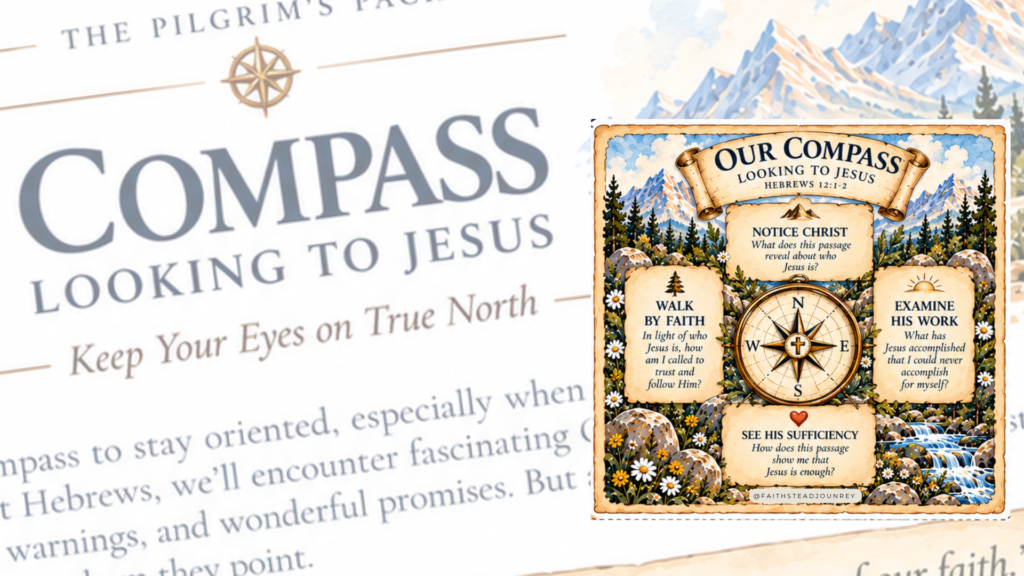
Compass — Look to Jesus
Every traveler needs a compass to stay oriented, especially when the road becomes difficult or unfamiliar. Throughout Hebrews, we’ll encounter fascinating Old Testament history, rich theological truths, serious warnings, and wonderful promises. But amid all these things, we must never lose sight of the One to whom they point.
Our compass is Hebrews 12:2: “Looking to Jesus, the founder and perfecter of our faith.”
Whenever we find ourselves getting lost in the details, these four simple questions will help turn our eyes back to Christ. After all, He is not merely part of our journey—He is the Way, the One who sustains us along it, and the One who brings us to the Father.
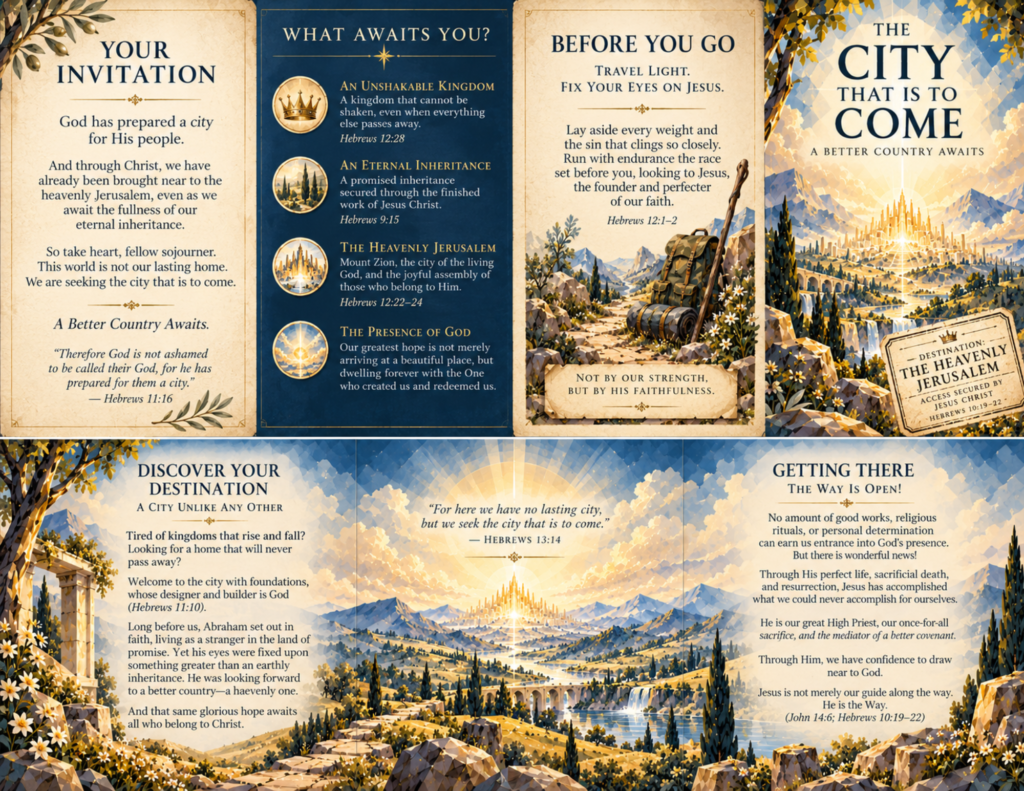
Destination Brochure — The City That Is to Come
Every good journey begins with knowing where you’re going. Beyond the wilderness lies a better country, an unshakable kingdom, and a city whose designer and builder is God. Hebrews calls us strangers and sojourners here, reminding us that this world is not our lasting home. But we are not wandering without a destination, nor are we left to find the way ourselves. God has prepared a city for His people, and Jesus has opened the way.
And when the journey becomes difficult, remembering where we’re headed gives us hope to keep going. Hebrews continually turns our eyes from what we can see now to what God has promised—just as Abraham looked forward to the city to come, Moses looked to the reward, and Jesus endured the cross for the joy set before Him. Keeping our eyes on the destination helps us endure the road beneath our feet.
So unfold your brochure, fellow pilgrim, and take a glimpse of the glorious hope that lies ahead. Behold, a better country awaits!
Note: This brochure comes in two formats: one designed to be viewed as a flat page, and another designed to be printed, folded, and taken along on your journey through Hebrews. Choose whichever format works best for you!