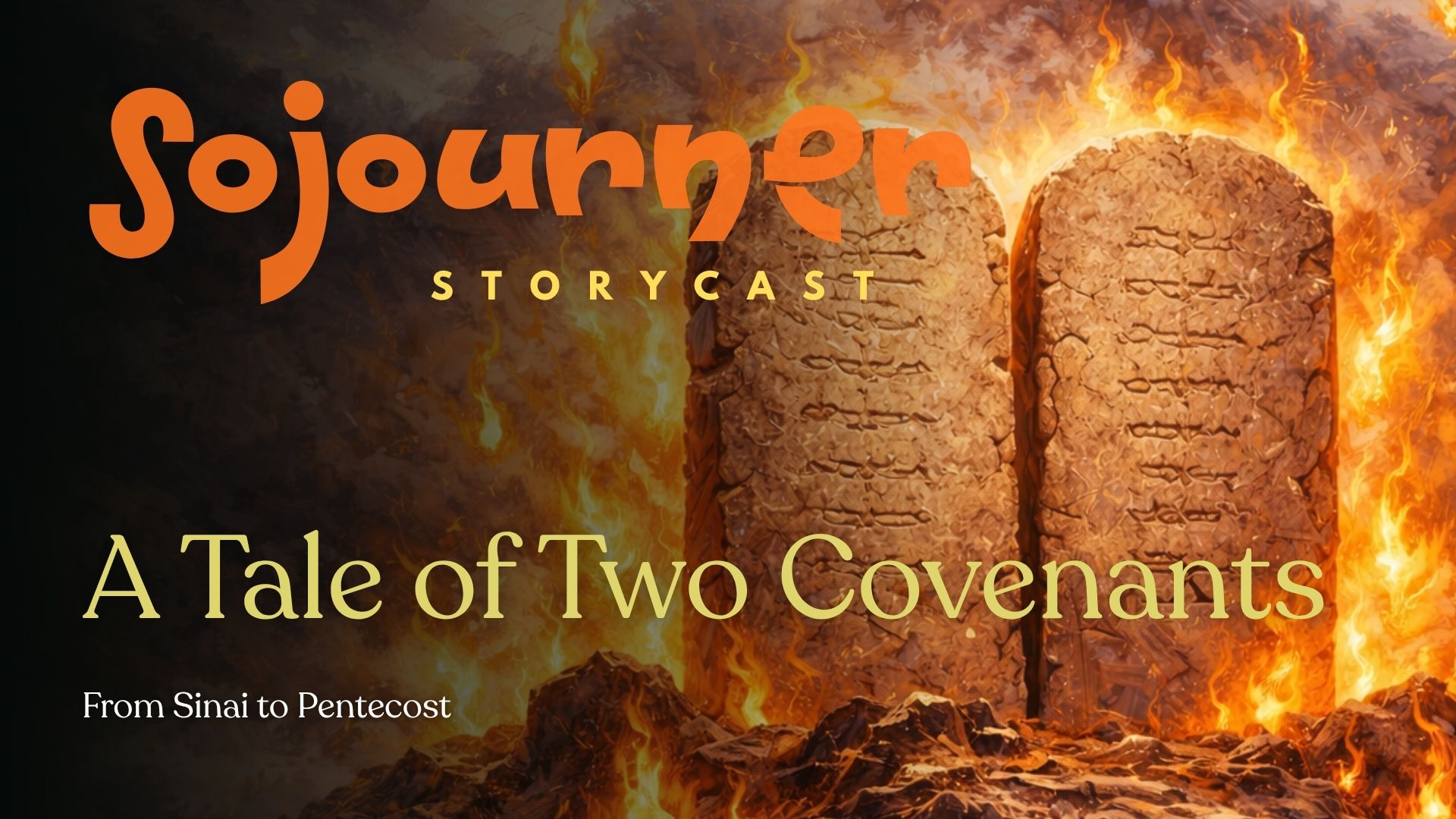
The Mountain That Burned
Long before there was a city called Jerusalem, long before kings and temples, God’s people were sojourners.
This means they were travelers that had no land to call their own. No houses. No gardens.
Only tents… and a long road stretching out behind them.
Not many days earlier, they had been slaves in Egypt—working under the hot sun, making bricks for a king who did not know their God. But everything had changed when God sent a man named Moses.
Through mighty wonders—rivers turning to blood, darkness covering the land, finally on the night of the Passover—God led His people out by His mighty arm.
And when they reached the edge of the sea, trapped with nowhere to go, God made a path through the waters themselves. The sea stood up like walls on either side, and His people walked through on dry ground.
They were free.
But freedom did not mean they had arrived.
They were now in the wilderness—a wide, open land of dust and rock, where the sun burned hot in the day and the nights turned cold. They moved from place to place, carrying their tents, their children, and everything they owned.
God did not leave them alone in that wilderness. By day, He led them with a cloud that stretched across the sky. By night, that same cloud glowed with fire, lighting their way in the darkness.
Where the cloud moved, they moved.
Where it stopped, they stopped.
Until one day… the cloud stopped at a mountain.
It was called Mount Sinai.
God called to Moses from the mountain and said, “Tell the Israelites what I have done. Tell them how I carried them on eagle’s wings… and brought them to myself.”
Imagine that.
Not just out of Egypt…but to Himself.
God was not only rescuing them—He was drawing them close.
And then He made them a promise: “If you obey me and keep my covenant, you will be my special treasure… a holy nation.” A covenant is a special promise between God and His people—like a strong agreement where God says, “You will belong to me and He shows them how to live as His people.
Out of all the nations on the earth—the Israelites would belong to Him in a special way.
Moses came down from the mountain and told the people everything God had said.
And the people answered together, with one voice: “We will do everything the Lord has said.”
Then God said something surprising. “I am going to come down.”
God wasn’t going to stay far away. He would come down close to His people.
“Prepare yourselves,” God said.
But before He came, He gave them a warning. “Set a boundary around the mountain. Do not go up the mountain. Do not even touch it or else you will die”
This warning was serious. But it was not because God is cruel. It was because God is holy.
It is a little like the sun. The sun gives light. It gives warmth. Without it, nothing could live. But if you tried to get too close to the sun, it would burn you. Not because the sun is unkind, but because it is so powerful.
God is like that—but even more. His goodness is so pure, so bright, so perfect… that anything broken by sin cannot simply rush into His presence. So God set limits. Not to push His people away—but to keep them safe. To teach them: “This is who I am… and you must come near in the right way.”
So the Israelites washed their clothes and prepared themselves.
On the third morning, the waiting ended. The ground began to tremble.
A thick cloud covered the top of the mountain, darker than any storm they had seen. Thunder rolled across the sky, and flashes of lightning broke through the darkness. A sound like a trumpet—loud and growing louder—filled the air.
And then… fire.
The top of the mountain burned, wrapped in smoke that rose high into the sky, as if the mountain itself had become a furnace.
Moses walked into the fire and the cloud, where God was.
And there, God gave His people His law—teaching them how to live, how to love what is good, and how to belong to Him. It was a holy and unforgettable moment that would be remembered for generations. Jewish tradition holds that this day came about fifty days after the Passover, the night they left Egypt.
The people saw it and they were afraid. So afraid that they stepped back… far back… away from the mountain.
And they said to Moses: “Speak to us yourself. Then we will listen. But don’t let God speak to us… or we will die.”
But Moses answered them: “Do not be afraid. God is teaching you to respect Him, so that you will not sin.”
God was not trying to scare them—He was teaching them who He truly is: holy, good, and not ordinary—so they would understand how serious sin really is and not walk into it blindly.
The Golden Calf
But while God spoke to Moses on the mountain the people grew restless. Moses had been on the mountain for forty days and forty nights and they grew impatient.
So the Israelites made a golden calf to worship instead of God. You would think that after seeing God’s power, they would hold tightly to His words. But human hearts forget easily.
When Moses came down and saw what had happened, there was judgment. And on that day, about three thousand people died.
It was a heartbreaking moment. God had chosen them to be His special people and given them the law so that they could be near Him. But even after hearing God’s voice, even after promising to obey, their hearts still turned away.
And yet, even after their failure, God did not give up on His people. Instead, He showed both His justice and His mercy.
After the sin of the golden calf, Moses stood as a mediator—a peacemaker—between God and the people, asking God to forgive them. And in His mercy, God chose to stay with them and continue leading them.
Then God renewed the covenant—the agreement between Him and His people—He promised to be their God, even after they failed.
Moses went back up the mountain, and God gave him the Ten Commandments again. Then this covenant was sealed in a special way—kind of like when you make a promise with someone and sign an agreement, do a special handshake, or even a pinky swear to show you really mean it.
Moses built an altar where animal sacrifices were offered to God. And then Moses took half of the blood of those sacrifices and sprinkled it on the altar representing God’s side of the covenant. Then he took the other half and sprinkled it on the people showing that the people agreed to the covenant, saying, “This is the blood of the covenant that the LORD has made with you.”
This showed something very important: being in a relationship with God is serious. Sin is costly, and forgiveness always involves the giving of life in someone’s place.
In the old covenant, God allowed animals to be sacrificed as a way to cover sin for a time. When people sinned, an animal would die instead of them. This helped the people understand that sin is serious and that it always brings consequences.
But animal sacrifices could not take away human sin completely. They were never meant to be the final solution. They could only point forward to something greater. That is why the sacrifices had to be offered again and again. Every time people sinned, another sacrifice was needed, because these offerings could only cover sin for a time, not remove it forever.
So their sacrifice was temporary, showing that God’s people needed something greater—a better covenant, a perfect sacrifice, and a Savior who would one day come to take away sin once and for all.
The Law (Ten Commandments)
Hi Sojourners,
Before we move on, I want you to sit with this for a moment. Because what we just saw at Mount Sinai is something we all need to understand.
God gave the Israelites His law—the Ten Commandments. He wrote them on two tablets of stone. Maybe this is something you’ve heard in church or Sunday school before.
Things like:
- Do not worship other gods
- Honor your father and your mother
- Do not lie
- Do not steal
- Do not misuse God’s name
Simple words… but deep and serious. The law is good. It shows us what is right. It shows us what is wrong. It shows us how life is meant to be lived under a holy God.
But the law also does something else…
It shows us that we cannot keep it perfectly. It shows us that we are sinful, and that sin keeps us from being close to a holy God.
It is like a mirror—you look into it and you see what is true about yourself. But the mirror cannot change you. It can only show you what is there.
That is what happened at Mt. Sinai.
God gave His people truth… but their hearts were still broken. Just like the Israelites were slaves in Egypt, all people are slaves to sin. And that’s why God made a way for His people to be cleansed of their sins through the sacrificing of animals.
We might wonder, “Why does God make people kill animals?” But it’s important to understand that God is not being mean. It is not God’s cruelty that brings death—it is our sin. When we sin and do something bad, we hurt people and invite death into the world.
However, God did not leave His people without hope.
Throughout the Old Testament, God spoke through prophets who pointed forward to a day when hearts would be healed and made new from the inside.
The prophet Jeremiah said that God would one day make a new covenant—not written on tablets of stone anymore, but written on our hearts.
That means God’s truth would not just be something we read or try to follow from the outside… but something God would place inside us, helping us want what is right and love what is good.
And the prophet Ezekiel said something even more amazing—that God would take out hearts that were “hard like stone” and give hearts that are living and soft.
In other words, hearts that were once stubborn toward God would be changed so they could respond to Him, love Him, and follow Him.
And this promise was pointing forward to another Passover about 1,400 years later to a Savior who would set people free from sin. And do you know who it is? Yes, Jesus Christ!
A New Covenant
On this Passover, Jesus made a new covenant — a new promise between God and His people. This new covenant was not written on tablets of stone, but written on the hearts of those who would believe.
Under the old covenant, God’s people were expected to keep His law perfectly — to live in complete obedience. But since no one could fully keep the law, the law revealed our sin and our need for a Savior.
In the new covenant, God did something extraordinary: He sent Jesus to fulfill everything the law required on our behalf. He lived a perfect life and never disobeyed the law. Where we failed to obey, Jesus obeyed completely. And where we deserved judgment, Jesus took our place.
Just as a lamb was sacrificed during Passover to pay for sins, Jesus willingly went to the cross to die and take the punishment for our sins, so that we could be forgiven, cleansed, and brought back into a close relationship with God.
Jesus is the final and perfect sacrifice. Unlike the old sacrifices that had to be repeated again and again, Jesus’ sacrifice was once for all. He took care of our sin completely—past, present, and future—so that anyone who trusts in Him can be fully forgiven and made right with God.
That’s why, on the night of the Passover, during the last supper, Jesus took the cup and said, “This is the blood of the new covenant.” He was showing that His own blood would be the covenant seal—the way God was making and confirming this new promise with His people.
Just like Moses sprinkled the blood of animals on the altar and on the people to show they were entering into God’s covenant, Jesus would soon pour out His own blood on the cross as the true and final sacrifice—securing the new covenant with us forever.
Because Jesus was perfectly sinless, death could not hold Him. On the third day, He rose again, victorious over sin and death. His blood was poured out to establish the new covenant, and His resurrection confirmed that His sacrifice was accepted and complete.
So now we have a new covenant with God! This new covenant is not based on our ability to keep the law, but on Jesus’ finished work on the cross. He fulfilled the law on our behalf, and through His death and resurrection we receive forgiveness, a restored relationship with God, and the gift of a new heart empowered by His Spirit.
And this is where the rest of our story picks up.
It was the day of Pentecost—which means “fifty” in Greek. And this was a Jewish feast that happened fifty days after Passover.
In the city of Jerusalem, the followers of Jesus were all gathered together. About 120 men and women in all. And they were not there by accident.
Before Jesus had ascended into heaven just days earlier, He had told them to wait in Jerusalem, because God the Father had promised to give them the gift of the Holy Spirit.
And so they waited. Not on a mountain this time, but in a room.
And suddenly—it came.
A sound like a mighty rushing wind filled the house where they were sitting. Not a gentle breeze… but something powerful, something alive, something that seemed to come from everywhere at once.
Just as at Mt. Sinai there had been thunder and the shaking of the ground…now there was a loud sound that filled every corner of the room.
And then—fire! What looked like tongues of fire appeared and rested on each one of them.
Not fire on a mountain that kept people away…but fire that came down upon people themselves.
At Sinai, the mountain burned with fire and the people stood back in fear. But here… the fire did not burn them. It rested on them. And they were all filled.
Filled with the Holy Spirit. The gift that the Father had promised had come.
This time, God was not speaking only to one man on a mountain. He was speaking through all of them.
The Holy Spirit gave them the ability to speak in many different languages they had never learned before. As they were all speaking, people from every nation that were staying in Jerusalem gathered to see what was going on.
They were amazed. They heard the followers of Jesus speaking in their own languages.
“Wait… aren’t all these people from Galilee?” they said. “Then how is it that we hear them speaking about the mighty works of God in our own languages!” they asked.
Then Peter stood up and preached the good news about Jesus: how He had died on the cross for sin, how He had risen from the dead, and how He is now Lord over all.
And that day, about three thousand people believed. They turned from their sin, trusted in Jesus, and were baptized.
Three thousand people brought from death to life in one day.
Do you remember what happened at Mt. Sinai… when the people worshiped the golden calf, about three thousand people died under judgment.
But now, at Pentecost, after the gift of the Spirit came, three thousand people were saved through grace.
From judgment… to mercy.
From death… to life.
From law written on stone… to Spirit written on hearts.
Key Scripture
The Bible tells us in 2 Corinthians 3:6: “He has given us the power to serve under a new covenant. The covenant is not based on the written law of Moses. It comes from the Holy Spirit. The written law kills, but the Spirit gives life.”
The law “kills” because it shows us the truth about ourselves—we are sinners, and we deserve judgment before a holy God.
But the Spirit “gives life” because the Holy Spirit does what the law could not do. He gives us new hearts, helps us turn away from sin, and gives us the power to follow Jesus.
Isn’t that wonderful!
Old Covenant vs New Covenant
Did you know that our Bible has two main sections? The first part is called the Old Testament, and it tells the story of the world from creation all the way up to just before Jesus is born. The second part is called the New Testament, and it begins with the birth of Jesus and continues through the life of the early church and the letters written by the apostles.
The word testament actually means covenant, which if you remember is a special word for a promise or agreement God makes with His people. So you could also say the Bible shows us two big covenants: the old covenant and the new covenant.
The old covenant was given through Moses, when God gave His law to Israel at Mount Sinai. The new covenant was fulfilled through Jesus Christ. After Jesus rose from the dead and ascended into heaven, God poured out His Holy Spirit at Pentecost in the book of Acts. This marked the beginning of the new covenant in a powerful and visible way, as God formed His church and brought people into a new life of faith in Christ.
So you might wonder: what happened to the old covenant? And does that mean we don’t need to obey the Ten Commandments anymore?
That’s a really important question.
The old covenant did not mean that God’s law was bad or useless. The Ten Commandments still show us what God is like and what is good and right. They teach us how people should live in a way that pleases God and love others.
But in the old covenant, the law was given as a rule to obey, and it showed people that they could never perfectly keep it. It pointed out sin, but it could not fix the human heart.
In the new covenant, something changes. God’s law does not disappear—but it is fulfilled by Jesus. He perfectly obeyed God’s law in our place, and then He gives us His Holy Spirit to help His people begin to live in a new way.
So Christians don’t ignore God’s commands. Instead, we are now actually empowered to follow God’s commands because His Spirit is working in us from the inside out.
In the old covenant, Moses acted as a mediator—someone who stands between two sides—to help connect God and the people. But in the new covenant, Jesus is our perfect Mediator. He is the one who brings us to God. Because Jesus is both fully God and fully man, He connects us to God in a way no one else ever could. Through Jesus, we can come close to God.
And isn’t that the whole story from the very beginning?
God was not just rescuing His people from Egypt… He was bringing them to Himself. He wasn’t only giving them freedom—He was calling them to be His own special treasure, a holy people who belong to Him.
And that same heart of God is still true today.
If this episode helped you understand God’s story a little better, share it with a friend so they can also learn what God has done.
And remember, because of what Jesus has done for us, we can come to God. We are not far away anymore. We are welcomed. We are forgiven. And we belong to Him.
Links to podcast: