
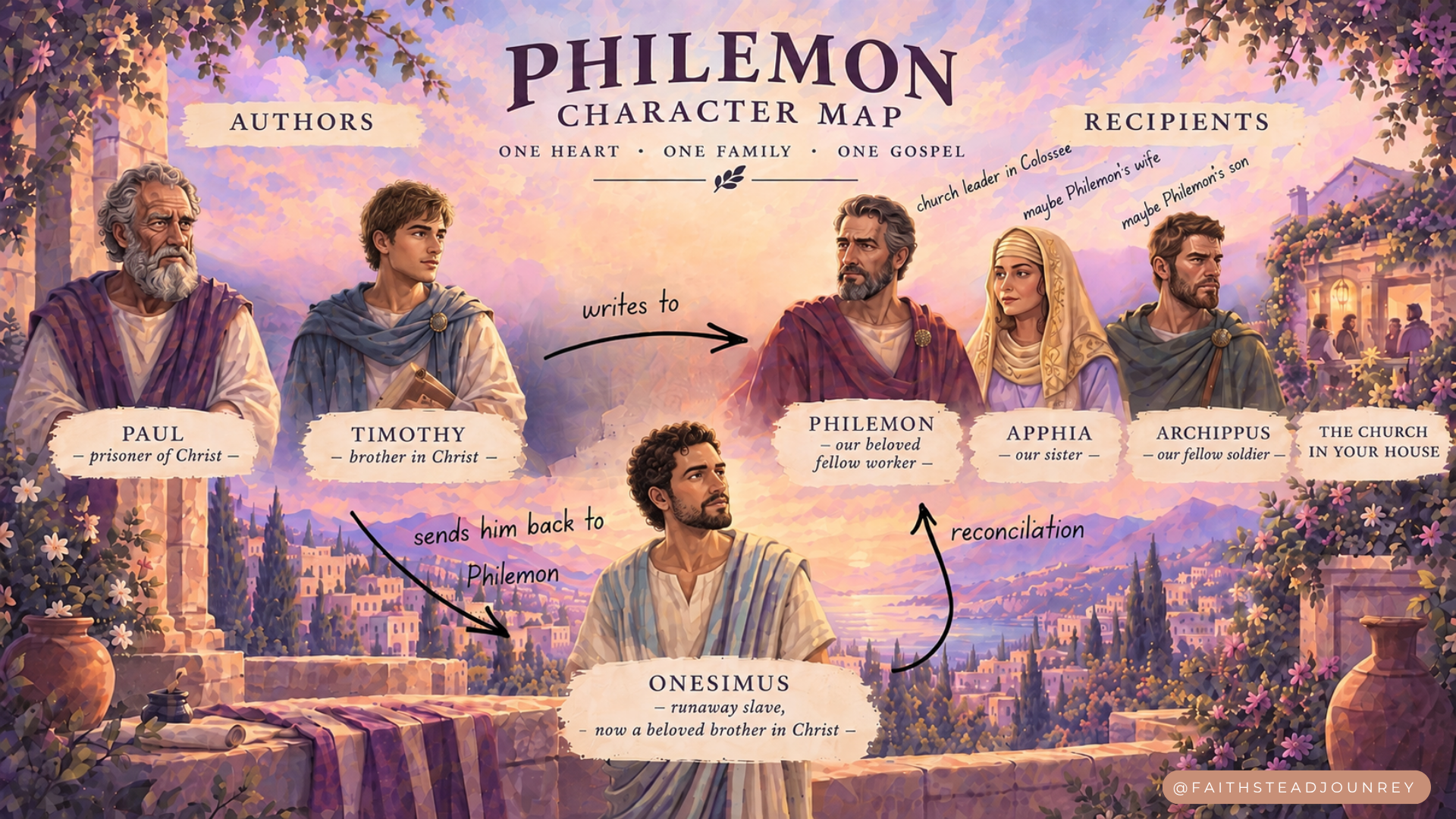
The book of Philemon is a letter that Paul wrote, with Timothy, to Philemon concerning a man named Onesimus, who was Philemon’s slave. We don’t know all the details surrounding the events that led to this letter, but we do know this: Paul met Onesimus while he was imprisoned, and during that time Onesimus became a believer in Christ. Now Paul is sending Onesimus back to Philemon with the hope of reconciling the two and restoring their relationship—not simply as master and slave, but as brothers in Christ.
Have you ever disliked, quarreled with, or simply been annoyed by another Christian? If so, this letter is for you.
Go ahead and fill in the blanks. Make this letter your own.
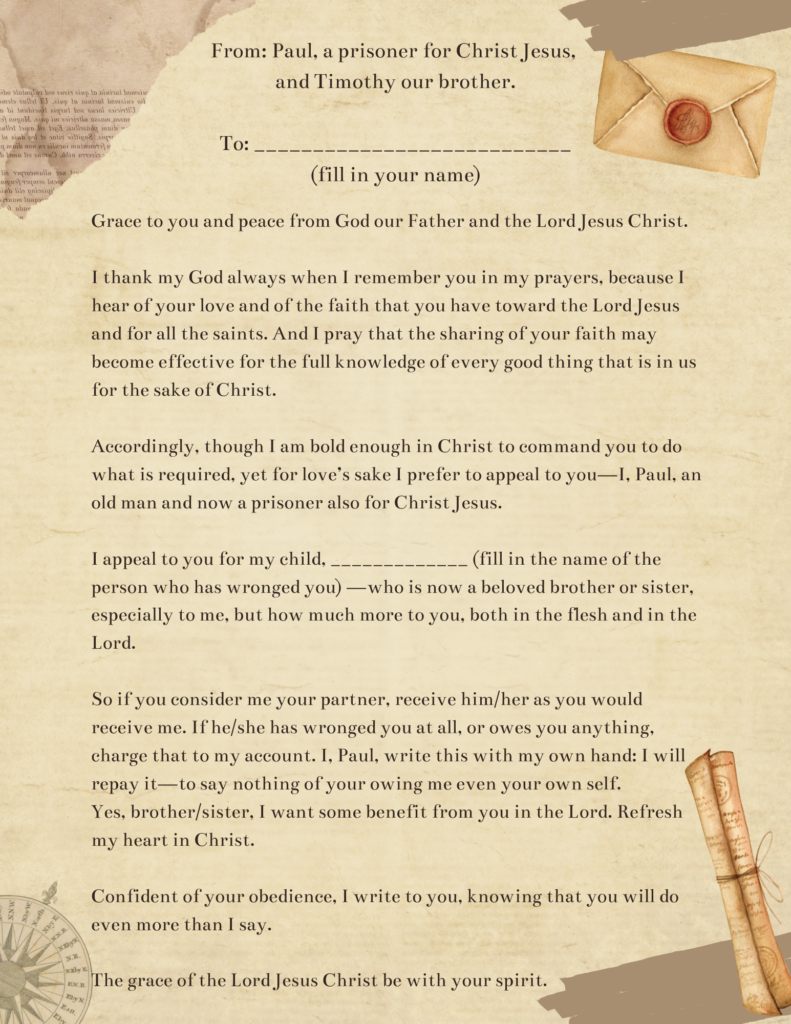
Interestingly, this is the only letter of Paul’s in which he does not explicitly mention the death and resurrection of Jesus. And yet, the gospel is stamped all over this letter. Though Philemon is the shortest letter Paul wrote—only 25 verses—it packs a powerful punch in showing us what the gospel looks like when it is lived out in the difficult reality of a broken relationship.
Prisoner for Christ Jesus
1 Paul, a prisoner for Christ Jesus, and Timothy our brother,
This letter is written by a prisoner. Paul is traditionally believed to have written Philemon from Rome around AD 60–62, while he was under house arrest. You can read how Paul ended up in Rome at the end of the book of Acts. During this imprisonment, Paul also wrote what are traditionally called his prison epistles: Ephesians, Philippians, Colossians, and Philemon.
What is especially interesting is how Paul identifies himself in this particular letter.
Paul explicitly identifies himself as a prisoner twice:
- Philemon 1 — “Paul, a prisoner for Christ Jesus…”
- Philemon 9 — “I, Paul, an old man and now a prisoner also for Christ Jesus…”
He then returns to the idea of his imprisonment several more times:
- Philemon 10 — Onesimus is the child “whose father I became in my imprisonment.”
- Philemon 13 — Onesimus had been ministering to Paul while he was “in imprisonment for the gospel.”
- Philemon 23 — Paul mentions Epaphras, “my fellow prisoner in Christ Jesus.”
So imprisonment isn’t merely a passing detail in the letter. Paul deliberately brings it to the forefront.
Among Paul’s thirteen letters, he begins nine by identifying himself as an apostle, two without a title, Philippians by identifying himself and Timothy as “slaves” of Christ Jesus, and Philemon by identifying himself as a “prisoner.” I find it particularly interesting that Paul doesn’t call himself a “slave” here, especially since the subject of the letter is a slave. Instead, he chooses the word “prisoner.”
Why?
“Prisoner” immediately places Paul in a position of vulnerability. If Paul had begun by calling himself a “slave of Christ Jesus,” the emphasis would naturally fall on his belonging and submission to Christ. But by beginning with “a prisoner for Christ Jesus,” Paul puts himself in the position of someone who is not free. And that is significant because he is about to ask Philemon to reconsider his relationship with Onesimus.
Paul has the authority of an apostle. In fact, he acknowledges in verse 8 that he could command Philemon:
“Though I am bold enough in Christ to command you to do what is required, yet for love’s sake I prefer to appeal to you.”
Paul could exercise his authority, but he deliberately chooses not to. Instead, he approaches Philemon from a position of weakness and suffering.
It’s almost as if Paul is saying:
“I could command you, but instead I am appealing to you in love. I am suffering for Christ, and I am asking you to willingly bear a cost for the sake of your brother.”
And this is where Paul’s identity as a prisoner becomes so powerful.
Paul doesn’t simply tell Philemon, “Be like Jesus.” He models the gospel toward Philemon. He lays down his right to command, identifies himself with weakness, intercedes for the one who has wronged Philemon, offers to bear the debt, and asks that the offender be received as a beloved brother.
Paul chooses the identity of “prisoner” because it embodies the posture from which he is making his appeal: a suffering servant who voluntarily sets aside his authority for the sake of love and reconciliation.
And ironically, that makes Paul’s choice of “prisoner” even more powerful in a letter about a slave.
Christian Accountability
To Philemon our beloved fellow worker 2 and Apphia our sister and Archippus our fellow soldier, and the church in your house:
3 Grace to you and peace from God our Father and the Lord Jesus Christ.
Although Philemon had a personal decision to make about Onesimus, that decision had implications for the whole Christian community. Paul therefore addressed the letter not only to Philemon, but also to Apphia, Archippus, and “the church in your house.” Apphia may have been Philemon’s wife or daughter, and Archippus, who is also mentioned in Colossians 4:17, may have been his son.
This may feel countercultural to us. We generally don’t like having our private matters aired publicly, and we tend to believe that other people’s personal problems are none of our business. But Christianity isn’t merely private. Philemon’s relationship with Onesimus existed within the body of Christ. The gospel had changed the very category of their relationship, and Paul created a positive form of social accountability by bringing their reconciliation into the life of the church.
The church doesn’t simply observe our reconciliation from the sidelines; it provides the community and shared identity in Christ that make reconciliation possible. Philemon and Onesimus were no longer defined merely by what had happened between them. They belonged to one another as brothers within the body of Christ.
This doesn’t mean that every personal conflict should be broadcast to the entire church. Paul himself is remarkably discreet about what Onesimus had done. The point is not public exposure, but Christian restoration. When a relationship between believers is broken, the goal of bringing others into the situation should never be humiliation or taking sides, but helping the people involved move toward truth, forgiveness, and restored fellowship.
The church is supposed to help us live out the gospel. Obedience is not merely something we practice privately; it is something the Christian community can witness, encourage, and help us pursue.
Our relationships are actually discipleship opportunities. We can be tempted to divide our lives into “my spiritual life” and “my personal relationships,” but Paul doesn’t allow that division. How we treat our spouse, children, neighbors, coworkers, friends—and even the people who have hurt us—is part of our obedience to Christ.
Philemon’s theology wasn’t being tested primarily by what he said in church, but by a much harder question: What will you do when the person who hurt you comes back to your door?
There is also something beautiful about Paul not leaving Philemon and Onesimus to work everything out completely on their own. Paul steps into the relationship as a mediator and gives Philemon an opportunity to demonstrate Christian honor before the community. At the same time, he restores honor to Onesimus by elevating him from his former social position to the status of a beloved brother in Christ.
The church should be a place where reconciliation restores people rather than publicly humiliates them. Our relationships are part of our discipleship, and the church is the community in which that discipleship is lived out.
Philemon’s Love and Faith
4 I thank my God always when I remember you in my prayers, 5 because I hear of your love and of the faith that you have toward the Lord Jesus and for all the saints, 6 and I pray that the sharing of your faith may become effective for the full knowledge of every good thing that is in us for the sake of Christ. 7 For I have derived much joy and comfort from your love, my brother, because the hearts of the saints have been refreshed through you.
Paul has high praise for Philemon. He commends his love and faith toward the Lord Jesus and toward the saints, and he tells him how much joy and comfort his love has brought to the hearts of other believers. But what stood out to me most in this opening section is what Paul says in verse 6:
“And I am praying that you will put into action the generosity that comes from your faith as you understand and experience all the good things we have in Christ.” (NLT)
This is an important principle in the Christian life: the fruit of the Spirit is not produced simply by knowing what is right and wrong or by training ourselves to behave better. Love, joy, peace, patience, kindness, goodness, faithfulness, gentleness, and self-control are the fruit of a life that has been touched and transformed by God. They are the overflow of what God is doing within us.
The more deeply we understand and experience the good things we have in Christ—His forgiveness, reconciliation, grace, love, mercy, freedom, fellowship, new identity, and eternal life—the more those realities begin to shape the way we live.
What we believe about the gospel eventually works its way into our relationships.
And I think that is exactly what Paul is getting at with Philemon. He isn’t simply asking Philemon to follow a rule: “Onesimus is a Christian now, so you need to be nice to him.” Instead, Paul is asking Philemon to let the reality of what he already possesses in Christ transform the way he sees Onesimus.
If Philemon truly understands that he has been forgiven, how will he respond to someone who has wronged him? If he understands that he has been reconciled to God, what will reconciliation look like in his own relationships? If he understands that Christ has given him a new identity, how will that change the way he sees another believer?
Paul is essentially saying: I want you to understand and experience what you have in Christ so deeply that it changes the way you see Onesimus—and therefore changes the way you receive him.
Think about what it would be like to find out that you had just won the lottery. Imagine waking up in the morning and knowing, without a doubt, that you were suddenly a multi-millionaire. Would the little annoyances of that day really bother you in the same way? Your coffee spills. Someone cuts you off in traffic. The kids make a mess. You get an irritating email. These things might still be annoying, but they would probably have a very different weight because you would be living with the awareness of a much greater reality.
A more apt analogy would probably be from Matthew 18:21-31, the Parable of the Unforgiving Servant. In this parable a master pardons his servant for an astronomical debt of ten thousand talents (Google says that’s like $18 billion). But then his servant turns around and harshly treats someone who owed him 100 denarii (Google says that’s like $10k). It’s not to say that people in this life won’t ever serious wrong us or owe us, but we often downplay our own sins against God. Had God dealt justly with us, we would have perished. Do we not see that we were once in the same state as our fellow transgressor when it comes to our crimes against God? Should we not all the more have mercy and pray for their deliverance?
I think there is something similar happening in the Christian life. We can know about forgiveness, grace, reconciliation, freedom, adoption, fellowship with God, and the hope of eternal life without allowing the reality of those things to sink deeply into our hearts. But as we come to understand and experience what we have been given in Christ, those realities begin to change the way we respond to everything else.
The gospel doesn’t mean that difficult things stop hurting or that we never become frustrated, angry, or discouraged. But it does mean that those things no longer have the final word. When we remember the gospel, that we were once sinners that owed an exorbitant debt that could have never been paid, but someone paid it for us at cost to Himself, can we not pay a smaller debt for someone at cost to ourselves? Jesus, the greater reality has entered our lives and we should not remain unchanged.
And that seems to be what Paul is praying for Philemon. He wants Philemon’s faith to become effective as he understands and experiences “all the good things that are in us for the sake of Christ.” The gospel doesn’t merely give us something new to believe. It gives us a new way of seeing—and eventually, a new way of living.
Plea for Onesimus
8 Accordingly, though I am bold enough in Christ to command you to do what is required, 9 yet for love’s sake I prefer to appeal to you—I, Paul, an old man and now a prisoner also for Christ Jesus— 10 I appeal to you for my child, Onesimus, whose father I became in my imprisonment. 11 (Formerly he was useless to you, but now he is indeed useful to you and to me.) 12 I am sending him back to you, sending my very heart. 13 I would have been glad to keep him with me, in order that he might serve me on your behalf during my imprisonment for the gospel, 14 but I preferred to do nothing without your consent in order that your goodness might not be by compulsion but of your own accord. 15 For this perhaps is why he was parted from you for a while, that you might have him back forever, 16 no longer as a bondservant but more than a bondservant, as a beloved brother—especially to me, but how much more to you, both in the flesh and in the Lord.
We see the gospel in motion here as Paul appeals to Philemon out of love. This tells us something important about Christian obedience and authority. Paul has enough authority to command Philemon to do what is right, but he deliberately chooses not to. He wants Philemon’s response to come from love rather than compulsion.
This is an important distinction in the Christian life. Legalism says, Do the right thing because you are required to. The gospel says, Because you have been changed by the love and grace of God, let that transformation produce the right thing in you. Christian obedience is not merely external behavior forced upon us from the outside. It is the fruit of a heart that has been changed from the inside.
We also see this transformation in Onesimus. Paul makes a play on his name, which means “useful” or “profitable.” Onesimus may have once been considered useless to Philemon, but Paul says that he is now useful to both Philemon and himself. The contrast is intentional: formerly… now. Something has changed.
And what changed Onesimus? Ultimately, it was Christ.
Paul doesn’t pretend that Onesimus had done nothing wrong. He doesn’t tell Philemon to forget what happened or act as though the past never existed. Instead, he acknowledges the past while pointing to what Christ has done in Onesimus. Grace doesn’t require us to pretend that wrong never happened. Grace tells the truth about what happened while refusing to let what happened have the final word.
This is important because Christians sometimes hear that we are supposed to “forgive and forget.” But that phrase can oversimplify what the Bible actually teaches. Forgiveness does not mean pretending that sin didn’t happen, nor does it mean that every relationship must immediately return to the way it was before.
Jesus himself teaches in Matthew 18 that there are situations in which someone sins against another person, refuses to listen, and remains unrepentant. In such a case, the relationship changes. Jesus says to let such a person be “to you as a Gentile and a tax collector.” There are circumstances in which persistent, unrepentant sin requires distance, accountability, and boundaries.
That isn’t a failure to love. Sometimes love requires us to tell the truth about what is happening. Paul says in Ephesians 4:15 that we are to speak “the truth in love.” Biblical love is not sentimental. It doesn’t call evil good simply to preserve peace. It doesn’t require us to ignore sin, enable destructive behavior, or remove every boundary.
Loving our enemies, forgiving those who have wronged us, and refusing to seek revenge does not mean becoming passive toward evil. We can forgive someone while still acknowledging the wrong that was done. We can refuse bitterness while still establishing boundaries. We can desire someone’s restoration while still requiring repentance and accountability.
And this is part of what makes Philemon so beautiful. Paul does not ask Philemon to erase the past. He asks him to see Onesimus in light of what Christ has done. The past is acknowledged, but it is no longer the deepest truth about Onesimus.
He was formerly a slave. Now he is a beloved brother.
He was formerly “useless.” Now he is useful.
He was once separated from Philemon. Now Paul hopes they can be reconciled—not merely as master and slave, but as brothers “both in the flesh and in the Lord.”
The gospel doesn’t deny what happened. It transforms what happens next.
I know that many people assume that the book of Philemon is primarily about slavery. And certainly, slavery is an unavoidable part of the story. Onesimus is identified as Philemon’s slave, and we cannot understand the letter without taking that social reality seriously. But I would push back on the assumption that the book is about slavery in quite the way a modern reader might expect.
Paul never makes a direct appeal for the abolition of slavery, nor does he spend the letter explaining why the institution itself is wrong. His argument takes a different—and in some ways more radical—direction. The foundational reason Paul gives Philemon for receiving Onesimus differently is that Onesimus is now his brother in Christ.
Paul doesn’t simply say, “Treat your slave better.” He says, “Receive him… no longer as a bondservant but more than a bondservant, as a beloved brother.” The gospel has changed the category of their relationship.
This doesn’t mean Paul is condoning slavery. We need to be careful not to confuse the subject Paul chooses to address in this particular letter with everything Paul might believe about the institution itself. Philemon is not a treatise on slavery. It is a personal letter about what happens when the gospel enters into a relationship that has been defined by social status, debt, offense, and power.
And I think that is precisely what makes the letter so powerful. If we reduce Philemon to a discussion about slavery, we can actually miss the larger theological point Paul is making. The gospel doesn’t merely tell us to treat people more kindly within our existing categories. It gives us new categories altogether.
Onesimus is no longer merely “a slave.” He is a brother.
Philemon is no longer merely “a master.” He is a brother.
The gospel begins dismantling the ways we naturally categorize people—by status, usefulness, debt, social position, past failures, or what they have done to us—and teaches us to see them first in relation to Christ.
And even though most of us don’t have slaves today, we certainly have our own categories. We have the person who hurt us, the difficult person, the person who owes us, the person who disappointed us, the person we don’t respect, the person who is beneath us, or the person we have decided doesn’t deserve another chance.
Paul is telling us to lay those categories down.
Not because what happened didn’t matter, and not because social distinctions or past wrongs suddenly ceased to exist, but because they could no longer be the deepest truth about fellow saints in Christ. Our identity in Christ is more important than the category through which others perceive us and vice versa.
That is what the gospel does. It doesn’t necessarily erase every distinction between people, but it changes which distinctions have the final word.
Before Onesimus was Philemon’s slave, he was now his brother. Before he was someone who had wronged Philemon, he was now someone Christ had redeemed. Before Philemon could only see what Onesimus owed him, now Paul wanted him to see what he and Onesimus had both received from Christ.
And perhaps that is where Philemon becomes uncomfortably relevant to us. The question isn’t simply, “Do I believe the gospel?” The question is, “What categories am I still using to determine how I see people?”
Because the gospel doesn’t just change our relationship with God; it changes the way we see and relate to all of God’s children.
Charge That To My Account
17 So if you consider me your partner, receive him as you would receive me.18 If he has wronged you at all, or owes you anything, charge that to my account. 19 I, Paul, write this with my own hand: I will repay it—to say nothing of your owing me even your own self. 20 Yes, brother, I want some benefit from you in the Lord. Refresh my heart in Christ.
Here Paul brings his appeal to its climax. He has already asked Philemon to receive Onesimus as a brother. Now he goes even further: “If he has wronged you at all, or owes you anything, charge that to my account.”
Paul doesn’t deny that there is a debt. He doesn’t tell Philemon to pretend nothing happened. He acknowledges that Onesimus may have genuinely wronged him and that there may be something that needs to be repaid. But then Paul does something remarkable: he offers to take the debt upon himself.
And this is where the gospel comes rushing into the picture.
Paul is not Jesus, and his sacrifice here is obviously not the atoning work of Christ. But his actions give us a beautiful picture of the logic of the gospel. The gospel does not say that our sin doesn’t matter. It says that our sin matters so much that it required a price to be paid—and Christ willingly paid it for us.
Our debt before God was real. We couldn’t simply erase it by deciding to forget about it. We couldn’t make ourselves righteous by promising to do better. We couldn’t pay what we owed.
So Christ stepped in.
He took what was ours and bore it Himself. He paid the debt we could not pay so that we could receive the righteousness we could never earn. He didn’t simply tell the Father to overlook our sin; He gave Himself to bear its penalty.
That is the heart of grace.
Legalism says, “Make him pay.”
Cheap grace says, “It doesn’t matter; just forget about it.”
But the cross says, “The debt is real—and Chris has paid it.”
This is why Paul’s words, “charge that to my account,” are so powerful. Paul is willing to absorb the cost of Onesimus’ wrong in order to make reconciliation possible. In an infinitely greater way, Christ absorbed the cost of our sin in order to reconcile us to God.
And notice what Paul asks Philemon to do because of all of this: “Receive him as you would receive me.”
That is the gospel again.
Onesimus doesn’t come back to Philemon saying, “Look at everything I’ve done. Look at how much I’ve changed. Look at how I have paid my debt. Look at how useful I have become.” Paul doesn’t tell Philemon to receive Onesimus because Onesimus has somehow earned his way back into the relationship. Instead, Paul asks Philemon to receive him on the basis of another person’s relationship with him.
Onesimus comes back under Paul’s advocacy. Philemon is being asked to look at Onesimus differently because of Paul’s relationship with him.
And doesn’t that sound remarkably like the gospel?
We don’t stand before God saying, “Look at everything I’ve done. Look at how much I’ve changed. Look at how I’ve paid my debt.” We come empty-handed. We come because Christ stands for us. We are received not because we have made ourselves worthy, but because Christ has made us His own.
Paul says, “Receive him as you would receive me.”
And the gospel says, in an infinitely greater way: Because you are in Christ, God receives you as His beloved child.
And suddenly I can’t help but think of the story Jesus told about the prodigal son.
The son had left his father. He had squandered what had been given to him. He had every reason to believe he had forfeited his place in the household. When he finally comes home, he has rehearsed his speech. He is prepared to ask to become a servant.
But the father doesn’t stand at the door waiting for him to prove that he deserves to come home.
He runs to meet him. He embraces him. He puts a robe on him. He puts a ring on his finger. He puts shoes on his feet. And he throws a feast.
The son comes home thinking he might be allowed to return as a servant, but the father receives him as a son.
And that is the wonder of grace. God doesn’t merely forgive us and leave us standing at a distance. He brings us home.

This is what makes Paul’s words to Philemon so powerful. He isn’t merely asking Philemon to stop holding Onesimus’ past against him. He is asking him to receive him—to welcome him, to restore fellowship with him, to regard him as a beloved brother.
The gospel doesn’t simply say, “Your debt has been canceled.” It says, “Come home.”
And perhaps this is one of the most beautiful truths of the gospel: Christ doesn’t merely pay our debt so that God will tolerate us. He pays our debt so that we can be received as beloved children.
Onesimus returns under Paul’s advocacy. We come before God under Christ’s. And because of Christ, the Father doesn’t look at us and see only what we were. He sees us in His beloved Son.
There is one more detail that makes Paul’s appeal even more striking. He reminds Philemon that Philemon himself owes Paul “even your own self.” Philemon is not being asked to extend a kind of grace that he has never received. He is a man who has himself been the recipient of grace.
And that is often what we forget when someone has wronged us. We remember what they owe us, but we forget what we owe to grace.
Paul is essentially reminding Philemon: You know what it is to receive something you could never repay. Now let that grace shape what you do with Onesimus.
This is what makes Philemon such a beautiful picture of the gospel. Paul doesn’t merely explain the gospel. He begins to embody it. Christ paid the debt so that the guilty could be received, the alienated could be reconciled, and those who were once separated could become family.
And perhaps that is the question Philemon ultimately puts before us: If Christ was willing to bear the cost of our reconciliation with God, what does His grace ask us to do when someone else owes us?
A quick distinction is important here. Paul is acting as a mediator between Philemon and Onesimus, helping to bring about reconciliation between two people. But Paul is not a mediator between God and humanity. Scripture says there is only one mediator between God and man: Jesus Christ (1 Timothy 2:5).
Paul is therefore not replacing Christ; he is reflecting Christ. His willingness to advocate for Onesimus and bear his debt gives us a small picture of the far greater work Christ accomplished for mankind. Paul helps reconcile two people; Christ reconciles sinners to God.
The Fellowship
21 Confident of your obedience, I write to you, knowing that you will do even more than I say. 22 At the same time, prepare a guest room for me, for I am hoping that through your prayers I will be graciously given to you.
23 Epaphras, my fellow prisoner in Christ Jesus, sends greetings to you,24 and so do Mark, Aristarchus, Demas, and Luke, my fellow workers.
25 The grace of the Lord Jesus Christ be with your spirit.
One of the most enduring things I discovered in this little letter was the deep fellowship that seems to have existed between Paul and Philemon. It reads like a letter between two kindred spirits. Now, I don’t know exactly what their friendship looked like in real life, or how often they had spent time together, but the tone of Paul’s letter gives us a glimpse of a genuine affection and trust between them.
Paul doesn’t write to Philemon like a distant authority giving instructions. He praises Philemon for his faith and love, speaks honestly with him, and yet never seems to doubt his character. In fact, after making this difficult request, Paul says, “Confident of your obedience, I write to you, knowing that you will do even more than I say.”
There is something beautiful about that kind of relationship. Paul knows Philemon well enough to speak truth to him, but he also knows him well enough to trust him. He doesn’t flatter him, but neither does he approach him with suspicion. He appeals to the work God has already done in Philemon’s life and trusts that the gospel will bear fruit in the way Philemon responds to Onesimus.
What a gift it is to have friendships like that: people who will tell us the truth when we need to hear it, pray for us when we are struggling, remind us of what is true when we forget, and yet have enough confidence in God’s work in us to say, I believe you will do the right thing.
And perhaps we should ask ourselves not only, “Do I have friends like that?” but also, “Am I that kind of friend to someone else?”
Am I willing to care enough about someone to speak the truth in love? Am I willing to believe the best of a brother or sister rather than assuming the worst? Do I know my friends well enough to know when they need correction and when they simply need encouragement? And when I see God working in someone’s life, do I have the humility to trust Him with their growth rather than feeling that I have to manage or control it?
But there is one more beautiful detail in this letter that we can easily overlook. Paul doesn’t end his letter with Philemon and Onesimus. He sends greetings from Epaphras, Mark, Aristarchus, Demas, and Luke. These names may seem like little more than a closing list, but they remind us that the story of Philemon is taking place within something much bigger than a private disagreement between two men.
There is a community of believers surrounding them. There are fellow workers, friends, prisoners, missionaries, and brothers and sisters who are connected to one another because of Christ. The gospel has created a family where there once would have been barriers of status, background, social position, and personal history.
And perhaps that is where this little letter leaves us: not simply with a lesson about forgiveness or reconciliation, but with a picture of Christian fellowship.
And that is part of the beauty of Philemon. The gospel that Paul preached is the gospel he lived. We see it in the way he loves, the way he appeals rather than coerces, the way he advocates for Onesimus, the way he trusts Philemon, and the way he gathers this whole community into the story.
What began as a letter about a slave returning to his master becomes a picture of something far greater: a people transformed by Christ, learning to see one another differently, forgive one another, bear one another’s burdens, and receive one another as family. Onesimus comes back expecting to face his past, but Paul asks Philemon to receive him as a beloved brother and believes he will do even more. Maybe Philemon sees Onesimus walking a long way off and filled with love and compassion runs to embrace him like the father of the prodigal son and we see the story of this parable played out in real life?
And perhaps that is one of the greatest gifts of the gospel: it doesn’t merely give us a new relationship with God. It gives us a family and brings us home. We who were once far off are welcomed through Christ, received as beloved children, and brought into a family where we learn to extend that same welcome to one another. The gospel teaches us not only to receive the Father’s grace, but to become people who reflect that grace—people who can look at someone else’s past and say, “Because of Christ, you are my brother. Because of Christ, you are my sister. Come home.” That is the beauty of Christian fellowship: people who have all been received by grace learning to receive one another.
Here’s a playlist for you to enjoy while you read and study the book of Philemon!