Can you believe it? This is our last week in Revelation! And while it was quite a bit of work, it has been such a worthwhile ride! And guess what? When we finally get off this ride, we’ll discover that we’ve somehow arrived back at the beginning.
Revelation ends by bringing us back to the beginning: God dwelling with His people, creation restored, and heaven and earth reunited.
The New Jerusalem
Throughout the Book of Revelation, we have been contrasting two cities.
We begin this section with one of the seven angels who held the seven bowls carrying John away in the Spirit to a great, high mountain to show him “the holy city Jerusalem coming down out of heaven from God, prepared as a bride adorned for her husband” (Revelation 21:2).
You may remember that just a few chapters earlier, in Revelation 17, one of those seven angels carried John away in the Spirit—only this time into the wilderness—to show him Babylon, the great prostitute.
Two cities.
And Jen Wilkin points out that we needed to see the contrast—and ultimately the fall—of Babylon because if we don’t apprehend the total depravity of the city of man, we will not appreciate the utter purity of the city of God.
Well, here we are and now that Babylon has fallen, I’m looking forward to appreciating the bride’s beauty…
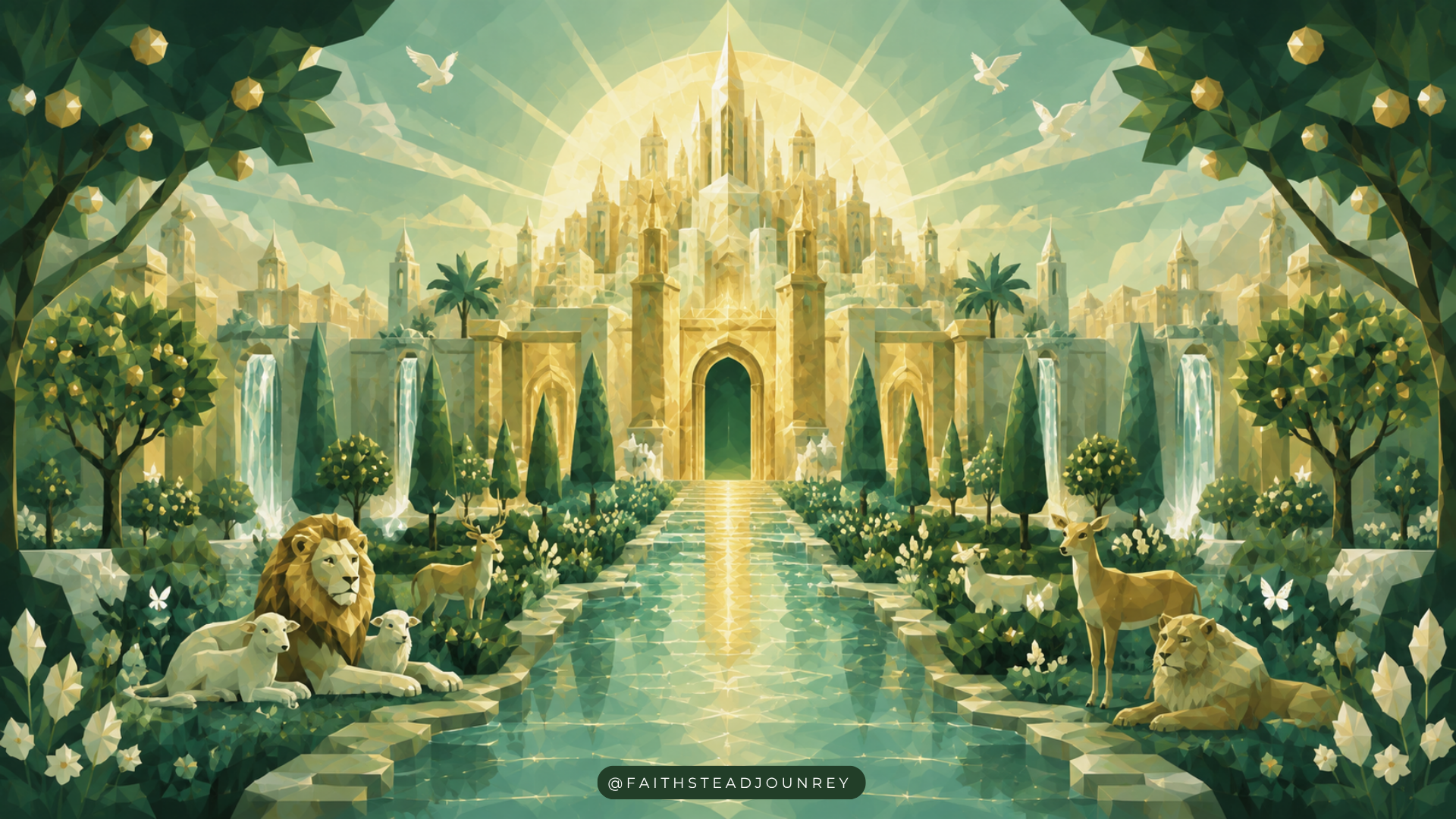
By now, we’re probably not surprised that John gives us “seven” descriptions of the holy city.
- Radiance like a precious jewel — communicating the city’s beauty, glory, and worth.
- Massive, high walls with twelve gates — communicating security and permanence.
- Twelve angels at the gates — and unlike the cherubim guarding Eden with flaming swords, these angels aren’t keeping God’s people out. The gates are open.
- The names of the twelve tribes of Israel on the gates — reminding us of God’s covenant people under the Old Covenant.
- Three gates facing each direction — north, south, east, and west. God’s people are gathered from every direction, pointing us toward the worldwide scope of God’s redemption.
- Twelve foundations — communicating strength, permanence, and stability.
- The names of the twelve apostles of the Lamb on the foundations — reminding us of God’s covenant people under the New Covenant.
There is something beautiful happening here: The twelve tribes are on the gates, and the twelve apostles are on the foundations. The whole story of God’s people is represented in this city. What God began in the Old Covenant finds its fulfillment in the New.
We can probably bet that seven is John’s favorite number, but he does have a few other numbers up his sleeve. He uses the number “twelve” ten times in Revelation 21:12-21 in describing the dimensions of the holy city. By now, we know that these numbers are not random. Ten represents completion and perfection and twelve represents the people of God. When you have ten “twelves” Wilkin explains that there is perfect room for all the children of God in the New Jerusalem.
I admit, as a child, I used to wonder: If heaven is going to be on earth, what happens when you add up everyone who has ever lived? Wouldn’t we run out of room? But John’s vision gives us something much bigger than an answer to that question. The city is enormous, secure, glorious, and perfectly suited to God’s people. God’s dwelling place will be large enough for everyone He has redeemed.
A City Abraham was Waiting For
And this isn’t the first time we’ve encountered this city in Scripture.
Hebrews 11 tells us that Abraham “was looking forward to the city that has foundations, whose designer and builder is God.” Abraham had been looking forward to this city since Genesis! Are we looking forward to this city? Abraham, Isaac, and Jacob spent their lives living in tents, wandering through a land that God had promised to them. They were, in a very real sense, rootless in this world.
But they knew something: This world was not their final home. They were waiting for something a city with foundations.
Which makes me wonder: Am I longing for the city of God or am I trying to make myself completely comfortable in the city of man? How much of my life is spent trying to build something permanent here?
Let us not build our foundation on the shifting sands of Babylon, but look forward to the city whose foundation has already been laid by God. We are living in the tension of the already and the not yet. The kingdom has come in Christ, but we are still waiting for its fullness. And so, like Abraham, we live here as people who are looking for another city.
The Fulfillment of All Things
An angel with a golden measuring rod measures the holy city. (I’ll admit, measuring—or anything related to math—is not my idea of utopia, but alas, there is measuring.) And what John discovers is that the city is a perfect cube: its length, width, and height are all the same—12,000 stadia. Even the wall is measured at 144 cubits. These measurements aren’t just giving us the dimensions of the city; they point us back to the Holy of Holies, which was also a perfect cube and represented God’s dwelling place among His people. Under the old covenant, only the high priest could enter the Holy of Holies, and even he could enter only once a year. But here in Revelation, the entire city is a Holy of Holies. What was once a restricted room has become the dwelling place of God with His people. The presence of God is no longer confined behind a curtain or contained within a temple—the whole creation has become the Holy of Holies.
John then describes the city with gold and precious stones, twelve foundations bearing the names of the apostles, and twelve pearl gates bearing the names of the tribes of Israel. I love Jen Wilkin’s observation that the gold and precious stones are the very things the earth dwellers in Revelation made into idols and considered precious, yet here they are almost ordinary building materials—an upside-down kingdom where what the world worshiped is trodden underfoot. The twelve gates are never shut because there is no longer any danger or darkness, yet nothing unclean can enter. There is also no temple in the city because God Himself and the Lamb are its temple; His presence is no longer restricted behind a veil. There is no need for sun or moon because God’s glory provides the light, and the nations and kings who once followed Babylon now walk in God’s light and bring their glory into the city.
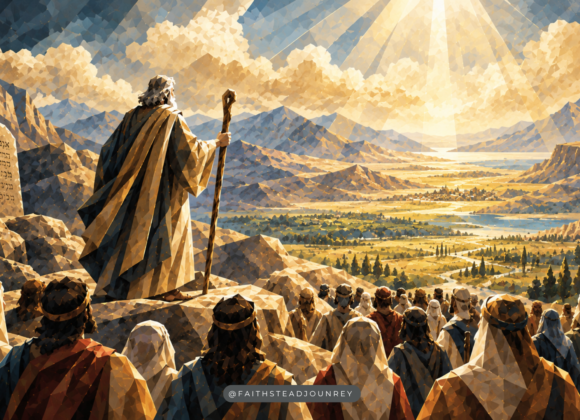
And then comes perhaps the most astonishing fulfillment of all: “They will see his face, and his name will be on their foreheads” (Revelation 22:4). What Moses was told he could not experience—to see God’s face and live (Exodus 33:19–23)—is now the reality of God’s redeemed people. Jesus promised, “Blessed are the pure in heart, for they shall see God” (Matthew 5:8), and John tells us that when Christ appears, “we shall be like him, because we shall see him as he is” (1 John 3:2). The priestly imagery of Exodus 28:36–38 is also brought to its fullness: what was once inscribed on the forehead of the high priest—“Holy to the LORD”—now characterizes God’s entire redeemed people. Jew and Gentile together have become the royal priesthood belonging to God, bearing His name and dwelling in His presence. Everything the tabernacle, temple, priesthood, sacrifices, and promises pointed toward has finally come to fulfillment: God’s people can see His face and live.
The Edenic Reality Fulfilled
John is then shown a river of the water of life, bright as crystal, flowing from the throne of God and of the Lamb, with the tree of life growing beside it. We are immediately taken back to Genesis 2, where a river flowed out of Eden and watered the garden, and where the tree of life stood in the midst of it. But what was lost in Genesis is now restored and brought to its fullness. After Adam and Eve sinned, humanity was expelled from Eden and barred from the tree of life; now the river flows freely from God’s throne, the tree continually bears fruit, and its leaves are for the healing of the nations. Even the curse introduced in Genesis 3 is gone—there is no more death, pain, toil, exile, or separation from God. And this is more than simply returning to Eden; the Edenic reality has been fulfilled and expanded. What began as a garden now encompasses a city filled with people from every tribe, tongue, people, and nation. Humanity’s original calling to bear God’s image and exercise dominion over His creation is also restored, as God’s servants worship Him and “will reign forever and ever.” What humanity lost through sin—life, God’s presence, creation’s harmony, and our God-given vocation—is not merely recovered but brought to its intended completion. Revelation ends where Genesis was always heading: humanity dwelling with God in a creation overflowing with life, but now in a reality that can never again be lost.
The Final Invitation: Come, Lord Jesus
After showing John this extraordinary vision, the angel declares that these words are “trustworthy and true,” reminding us that Revelation is not a fantasy meant merely to comfort us but the sure promise of God concerning what is to come. And because the end is certain, faithfulness now matters.
Jesus says, “Behold, I am coming soon,” and Revelation’s final call is not for us to become experts at predicting dates or decoding every mystery, but to remain faithful to the Lamb, to worship God alone, and to refuse the false promises of Babylon. Even John is reminded not to worship the angel but God, and he is told not to seal up the prophecy because it is meant to be heard and lived by God’s people.
Jesus promises that He is coming with His reward, reminding us that our faithfulness is not unnoticed, and then He identifies Himself as “the Alpha and the Omega, the first and the last, the beginning and the end.” The One who began the story is the One who brings it to completion. The tree of life that humanity lost in Eden is now accessible, the gates that once closed behind exiled humanity stand open, and Jesus, the promised descendant and root of David, the bright morning star, announces that the night is ending and the eternal day is coming.
And then comes the final invitation of Scripture:
“The Spirit and the Bride say, ‘Come.’”
The thirsty are invited to come and receive the water of life without price. Babylon’s kingdom says buy, sell, consume, and gain, but God’s kingdom says come and receive. Revelation began with humanity questioning God’s word, “Did God actually say?” and now it closes by warning us not to add to or take away from what He has said.
And then Jesus gives us His final promise:
“Surely I am coming soon.”
John responds with the cry that Revelation has been preparing God’s people to make:
“Amen. Come, Lord Jesus!”
And after everything we have witnessed—creation, rebellion, judgment, beasts, Babylon, the Lamb, the resurrection, the defeat of evil, the New Jerusalem, the river of life, and the tree of life—the Bible ends with one final word: grace.
“The grace of the Lord Jesus be with all. Amen.”
And perhaps that is the perfect final word: grace brought us into the story, grace sustains us as we wait, and grace will finally bring us home.
Final Thoughts
This was only my first deep dive into Revelation, and I hope and anticipate many more shallow swims and deep dives in the years to come. What resonated with me most in this reading was the unveiling of reality. Revelation means “apocalypse,” which means unveiling or revealing. Throughout human history, some of the greatest thinkers have wrestled with the most basic, and yet most elusive, questions: What is a human being? Where did we come from? Why are we here? What is the meaning of life? What is real? And without God, we can never arrive at a true understanding of these things because we are trying to make sense of reality while leaving out the One who created it. Thankfully, God has not left us to figure it out on our own. He has revealed Himself to us through His Word, and Revelation pulls back the curtain and allows us to see where the whole story is headed.
Revelation ultimately shows us that reality is bigger than what we can see right now. The kingdoms of this world are temporary. The things our culture tells us are valuable will one day be exposed for what they really are. Evil may appear powerful, but it has already been defeated by the Lamb. Suffering is real, but it is not the end of the story. Death is real, but it is not ultimate. And the world we live in now, though broken by sin, is not disposable—it is awaiting redemption. The final reality is not escape from creation but new creation: God dwelling with His people, the curse removed, the nations healed, the tree of life restored, and humanity finally living out the purpose for which we were created.
And perhaps that is what I needed most from Revelation, not simply a clearer picture of the end times, but a clearer picture of the present. If Revelation unveils reality, then it changes the way I see everything now. It tells me what is worth worshiping, what is worth fearing, what is worth pursuing, what is worth giving my life to, and what is ultimately passing away. It reminds me that the world is not as it appears, that Jesus really is Lord, that faithfulness matters, and that the story is moving toward a definite end. We are not wandering toward an unknown future. We are moving toward the day when the King returns, the curse is gone, and all things are made new.
So perhaps the greatest invitation of Revelation is not simply to understand the future, but to live faithfully in light of the reality it unveils. To worship God rather than the idols of this world. To remain faithful to the Lamb when faithfulness is costly. To resist Babylon’s counterfeit promises. To remember that what looks powerful now may be nothing more than dust in the light of eternity. And to live with the final words of Scripture always before us:
“Surely I am coming soon.”
Amen. Come, Lord Jesus!
I’ve compiled all of my Revelation Reloaded reflections into one PDF so you can read through them in one place, revisit them as you study, or keep them alongside your Bible as you journey through Revelation for yourself.