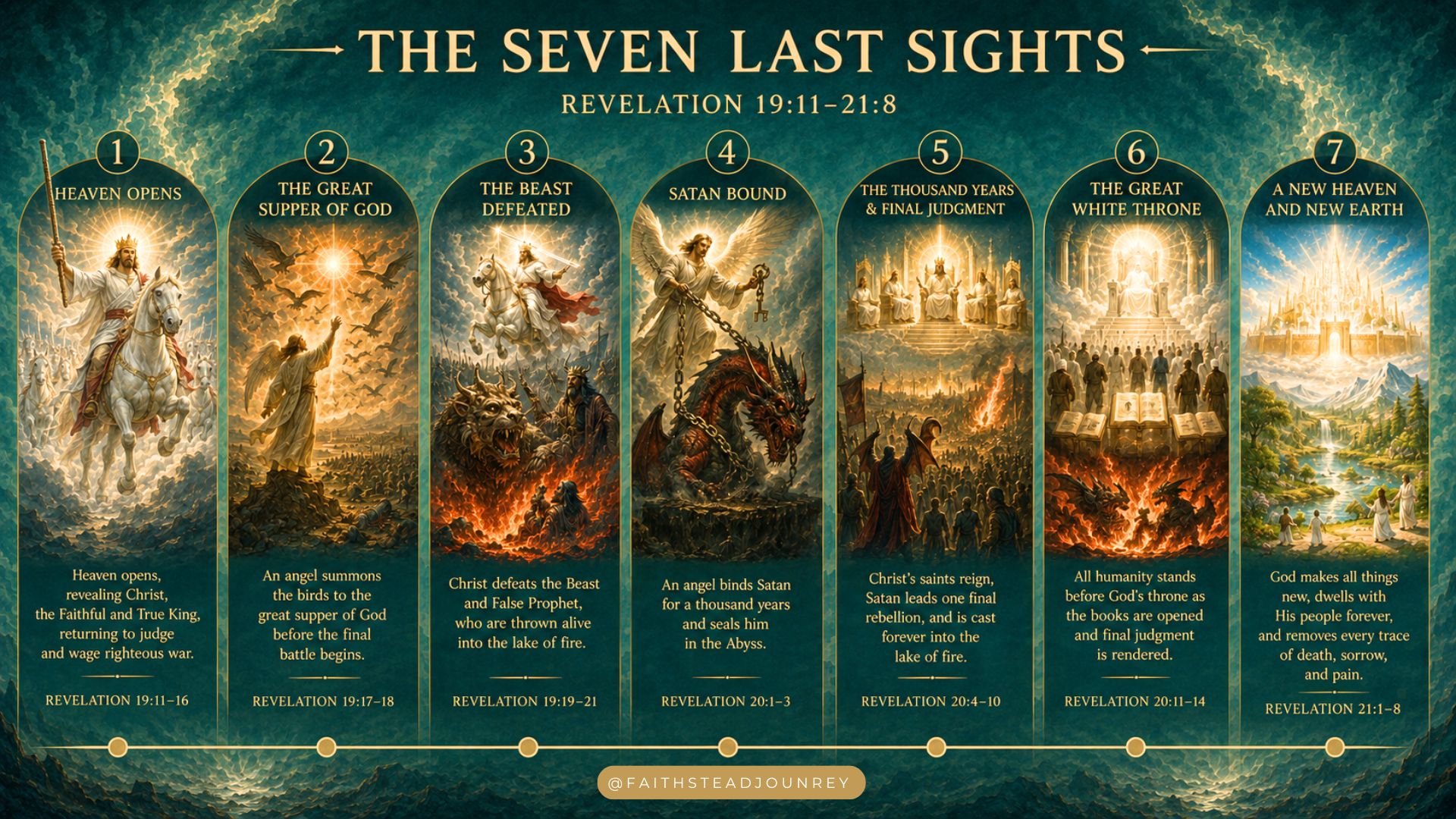
We are down to the last cycle of sevens — the seven last sights. What did John see?
First Sight – The Rider on a White Horse
Throughout Revelation, Christ has been described in many ways—as the slain Lamb, the Lion of Judah, the Son of Man walking among the churches, the Shepherd of His people. Here, all of those images converge into one final picture: the victorious King returning to judge evil and establish His kingdom.
Almost every image John uses comes directly from the Old Testament. Revelation doesn’t invent new symbols—it gathers together hundreds of biblical themes into one magnificent portrait.
Let’s walk through it phrase by phrase.
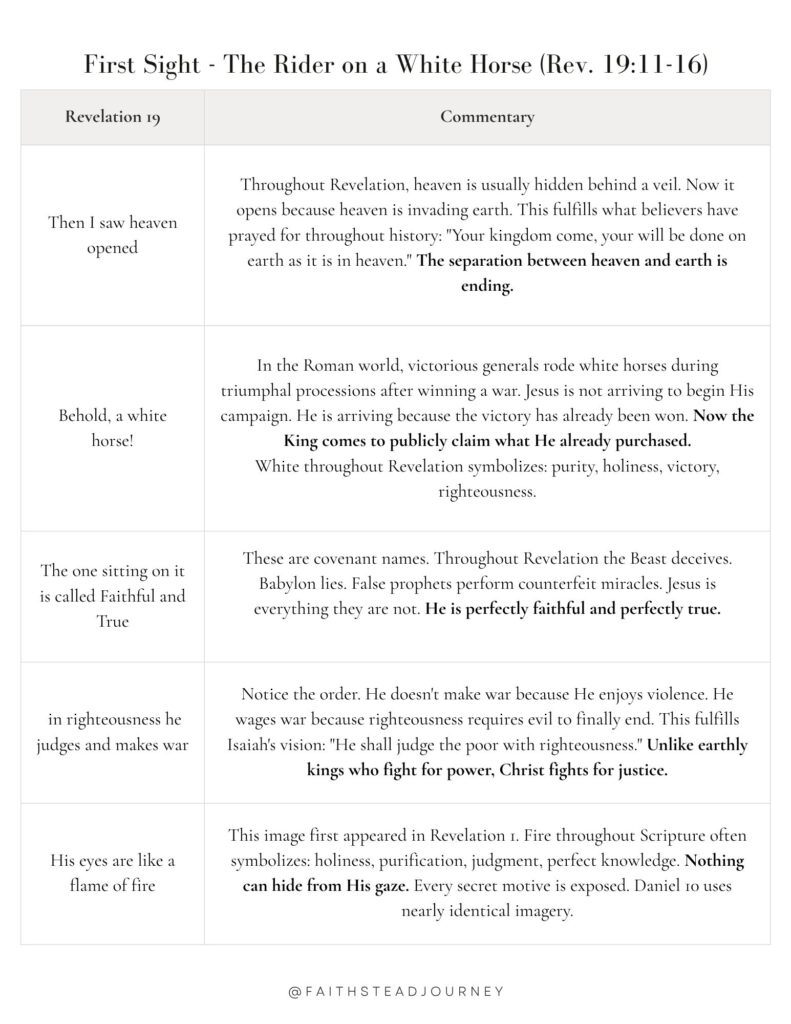
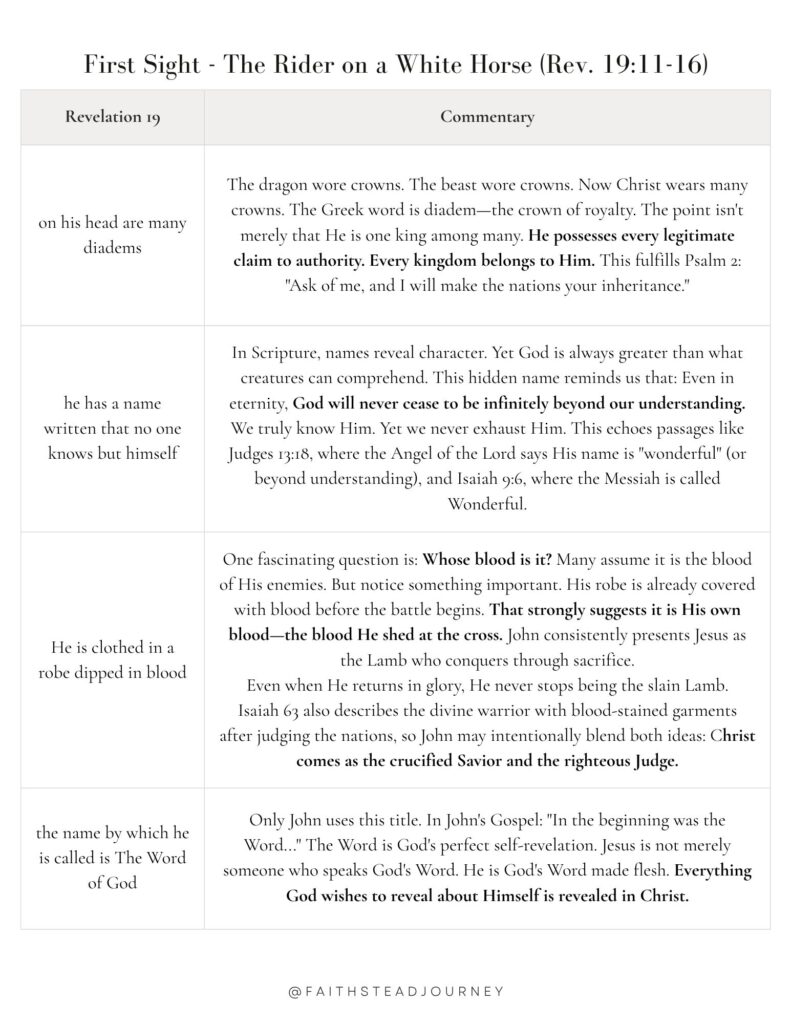
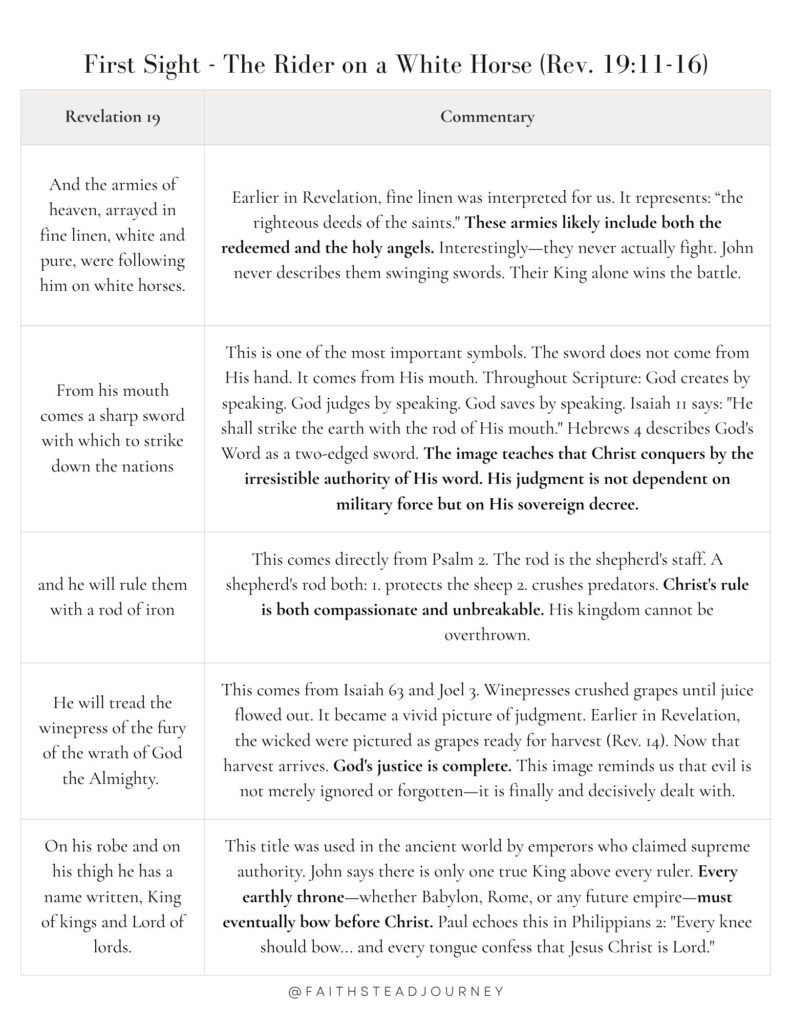
John is not primarily giving us a literal battle scene with horses and swords. He is painting a theological portrait using familiar biblical images. Each symbol reveals an aspect of Christ’s identity and mission:
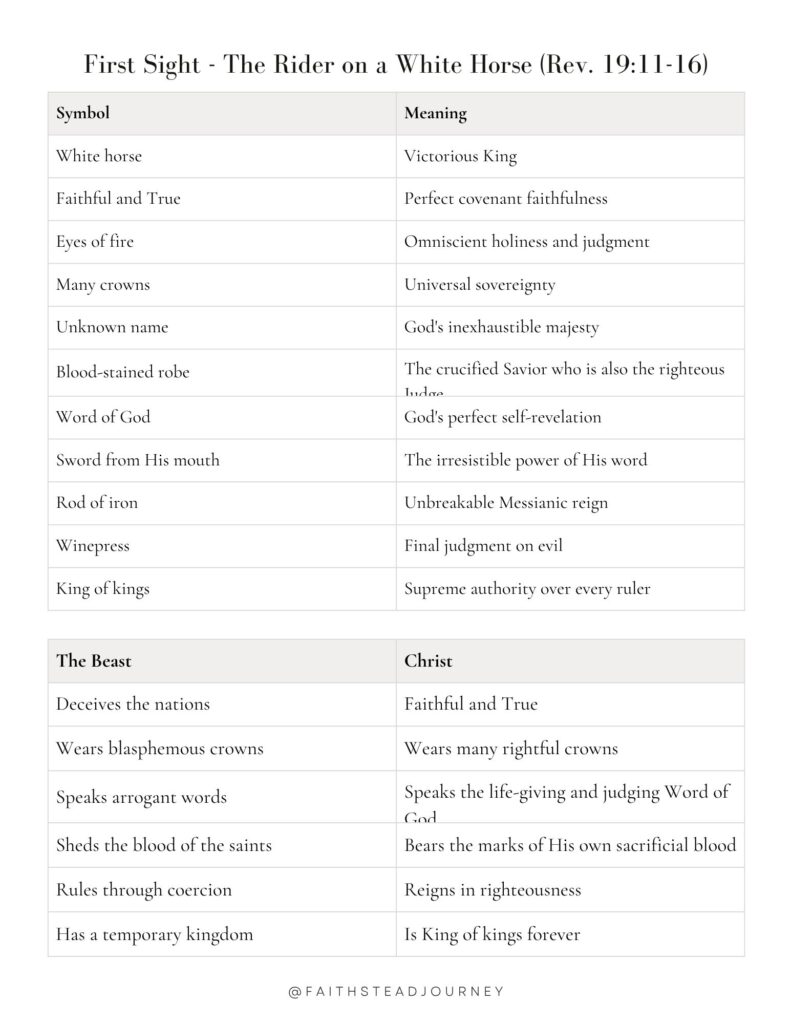
One of the most striking features of Revelation is how deliberately it contrasts Christ with the Beast. John’s readers lived under the shadow of Rome, where emperors claimed divine titles and exercised power through violence. Revelation declares that the true Rider is not Caesar or any earthly ruler, but Jesus Christ. His victory has been secured through the cross, His word is the final authority, and His return will bring the complete triumph of God’s righteous kingdom.
Second Sight – The Great Supper
Then I saw an angel standing in the sun, and with a loud voice he called to all the birds that fly directly overhead, “Come, gather for the great supper of God, to eat the flesh of kings, the flesh of captains, the flesh of mighty men, the flesh of horses and their riders, and the flesh of all men, both free and slave, both small and great. – Revelation 19:17-18
What stood out to me most in this vision is the striking contrast between the destiny of God’s people and the destiny of the earth-dwellers.
Just a few verses earlier, heaven proclaimed, “Blessed are those who are invited to the marriage supper of the Lamb” (Rev. 19:9). It is a feast of joy, fellowship, covenant, and life. Here, however, another invitation is announced—”the great supper of God.” This is not a feast of celebration but of judgment.
Revelation presents us with two suppers and, ultimately, two destinies. Those who belong to the Lamb are welcomed as honored guests at His wedding feast. Those who have given their allegiance to the Beast become the feast themselves. Having refused the gracious invitation to dine with the Lamb, they become the gruesome meal at God’s supper of judgment.
This imagery is intentionally shocking. In the ancient world, to be left unburied for the birds to consume was considered one of the greatest disgraces imaginable. John borrows this prophetic picture from passages like Ezekiel 39 to communicate the complete and public defeat of God’s enemies. Every earthly distinction disappears. Kings and captains, the mighty and the weak, the free and the slave, the small and the great—all stand equally before the righteous judgment of God.
There is also a profound irony here. Throughout Revelation, the earth-dwellers have accepted Babylon’s invitation. They drank from her cup, committed spiritual adultery with her, shared in her luxuries, and aligned themselves with the Beast. They thought they were attending a royal banquet, but in the end, they discover they were preparing for an entirely different feast.
In a sense, this is the final consummation of their union with the harlot. Just as the Bride becomes one with Christ at the marriage supper of the Lamb, those who persist in their allegiance to Babylon become one with the kingdom they chose. Their destiny is inseparable from the Beast’s. They share in his judgment because they shared in his rebellion.
Third Sight – The Beast and Its Armies Defeated
And I saw the beast and the kings of the earth with their armies gathered to make war against him who was sitting on the horse and against his army. And the beast was captured, and with it the false prophet who in its presence had done the signs by which he deceived those who had received the mark of the beast and those who worshiped its image. These two were thrown alive into the lake of fire that burns with sulfur. And the rest were slain by the sword that came from the mouth of him who was sitting on the horse, and all the birds were gorged with their flesh. – Revelation 19:19-21
What amazes me most about this vision is how anticlimactic the battle is.
After watching the Beast gather the kings of the earth and their armies, I expected an epic clash worthy of the greatest battle ever fought—something like the Battle of the Pelennor Fields from Lord of the Rings: Return of the King. The tension has been building throughout Revelation. Surely this is the moment when heaven and earth collide in one final, dramatic conflict.
But that isn’t what happens.
There is no prolonged battle. No exchange of weapons. No struggle for victory. The Beast and False Prophet are simply captured. We were expecting a battle, what we got was an arrest.
Both are immediately thrown alive into the lake of fire. The rest are slain by the sword that proceeds from Christ’s mouth. The battle is over almost before it begins.
That is precisely John’s point. There was never any question about the outcome because there was never any question about who truly reigns. Evil may appear terrifying, powerful, and unstoppable, but before the King of kings it is utterly powerless.
This scene is actually the fulfillment of Psalm 2. There, the psalmist asks:
“Why do the nations rage and the peoples plot in vain? The kings of the earth set themselves, and the rulers take counsel together, against the LORD and against his Anointed…” – Psalm 2:1–2
That is exactly what John sees in Revelation. The Beast gathers the kings of the earth to wage war against Christ, the Lord’s Anointed. But just as in Psalm 2, there is never any suspense about the outcome. God does not panic. He does not scramble to assemble an army. The psalm says that “He who sits in the heavens laughs,” and then, “He will speak to them in his wrath” (Psalm 2:4–5). The battle is won not by military might but by the effortless authority of God’s Word.
Notice again that the sword comes from Christ’s mouth, not His hand. Throughout Revelation, Christ conquers by His Word. The sword symbolizes the irresistible power and authority of His spoken decree. His enemies do not fall because of superior military strength but because the King has spoken.
This has been true from the very beginning of Scripture. God’s Word always accomplishes His purpose.
In Genesis 1, God speaks, and creation springs into existence: “Let there be light.” Psalm 33 declares, “For he spoke, and it came to be; he commanded, and it stood firm.” Through the prophet Isaiah, God promises that His Word “shall not return to me empty, but it shall accomplish that which I purpose” (Isa. 55:11). John’s Gospel opens by revealing that Jesus Himself is the eternal Word through whom all things were made, and Hebrews tells us that He even now upholds the universe by “the word of his power.”
It is therefore fitting that Revelation ends the same way the Bible began—with the sovereign Word of God accomplishing His will. In the beginning, God spoke creation into existence. At the end, Christ speaks judgment upon the rebellious kingdoms of this world. In a sense, just as creation was spoken into being, this final decreation is spoken into being as well, clearing away all that opposes God and preparing the way for the new heavens and the new earth.
Jen Wilkin points to Martin Luther’s great hymn A Mighty Fortress Is Our God, which beautifully captures this truth:
One little word shall fell him.
What a fitting summary of this vision. Satan, the Beast, and every kingdom raised against Christ do not fall because they finally meet an equal opponent. They fall because they stand before the sovereign Word of God. One word from the King is enough.
Perhaps this is the greatest irony of the entire scene. Revelation spends chapters describing the rise of the Dragon, the Beast, and the False Prophet, making them appear fearsome and invincible. Yet when they finally stand before Christ, there is no contest. The long-anticipated war becomes an epic battle that never was. The enemies of God muster all the power the world can offer, only to discover that they cannot withstand a single word from the One who is called Faithful and True.
Fourth Sight – Satan Bound
Then I saw an angel coming down from heaven, holding in his hand the key to the bottomless pit and a great chain. And he seized the dragon, that ancient serpent, who is the devil and Satan, and bound him for a thousand years, and threw him into the pit, and shut it and sealed it over him, so that he might not deceive the nations any longer, until the thousand years were ended. After that he must be released for a little while. – Revelation 20:1-3
When we come to this passage, one of the first questions many people ask is: What does the thousand years mean? Is it a literal thousand-year period? Is it symbolic? When does it happen?
Those are important questions, but before we rush to the timeline, Jen Wilkin reminds us of the approach we have taken throughout Revelation. John has consistently communicated heavenly realities through symbolic images and numbers. The question is not simply, “What does this number represent?” but “What truth is this symbol revealing?”
Throughout Scripture, numbers often communicate fullness or completeness. If we follow the same symbolic pattern we have seen throughout Revelation, the number 1,000 can be understood as 10 × 10 × 10 = a complete and perfect period of time determined by God.
We see a similar use of symbolic time earlier in Revelation when Jesus tells the church in Smyrna:
“You will have tribulation for ten days.” – Revelation 2:10
Jesus was not necessarily giving them a literal ten-day countdown. The point was that their suffering would last for a complete but limited period of time under God’s sovereign control. The emphasis is not on calculating the length of the millennium, but on recognizing the authority of the One who holds the key.
Notice something important in this passage: Satan does not bind himself. He is seized, chained, thrown into the pit, and sealed away by the authority of God. The great deceiver who appeared so powerful in Revelation 12 and through the Beast in Revelation 13 is ultimately under God’s complete control.
This also connects with Jesus’ own words in Mark 3:
“No one can enter a strong man’s house and plunder his goods, unless he first binds the strong man. Then indeed he may plunder his house.”
Jesus came to bind the strong man. Through His death and resurrection, Christ defeated Satan’s ultimate weapon—death—and began the work of rescuing people from Satan’s kingdom and bringing them into His own.
This understanding also fits with other New Testament passages that describe Satan as defeated and restrained in significant ways. In 2 Thessalonians 2, Paul speaks of a restraining power that prevents the full revelation of evil until God’s appointed time. Satan is active, but he is not free to do whatever he desires. His authority has been limited.
But this raises an important question: If Satan is bound, why does he still seem so active?
The answer is that being bound does not mean being completely inactive. A defeated enemy can still fight. A prisoner can still cause harm within limits.
According to Revelation 20, Satan’s deception of the nations has been restrained. Because of Christ’s victory, Satan can no longer prevent the spread of the gospel throughout the world. The nations that once sat in darkness are now being gathered into God’s kingdom.
But Revelation also tells us that Satan will be released for “a little while.” This reminds us again that even Satan’s final rebellion is not outside God’s control. His release is not a surprise or a victory for evil, it is another moment in which God demonstrates that His purposes will always prevail.
This also mirrors the pattern we have seen throughout Revelation. The Beast rises, but only for an appointed time. Babylon appears powerful, but only for an appointed time. Satan himself is released, but only for “a little while.” Evil always has a deadline.
The mystery of the millennium has led to many different interpretations among faithful Christians. But perhaps the most important truth is not knowing every detail of the timeline—it is knowing the One who holds the timeline.
Paul’s encouragement to the Thessalonians is especially fitting:
“So then, brothers, stand firm and hold to the traditions that you were taught… Now may our Lord Jesus Christ himself, and God our Father… comfort your hearts and establish them in every good work and word.” – 2 Thessalonians 2:15–17
Whatever mysteries remain, the response of God’s people is the same: stand firm, hold fast to Christ, encourage one another, and continue faithfully in good works and good words.
Revelation was not given to make the church obsessed with predicting dates. It was given to make the church faithful in the midst of waiting.
Fifth Sight – The Saints Reign with Christ
Then I saw thrones, and seated on them were those to whom the authority to judge was committed. Also I saw the souls of those who had been beheaded for the testimony of Jesus and for the word of God, and those who had not worshiped the beast or its image and had not received its mark on their foreheads or their hands. They came to life and reigned with Christ for a thousand years. The rest of the dead did not come to life until the thousand years were ended. This is the first resurrection. Blessed and holy is the one who shares in the first resurrection! Over such the second death has no power, but they will be priests of God and of Christ, and they will reign with him for a thousand years. – Revelation 20:4-6
Throughout Scripture, resurrection language is often used to describe both physical resurrection and spiritual life.
Jesus said: “Whoever hears my word and believes him who sent me has eternal life. He does not come into judgment, but has passed from death to life.” – John 5:24
And Paul writes: “Even when we were dead in our trespasses, [God] made us alive together with Christ… and raised us up with him and seated us with him in the heavenly places in Christ Jesus.” – Ephesians 2:5–6
Paul describes believers as already having experienced a resurrection. We were spiritually dead, but through Christ we have been made alive. We have been raised with Him and seated with Him in the heavenly places.
This raises the possibility that the first resurrection in Revelation 20 is describing the spiritual resurrection of believers—the moment when they are united to Christ through faith. Those who have been redeemed by Christ are already participating in His resurrection life. That would mean the second resurrection is our bodily resurrection at the second coming of Christ.
This fits the pattern throughout Revelation. John sees the souls of those who were faithful to Christ, including martyrs who refused to worship the Beast. The world considered them defeated. They were killed because of their testimony. But heaven sees them differently: they are alive, seated on thrones, and reigning with Christ.
The Beast appeared to conquer them, but Christ reveals the greater reality. They have conquered.
“They have conquered him by the blood of the Lamb and by the word of their testimony, for they loved not their lives even unto death.” – Revelation 12:11
What is the second death?
John explains this later in Revelation:
“This is the second death, the lake of fire.” – Revelation 20:14
The first death is physical death—the separation of the soul from the body. The second death is final judgment—the eternal separation from God.
Those who share in the first resurrection do not need to fear the second death: “Over such the second death has no power.” This is an incredible promise. The world may kill the body, but it cannot destroy the believer’s ultimate future. The Beast can take life temporarily, but Christ has conquered death itself.
Jesus expressed this same truth:
“Do not fear those who kill the body but cannot kill the soul. Rather fear him who can destroy both soul and body in hell.” – Matthew 10:28
So does that mean we’re reigning with Christ right now?
If we continue reading Revelation symbolically, then yes, there is a strong biblical case that believers are already participating in Christ’s reign.
This does not mean we reign in the same way earthly kings rule. It means that through union with Christ, believers share in His authority, identity, and victory.
Paul says in Ephesians: “God… raised us up with him and seated us with him in the heavenly places in Christ Jesus.” – Ephesians 2:6
Notice the past tense: raised and seated. Paul is describing a present reality. Jesus has already been given all authority in heaven and earth (Matthew 28:18), and those united to Him share in His kingdom.
Peter describes believers as: “a royal priesthood” – 1 Peter 2:9
Revelation itself says: “You have made them a kingdom and priests to our God, and they shall reign on the earth.” – Revelation 5:10
So the reign of Christ has already begun. We live in the “already but not yet”:
- Already: Christ reigns, Satan is defeated, believers have spiritual life, and we share in Christ’s kingdom.
- Not yet: Christ’s final victory has not been fully revealed, death has not yet been destroyed, and the new creation has not yet arrived.
The first resurrection is a message of hope to suffering believers. The world says: “They lost. They were killed. The Beast conquered them.” But Jesus says: “No. They are alive. They reign. The second death has no power over them.”
Revelation 20 is not primarily meant to satisfy our curiosity about end-times timelines. It is meant to strengthen the church to remain faithful. The Beast may appear to win. The saints may appear defeated. But heaven reveals the truth: Those who belong to Christ have already been raised, already seated with Him, and already share in His victory.
The question Revelation asks is not merely, “When will Christ’s kingdom come?” It asks: Will we live as citizens of that kingdom now?
Sixth Sight – The Great White Throne Judgment
Then I saw a great white throne and him who was seated on it. From his presence earth and sky fled away, and no place was found for them. And I saw the dead, great and small, standing before the throne, and books were opened. Then another book was opened, which is the book of life. And the dead were judged by what was written in the books, according to what they had done. And the sea gave up the dead who were in it, Death and Hades gave up the dead who were in them, and they were judged, each one of them, according to what they had done. Then Death and Hades were thrown into the lake of fire. This is the second death, the lake of fire. And if anyone’s name was not found written in the book of life, he was thrown into the lake of fire. – Revelation 20:11-15
John sees the final judgment before the great white throne. Every person, from the greatest to the least, stands before God. No earthly status, power, wealth, or reputation can shield anyone from the holiness and justice of God.
At first glance, this seems terrifying. Many of us naturally think, “I do not want all my deeds recorded. I do not want my failures exposed. I thought my sins were washed away by the blood of Christ. I thought God remembers them no more.”
And that is true. Scripture tells us: “As far as the east is from the west, so far does he remove our transgressions from us.” – Psalm 103:12
“Their sins and their lawless deeds I will remember no more.” – Hebrews 10:17
But as Jen Wilkin has pointed out, the books being opened should not only bring fear—they should also bring wonder for those who belong to Christ.
She explains that many of us think the recording of our deeds is frightening because we only think of the sins we know we have committed. But even as believers who have repented and been forgiven, there are countless sins we commit without even recognizing them. There are attitudes, thoughts, motives, and failures of love that we are blind to. Yet God sees them all.
And because they are recorded, they can also be completely and finally dealt with. They are not hidden from God; they are covered by Christ. The blood of Jesus does not merely forgive the sins we remember—it covers every sin we have ever committed, even the ones we never knew needed forgiveness.
The opening of the books does not reveal that God’s grace was insufficient. It reveals just how vast His grace truly is. When we finally understand the depth of our sin, we also begin to understand the unimaginable depth of God’s love.
Paul prays that believers would: “have strength to comprehend with all the saints what is the breadth and length and height and depth, and to know the love of Christ that surpasses knowledge.”- Ephesians 3:18–19
Perhaps only in eternity will we fully understand both sides of this reality: The depths of our sin. And the greater depths of Christ’s mercy.
When we see the full record, we will not respond with despair if we belong to Christ. Instead, we will respond with worship. We will see clearly that we had nothing to offer, nothing to hide, and nothing to fear because our salvation rested entirely on the Lamb who was slain for us.
For those who belong to Christ, the most important truth in all eternity is this: Our names are written in the Lamb’s Book of Life. They will never be erased.
And when we finally see the fullness of His holiness and the fullness of His mercy, our only response will be the worship of heaven: “Holy, holy, holy!”
The final judgment is not only a warning of God’s justice—it is also a revelation of the security of those who are hidden in Christ. The One who judges from the throne is the same Lamb who was slain for His people.
Seventh Sight – The New Creation
Then I saw a new heaven and a new earth, for the first heaven and the first earth had passed away, and the sea was no more. And I saw the holy city, new Jerusalem, coming down out of heaven from God, prepared as a bride adorned for her husband. And I heard a loud voice from the throne saying, “Behold, the dwelling place of God is with man. He will dwell with them, and they will be his people, and God himself will be with them as their God. He will wipe away every tear from their eyes, and death shall be no more, neither shall there be mourning, nor crying, nor pain anymore, for the former things have passed away.” And he who was seated on the throne said, “Behold, I am making all things new.” – Revelation 21:1–5
The final sight John sees is the fulfillment of everything God has been doing throughout the entire story of Scripture. The brokenness introduced in Genesis is finally undone. The curse is removed. Death is defeated. The old creation passes away, and God makes all things new. The hope of Scripture is not that humanity abandons the earth and goes to heaven forever. The hope is that heaven comes down, creation is renewed, and God once again dwells with His people.
Throughout Revelation, the people of God have been pictured as the Bride of the Lamb. Now that imagery is united with the image of a city. The New Jerusalem is both the dwelling place of God and the home of His people.
This also brings us back to the wisdom theme that runs throughout Scripture. The city of God stands in contrast to Babylon, the city of man. Babylon represents folly, self-glory, and rebellion against God. The New Jerusalem represents true wisdom, righteousness, and life with God.
In Proverbs, wisdom is personified as a woman calling people to come and dwell with her. The New Jerusalem is the ultimate picture of wisdom fulfilled. It is the city where God’s wisdom reigns completely. Those who dwell there are not merely living in a beautiful place—they are people who have been made wise by the presence of God Himself.
This is why the Bible’s story ends where it began: with God dwelling with humanity.
In Eden, God created a garden and walked with Adam and Eve. His presence was with them. But sin entered the world, and His presence could no longer reside on earth.
In the wilderness, God instructed Israel to build the tabernacle. God came down and dwelt among His people, but Israel repeatedly rebelled, and eventually His glory departed from the temple.
Then came Solomon’s temple. Again, God’s presence filled the temple, and He dwelt among His people. But once again, Israel turned away, and the temple was destroyed.
Then came the greatest act of God coming down. The eternal Son of God took on flesh and tabernacled among us. Jesus was the true temple, the true meeting place between God and humanity. But the world rejected Him, and He was crucified. Yet through His resurrection and ascension, He returned to the Father.
Then at Pentecost, God came down again—not in a temple made of stone, but through His Spirit dwelling within His people.
However, the final fulfillment comes in the New Jerusalem, where God’s presence and glory is fully manifested.
The seven sights of Revelation are not ultimately a map of how the world ends; they are a revelation of who God is, what He has accomplished through Christ, and where history is going. The Lamb wins, Babylon falls, the Beast is defeated, Satan is bound, the dead are judged, and God’s people dwell with Him forever. The end of the story is not destruction—it is restoration.
I’ve compiled all of my Revelation Reloaded reflections into one PDF so you can read through them in one place, revisit them as you study, or keep them alongside your Bible as you journey through Revelation for yourself.