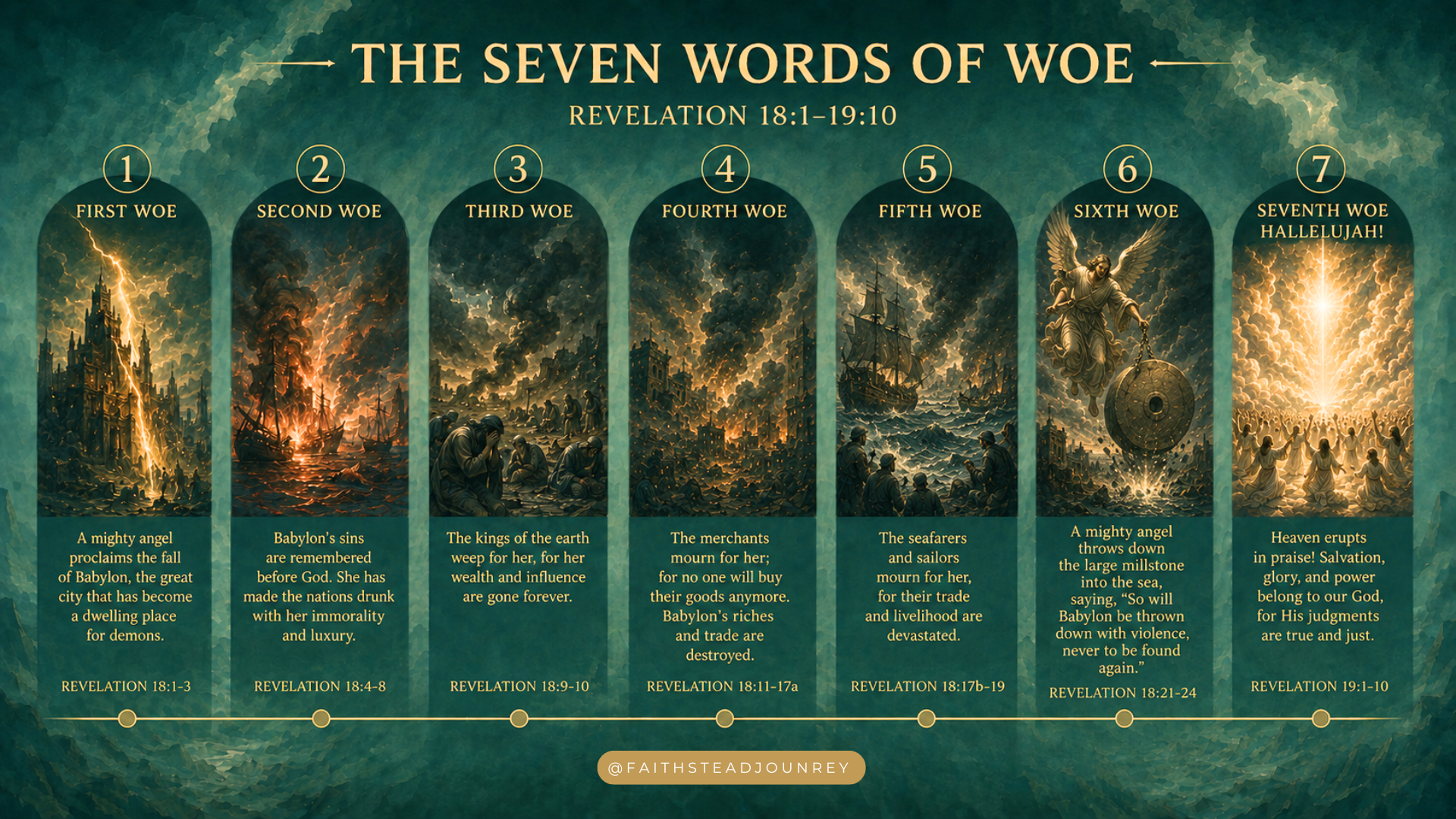
This week, Revelation presents seven proclamations announcing the fall of Babylon. Together, they expose the depth of her corruption, the reach of her influence over the nations, and the grief that follows her collapse. But this is more than the story of one city’s judgment. Revelation is the true tale of two cities or a better word might be kingdoms: Babylon and the New Jerusalem. Babylon represents the kingdom of this world that is built on pride, power, and rebellion against God. The New Jerusalem represents the kingdom of God, a city marked by holiness, peace, and the presence of the Lamb.
Revelation challenges us to consider where our hearts truly belong. Are we captivated by the passing glory of Babylon, or are we living as citizens of the city that is to come? The fall of Babylon is not merely a warning, but a cause for rejoicing because it makes way for the everlasting reign of Christ. As one kingdom passes away and the other is fully established, we’re reminded that God’s judgments are true, righteous, and worthy of our highest praise.
A Literary Pattern
It took a while, but I finally discovered a literary pattern John uses quite a bit. Revelation is not simply a sequence of events—it is carefully composed with recurring cycles of vision → interpretation → proclamation (or response). Once you see it, it appears throughout the book.
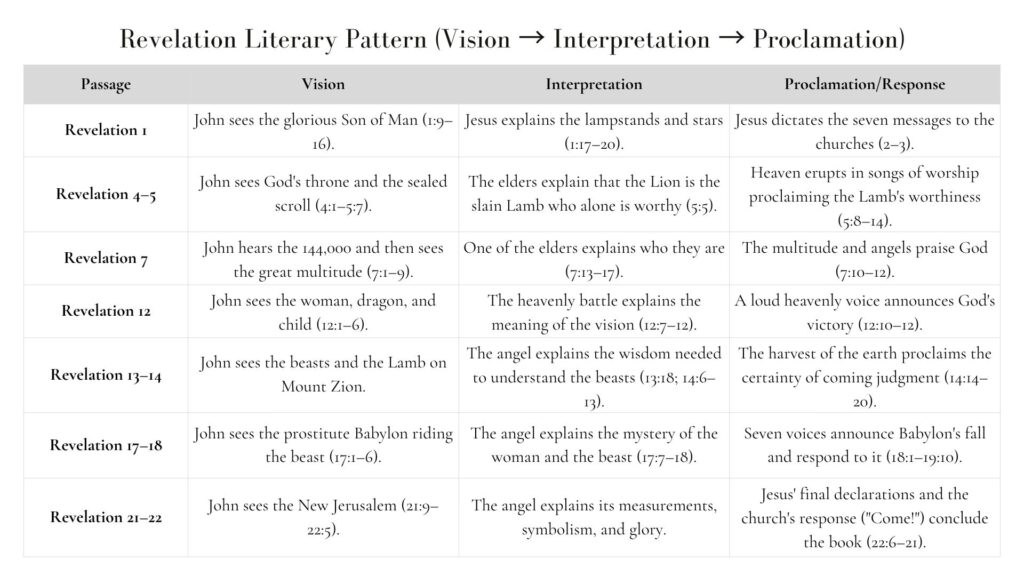
Vision → Interpretation → Proclamation
- See the symbol. The image captures our imagination.
- Learn what it means. An angel or heavenly figure interprets the symbolism.
- Hear heaven’s verdict. Songs, proclamations, blessings, or judgments teach us how to respond.
First, John sees a symbolic vision. The images are vivid, dramatic, and often mysterious, capturing our imagination but leaving us with questions.
Next, someone, usually an angel or heavenly messenger, interprets the vision. Rather than leaving us to speculate, Revelation often provides the key to understanding the symbolism. The point of the vision is not to fuel endless curiosity but to reveal spiritual realities from God’s perspective.
Finally, a series of proclamations follows. These may come as songs of worship, angelic announcements, blessings, warnings, laments, or declarations of judgment. Once the meaning has been revealed, heaven responds, teaching us how we should respond as well.
Interestingly, the climax is often not the vision itself but the interpretation. This pattern reminds us that Revelation is not meant to be read as a puzzle to solve but as a revelation to receive. John first invites us to see, then to understand, and finally to respond.
Chapters 17 and 19 follow this pattern carefully:
- Chapter 17:1–6 — John sees Babylon.
- Chapter 17:7–18 — The angel explains Babylon’s identity and destiny.
- Chapter 18–19:10 — Seven heavenly and earthly voices respond to Babylon’s fall with announcements, laments, commands, and praise.
John first wants us to look carefully at her, then understand who she really is, and only then hear God’s verdict. He is shaping how we think and feel about Babylon’s demise by discipling his readers to see rightly, understand rightly, then respond rightly.
The Woman – Lady Folly
Babylon is introduced as a prostitute. John is carried by the Spirit into a wilderness where he sees a woman sitting upon a scarlet beast with seven heads and ten horns. She is extravagantly dressed in purple and scarlet, adorned with gold, precious stones, and pearls. In her hand is a golden cup filled with abominations and impurity. Written across her forehead is her true identity: “Babylon the Great, the Mother of Prostitutes and of the Detestable Things of the Earth.” Though outwardly beautiful and alluring, she is drunk with the blood of God’s people, having persecuted the saints and the martyrs of Jesus. She embodies a civilization that seduces the nations through wealth, power, idolatry, and immorality while violently opposing the kingdom of God.
Applying our “look behind” skills, a term Jen Wilkin uses for tracing Revelation’s imagery back into the Old Testament, we find that this woman bears a striking resemblance to Lady Folly in Proverbs.
Lady Folly also presents herself as attractive and inviting. She calls to the simple, promising pleasure and satisfaction (Prov. 9:13–18). Yet beneath the appealing exterior lies death. Her guests “do not know that the dead are there, that her guests are in the depths of Sheol” (Prov. 9:18).
Babylon is Lady Folly on a global scale. She dazzles with luxury, wealth, influence, and sensuality. Like Folly, she offers immediate gratification while concealing destruction. Her golden cup appears desirable, but it contains corruption. She intoxicates the nations, not with wisdom, but with spiritual adultery. Those who are seduced by her eventually share in her judgment.
A Call for Wisdom
John is greatly astonished by the vision before him. Just a few verses later, however, we read that those who dwell on the earth, whose names have not been written in the Book of Life from the foundation of the world, are also astonished—not by the vision, but by the beast himself (Rev. 17:8). Both John and the unbelieving world marvel, yet their astonishment leads them in opposite directions.
We, too, are often tempted to be impressed by the very things God sees as corrupt. Wealth, influence, political power, cultural prestige, and even religious success can appear glorious on the surface, yet they may stand in direct opposition to God’s kingdom.
The angel’s question to John, “Why are you astonished?” almost serves as a gentle correction: Don’t stop at what you see. Let me show you what it really means. Revelation teaches believers to look beyond appearances. What dazzles the world is not always worthy of admiration. We are reminded how easily our hearts can be captivated by Babylon’s splendor and how desperately we need the Spirit to give us heaven’s perspective.
John’s astonishment leads to revelation because he receives God’s interpretation of what he sees. The world’s astonishment, however, leads to deception because it remains captivated by appearances. There are only two ways of seeing reality. We either view the world through heaven’s perspective, or we are captivated by Babylon’s illusions.
It’s no coincidence that John ends this section with a call for wisdom. Proverbs repeatedly contrasts the simple, who are easily enticed by appearances, with the wise, who see beneath the surface. Babylon herself is portrayed like the seductive woman of Proverbs—beautiful, persuasive, and inviting people into destruction. The wise person looks beyond the invitation and recognizes where it leads.
So when John says, “ This calls for a mind that has wisdom,” he may be saying much more than, “Here’s a difficult puzzle to solve.” He is calling readers to spiritual discernment. The question is not merely whether we can identify the beast or the seven heads, but whether we can resist being captivated by Babylon’s splendor.
The opposite of deception is not information—it is wisdom. Revelation calls believers to cultivate that kind of wisdom— the wisdom that refuses to judge by appearances and instead sees the world from heaven’s perspective.
The Meaning of the Woman and of the Beast
Honestly, after reading the angel’s explanation to John, I was still mighty confused. And that’s probably because I’m expecting to be told exactly which historical or future figures these mountains and horns are. But the angel is actually explaining how Babylon and the beast function throughout history and how they ultimately come to their end.
And this is where we need to exercise wisdom. Remember, wisdom is not simply the ability to solve a prophetic riddle but the spiritual discernment to see beyond appearances.
The seven heads of the beast represent both seven mountains and seven kings. Throughout the Old Testament, mountains often symbolize kingdoms or centers of authority. Mount Zion represents God’s kingdom, while prophets also use mountains to describe powerful nations and empires. John’s first readers would have immediately associated seven mountains with Rome, the famous city built on seven hills. Yet the symbolism extends beyond Rome. The seven heads represent the succession of worldly kingdoms that exalt themselves against God throughout history.
The seven kings reinforce this same idea. The angel says, “Five have fallen, one is, the other has not yet come.” Rather than inviting us to identify seven individual rulers with certainty, the emphasis seems to be on God’s sovereign control over history. Kingdoms rise and kingdoms fall according to His timetable. No empire lasts forever. Even the greatest kingdoms of the earth are temporary, while God’s kingdom alone endures.
The beast himself is then described as an eighth king who belongs to the seven. Rather than introducing an entirely new kingdom, the beast appears to be the culmination of every rebellious kingdom that has come before him. Throughout history, empires have shared the same beastly character—exalting themselves against God, persecuting His people, and demanding ultimate allegiance. The final beast gathers all of these characteristics into one climactic expression of human rebellion. Yet the angel quickly reminds us that despite his terrifying power, “he goes to destruction.” The beast’s destiny has already been determined.
The angel next explains the ten horns. They represent kings who receive authority for only “one hour,” a symbolic expression emphasizing the brevity and limitation of their rule. Their authority is real, but it is temporary and completely subject to God’s sovereign purposes. Even when evil appears strongest, its time is remarkably short.
These kings unite with one purpose: to wage war against the Lamb. This echoes the repeated biblical pattern of humanity joining together in rebellion against God, from the Tower of Babel to Psalm 2, where the nations rage against the Lord and His Anointed. Yet Revelation does not linger on the battle because the outcome is never in doubt. The Lamb conquers, not because He gathers a larger army, but because He is already “Lord of lords and King of kings.” Earthly rulers may appear powerful, but every king ultimately answers to Him.
The passage closes with a beautiful encouragement for believers. Those who stand with the Lamb are described as “called, chosen, and faithful.” The victory belongs to Christ, yet His people share in that victory because they remain faithful to Him. While the kingdoms of this world continually rise and fall, those who belong to the Lamb share in a kingdom that can never be shaken.
The angel now turns his attention from the beast to Babylon herself and explains why her downfall is certain. The waters upon which the prostitute sits symbolize “peoples, multitudes, nations, and languages” (Rev. 17:15). Babylon’s influence extends across the entire world. Her seductive power is not confined to one nation or one period of history but reaches people from every culture and language.
Then comes one of the greatest surprises in Revelation. The beast and the ten kings, who once supported Babylon, suddenly turn against her. They strip her of her wealth, make her desolate, and destroy her completely. The very powers that once carried her become the instruments of her judgment.
This dramatic reversal reveals an important truth about evil. Babylon believed she had found security by riding the beast, but evil is incapable of sustaining lasting unity. Alliances built on pride, greed, and self-interest inevitably collapse. Sin ultimately consumes itself. The kingdoms of this world promise security and prosperity, yet they eventually devour one another. Babylon trusted in worldly power, only to be destroyed by the very power she depended upon.
I was quite alarmed by this part, but it really shouldn’t come as a surprise. The beast’s betrayal of the prostitute illustrates a pattern that has repeated throughout history: when human power becomes ultimate, it eventually devours the very people and ideals it once promised to protect.
Francis Schaeffer makes a similar observation in How Should We Then Live? when discussing Marxism and other totalitarian systems. They often began with promises of equality, justice, and liberation but ultimately produced oppression because the state became the highest authority. Yet Revelation’s warning is even broader. The beast is not limited to one political ideology but represents every human kingdom that seeks ultimate power apart from God. Whether ancient Egypt, Babylon, Rome, or more modern totalitarian regimes, the pattern is the same. Systems built on pride, power, and rebellion against God cannot sustain justice or human dignity because they have rejected the One in whose image humanity is made. Babylon believes she has found security by riding the beast, but the beast ultimately turns against her. In the end, sin always destroys what it first promises to protect.
A modern example of Babylon’s seductive power can be seen in our pursuit of comfort, convenience, and technological advancement. The problem is not that comfort, wealth, or tools like artificial intelligence are inherently evil. These are gifts that can be used for human flourishing when they are guided by a biblical understanding of humanity. The danger comes when these gifts become ultimate—when we begin to believe that technology, efficiency, prosperity, and ease can provide what only God can give.
A culture built around constant comfort can slowly lose its ability to embrace sacrifice, perseverance, and dependence upon God. Likewise, technology such as AI, when separated from the truth that every person is made in the image of God, can begin to redefine human value. Instead of serving human creativity and wisdom, it can tempt us to measure people by productivity, efficiency, or usefulness. Convenience can replace community, automation can replace meaningful work, and the pursuit of endless progress can cause us to forget the deeper questions of purpose, dignity, and what it means to be human.
This is the pattern of Babylon. The gifts of human civilization—wealth, innovation, knowledge, and power—are not the enemy. The danger comes when we place our ultimate trust in them. Babylon promises, “You can secure your future through human achievement,” but Revelation reveals that every kingdom built on human pride eventually collapses under the weight of its own false promises. The danger of Babylon is not that it looks evil—it is that it looks like the answer to human problems. The question is not simply, “What can we create?” or “How successful can we become?” but, “What foundation guides our pursuit of progress?” Without the foundation that human beings bear God’s image and find their meaning in Him, even our greatest achievements can become tools that diminish the very people they were meant to serve.
Yet behind this apparent political upheaval stands the sovereign hand of God. The angel declares that “God has put it into their hearts to carry out his plan” (Rev. 17:17). This does not mean that God approves of their wickedness or causes them to sin. Rather, it demonstrates that even rebellious rulers unknowingly accomplish His sovereign purposes. Throughout Scripture, God repeatedly uses sinful nations and rulers to accomplish His plans without becoming the author of their evil. Pharaoh, Assyria, Babylon, and even Rome all acted according to their own sinful desires, yet God remained sovereign over history. Revelation reminds us that the same is true in the final conflict.
The angel concludes by identifying the woman as “the great city that has royal power over the kings of the earth.” For John’s original readers, this would have immediately called Rome to mind. Yet just as Babylon in Revelation represents far more than the ancient city of Babylon, the “great city” ultimately symbolizes every civilization that exalts itself against God through pride, idolatry, luxury, oppression, and self-sufficiency. Rome was one expression of Babylon, but it was not the last. Babylon is the recurring pattern of human society organized in defiance of God’s rule.
When we step back and consider the angel’s explanation as a whole, his purpose becomes much clearer. He is not primarily giving believers a prophetic code to decipher but a theological lens through which to understand history. The beast represents the recurring political power of rebellious human kingdoms. Babylon represents the seductive cultural, economic, and religious system that lures the nations away from God. For a time they appear inseparable and invincible, yet their alliance is temporary and ultimately self-destructive. Above them both stands the Lamb, reigning as King of kings and Lord of lords. That is the heart of the angel’s message and the source of hope for every generation of believers.
The Six Woes
Finally, the time has come, and an angel cries out with a mighty voice:
“It has fallen, Babylon the Great has fallen!” (Rev. 18:2)
This announcement echoes the prophets of the Old Testament, especially Isaiah and Jeremiah, who proclaimed the fall of ancient Babylon. The message is clear: the city that appeared unstoppable is not eternal. The kingdom that promised security, pleasure, and prosperity cannot save itself.
As judgment is declared over Babylon, we see three groups of people mourning over her: the kings of the earth, the merchants of the earth, and those who make their living from the sea. They mourn over what Babylon provided and weep over the loss of power, wealth, luxury, and comfort.
Their response reveals the true condition of their hearts. They were willing to benefit from Babylon but unwilling to repent of Babylon. They loved her gifts but not the God who gives all good things. Their grief is not the sorrow of repentance; it is the sorrow of losing what they worshiped.
This reminds us of another woman in Scripture: Lot’s wife. When God judged Sodom, she was given the mercy of being rescued, but as she left the city, she looked back. Her body was leaving Sodom, but her heart remained attached to it. Jesus later uses her as a warning:
“Remember Lot’s wife.” (Luke 17:32)
Lot’s wife and the mourners of Babylon reveal the same danger: it is possible to be close to God’s deliverance while still longing for the world He is judging. The question is not only, “Have we left Babylon?” but also, “Has Babylon left our hearts?”
The people mourning Babylon in Revelation 18 are not surprised that she falls; they are devastated that they can no longer enjoy what she offered. They had built their lives around a kingdom that could not last. Lot’s wife looked back at a city she was commanded to leave, and Babylon’s mourners look back at a city they never wanted to lose.
1 John 2:15-17 warns us: Do not love the world or the things in the world. If anyone loves the world, the love of the Father is not in him. For everything in the world—the lust of the flesh, the lust of the eyes, and the pride in one’s possessions—is not from the Father, but is from the world. And the world with its lust is passing away, but the one who does the will of God remains forever.
Yet Revelation gives us another response to Babylon’s fall. While the earth mourns, heaven is commanded to rejoice:
“Rejoice over her, heaven, and you saints, apostles, and prophets, because God has pronounced on her the judgment she passed on you!” (Rev. 18:20)
The contrast could not be greater. Those who belong to the world grieve because Babylon’s pleasures have been taken away, but those who belong to God rejoice because His justice has been revealed.
The Seventh Woe is a Hallelujah
The fall of Babylon is followed by a great heavenly celebration:
“Hallelujah! Salvation, glory, and power belong to our God, because his judgments are true and righteous,” (Rev. 19:1–2)
The word “Hallelujah” may be familiar to us, but its use in Scripture is actually quite rare. Hallelujah comes from two Hebrew words: hallelu (“praise”) and Yah (a shortened form of God’s covenant name, Yahweh), meaning “Praise the Lord.”
Outside of Revelation, the word appears almost exclusively in the Psalms, particularly in the final collection known as the “Hallelujah Psalms” (Psalms 146–150), where it serves as a call for God’s people to praise Him for His greatness, faithfulness, and coming reign. It is not a casual expression of excitement or celebration; it is a declaration that God alone is worthy of glory.
What makes Revelation 19 so significant is that it is the only place in the New Testament where the word appears, and it appears four times in just a few verses. It is a striking contrast to the mourning cries of the kings, merchants, and sailors in chapter prior. Earth cries, “Alas! Alas!” because Babylon has fallen. Heaven cries, “Hallelujah!” because God’s righteousness has triumphed.
The Bride – Lady Wisdom
After Babylon’s fall, heaven’s celebration turns toward something far greater: the marriage of the Lamb.
“Let us be glad, rejoice, and give him glory, because the marriage of the Lamb has come, and his bride has prepared herself.” (Rev. 19:7)
The contrast between Babylon and the Bride could not be more striking. Throughout Revelation, John has shown us two women representing two different paths. Babylon is the seductive woman who calls the nations away from God. The Bride, however, represents the people of God, made beautiful not by worldly luxury but by the righteousness given to her by the Lamb.
Yet there is another remarkable detail about the Bride:
“She was given fine linen to wear, bright and pure. For the fine linen represents the righteous acts of the saints.” (Rev. 19:8)
If Christ has made His Bride ready, why are her garments described as “the righteous deeds of the saints”? The answer is found in the beautiful tension between justification and sanctification.
The Bride’s garment is first and foremost a gift. She does not create her own wedding dress. It is “granted” to her. This reflects the doctrine of justification: we come before God clothed not in our own righteousness but in the perfect righteousness of Christ. Like the wedding guest in Jesus’ parable in Matthew 22, we are invited into the kingdom and provided with the proper garment. The king says:
“Friend, how did you get in here without a wedding garment?” (Matt. 22:12)
The garment represents the righteousness necessary to stand before the King. We do not earn this garment; we receive it. The wedding garment in this parable is not merely a lack of “good behavior” or “good works”; the guest who lacks the garment represents someone trying to enter the kingdom on their own terms.
The Bride’s garment is also described as “the righteous deeds of the saints.” This points to sanctification—the transforming work of God in His people. The same grace that declares us righteous also begins to make us righteous. We do not labor in order to earn the wedding garment; we labor because we have already been clothed by Christ.
The Bride prepares herself not by making herself acceptable to the Groom, but by responding to His love. Her faithful obedience, acts of love, perseverance, and good works become the beautiful evidence that Christ’s grace has truly transformed her.
This is the mystery of the Christian life: we are dressed before we are ready, and we become ready because we have been dressed.Christ gives His Bride the garment of righteousness, and through the work of the Spirit, He prepares her to wear it.
The Purpose of Prophecy: To Reveal Christ and Lead Us to Worship God
After seeing the fall of Babylon, the victory of the Lamb, and the glorious wedding feast, John responds in the only way that seems natural:
“Then I fell at his feet to worship him.” (Rev. 19:10)
John has just witnessed something overwhelming. He has seen the judgment of evil, the triumph of Christ, and the fulfillment of God’s promises. Yet in his awe and wonder, he makes a mistake: he directs his worship toward the messenger rather than the One who gave the message.
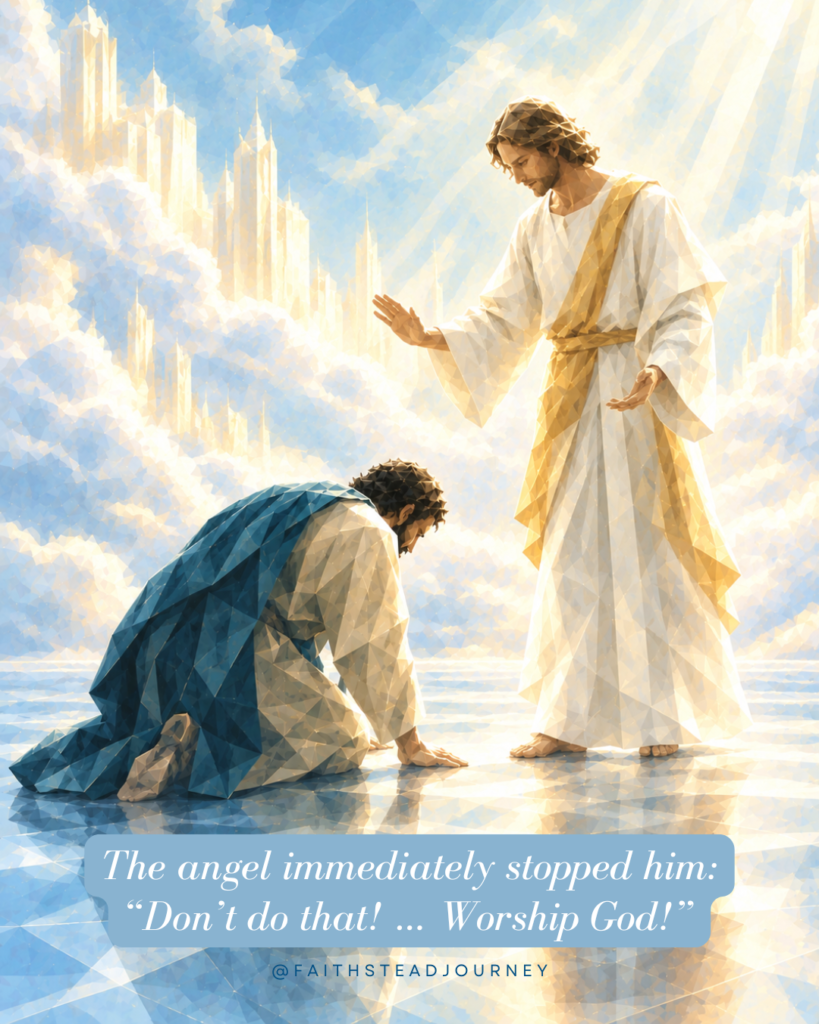
But the angel immediately corrects him:
“Don’t do that! I am a fellow servant with you and your brothers and sisters who hold firmly to the testimony of Jesus. Worship God!” (Rev. 19:10)
This moment is deeply significant. Even after receiving the greatest visions ever given to a human being, John still needed to be reminded of the most important truth: only God is worthy of worship.
The angel refuses worship because he understands his role. He is not the source of the revelation but simply the servant who delivers it. That detail is deeply convicting because it reveals how easily we can exalt created beings over the Creator. Throughout history, people have been tempted to idolize prophets, teachers, spiritual leaders, or even angels themselves. But prophecy was never meant to magnify the messenger, the interpretation, or even the future events it foretells. Its purpose is to exalt Christ.
That is why the angel says:
“For the essence of prophecy is to give a clear witness for Jesus.” (Rev. 19:10)
The phrase can be understood as meaning that the purpose and driving force of all prophecy is the testimony about Jesus. All true prophecy ultimately bears witness to Christ. The Old Testament points forward to Him. The Gospels reveal Him. Revelation shows His final victory and eternal reign.
Jesus Himself said:
“These are the very Scriptures that testify about me.” (John 5:39)
From Genesis to Revelation, the story of Scripture is not primarily about kingdoms rising and falling, beasts, signs, or future events. It is about the Lamb who was slain and who conquers. Prophecy is not given merely so that we can understand—it is given so we can worship rightly.
This also brings the entire message of Revelation into focus. Babylon calls humanity to worship what is created: wealth, power, pleasure, achievement, and human glory. The angel calls John back to worship the Creator.
The greatest danger is not failing to decode every symbol. The greatest danger is seeing all the wonders of Revelation and missing the One at the center of it all. The final goal of Revelation is not that we become experts in prophecy—it is that we become faithful worshipers of Jesus.
The true Spirit of prophecy always leads us to the same place:
“Worship God.”
I’ve compiled all of my Revelation Reloaded reflections into one PDF so you can read through them in one place, revisit them as you study, or keep them alongside your Bible as you journey through Revelation for yourself.