We’re getting closer to the end as God’s final judgments are being poured out this week. There are two important points to remember. One, God can never be cruel or over-punish as that would make Him unjust. Two, God’s wrath is not the opposite of His love, but an expression of His love. Since God loves His people, any harm done to them would stir up His wrath.
The Throne Room
“Then I saw another great and awe-inspiring sign in heaven: seven angels with the seven last plagues; for with them God’s wrath will be completed. I also saw something like a sea of glass mixed with fire, and those who had won the victory over the beast, its image, and the number of its name, were standing on the sea of glass with harps from God. They sang the song of God’s servant Moses and the song of the Lamb: Great and awe-inspiring are your works, Lord God, the Almighty; just and true are your ways, King of the nations. Lord, who will not fear and glorify your name? For you alone are holy. All the nations will come and worship before you because your righteous acts have been revealed.” – Revelation 15:1-4
It’s not a surprise that we find ourselves in the heavenly throne room again right before the seven bowls. This is intentional. John repeatedly interrupts the chaos on earth by taking us back to the throne room. In fact, these scenes are what anchor the whole book. Every time we begin feeling overwhelmed by dragons, beasts, plagues, persecution, or Babylon’s apparent triumph, John lifts our eyes back to heaven to remind us of what is ultimately true.
God’s will is done on earth as it is in heaven. This means that the heavenly interprets earth’s circumstances, not the other way around. If you only watched the events unfolding on earth, you might conclude that evil is winning. But every return to the throne room reveals the true reality that the throne never moves. Christ is reigning. The throne room becomes the “control room” from which all earthly events are governed. These repeated trips to heaven help strengthen the believers to endure suffering because they are reminded that God’s sovereignty is unshakable.
You may have also noticed that every throne room scene erupts into worship. Worship is not escapism. The more clearly we see God’s work, the more passionate we should be in our worship. Worship is the proper response to understanding reality.
“After this I looked, and the heavenly temple—the tabernacle of testimony—was opened. Out of the temple came the seven angels with the seven plagues, dressed in pure, bright linen, with golden sashes wrapped around their chests. One of the four living creatures gave the seven angels seven golden bowls filled with the wrath of God who lives forever and ever. Then the temple was filled with smoke from the glory of God and from his power, and no one could enter the temple until the seven plagues of the seven angels were completed.” – Revelation 15:5-8
Another surprising pattern is that judgment also begins in the throne room. The Lamb received the scroll before the seals were open. The saints’ prayers rose like incense before the trumpets sounded. And the bowls are handed out from the heavenly temple. This reminds us that God’s judgments are not arbitrary. They proceed from His holiness, justice, and covenant faithfulness.
Then what happens next signals a decisive turning point in the book. Even though we’ve already we’ve caught glimpses of the temple in several passages of Revelation, this is the first time that the heavenly temple is said to be filled with smoke. This draws on rich Old Testament imagery to communicate the holiness of God and the completion of His redemptive plan.
The first parallel is found at the completion of the tabernacle in Exodus 40 when “the cloud covered the tent of meeting, and the glory of the LORD filled the tabernacle. And Moses was not able to enter the tent of meeting because the cloud settled on it.”
A similar event occurred centuries later at the dedication of Solomon’s temple in 1 Kings 8. “The house of the LORD was filled with a cloud, so that the priests could not stand to minister because of the cloud, for the glory of the LORD filled the house of the LORD.”
Perhaps the most striking feature of the passage is John’s statement that “no one could enter the sanctuary until the seven plagues… were finished.” This is far more than a descriptive detail. It carries profound theological significance. Throughout Revelation, there has been repeated opportunity for repentance. But when God’s holiness fills the temple, the temple is inaccessible. God’s final judgment is no irreversible. The time for intercession has passed.
Wow, as members of the royal priesthood, it’s so important to seize the chance we still have now to intercede for the lost! The temple is not closed off yet. Does this scene encourage you to pray for those who don’t know the Lord yet?
The First Five Bowls
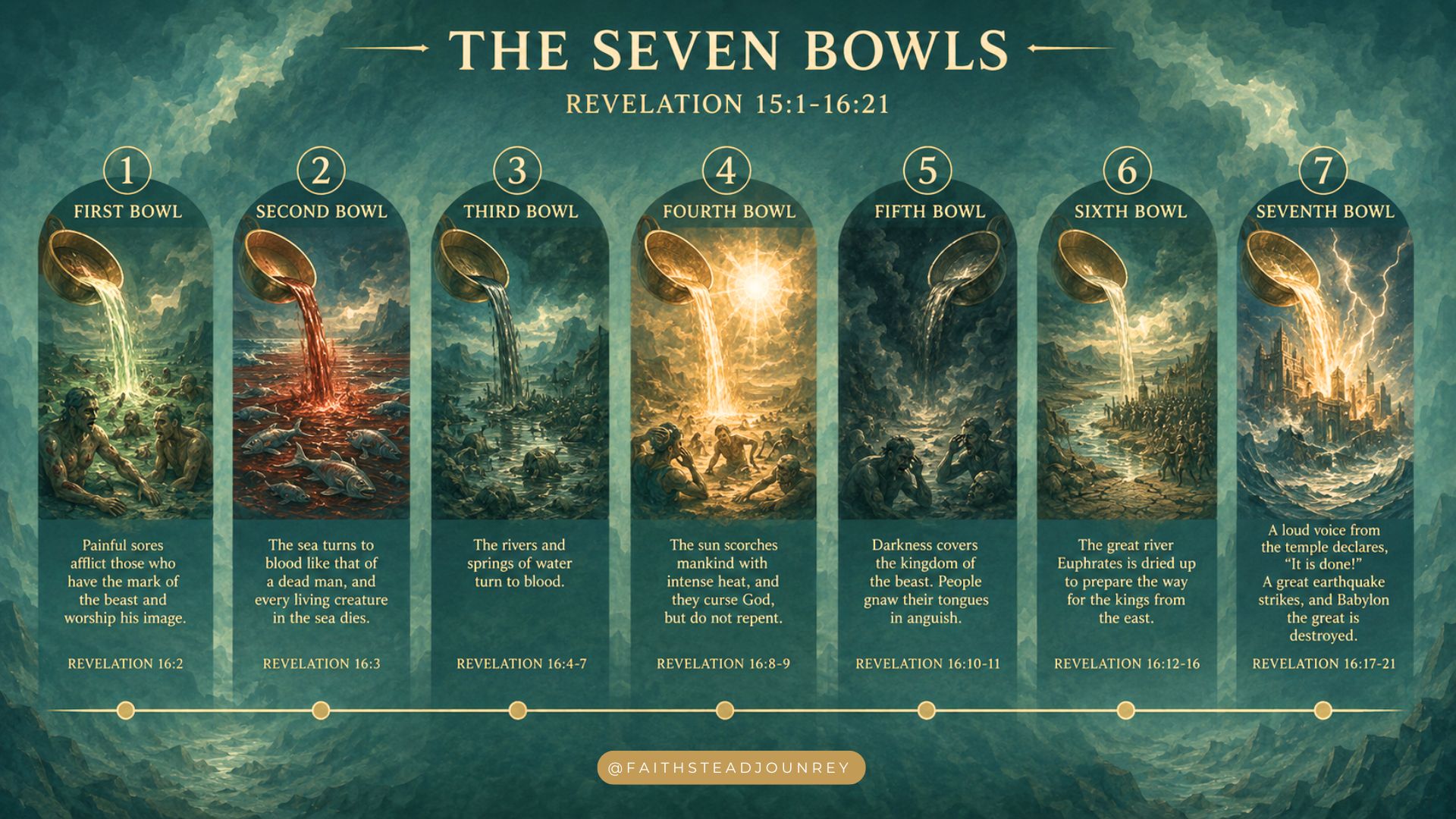
Like the seals and trumpets, the bowls also echo the Exodus plagues. The difference is that the judgments intensify with each series: the seals affect one-fourth, the trumpets one-third, and the bowls are poured out without limitation, signaling the completion of God’s wrath.
The first five bowls affect all three realms of God’s creation—the earth, the sea and rivers, and the heavens. Yet the greatest tragedy is not the devastation itself. It is humanity’s response.
Instead of turning to the One who made them, the earth-dwellers curse Him. Again and again, John repeats the same heartbreaking refrain: they did not repent… they blasphemed the name of God (Rev. 16:9, 11). The judgments expose hearts that have become so hardened that even the clearest displays of God’s power cannot soften them.
The scene deliberately echoes Pharaoh during the Exodus. Despite plague after plague, Pharaoh repeatedly hardened his heart until there came a point when judgment simply confirmed the path he had already chosen. Revelation presents the world as a new Egypt. Like Pharaoh, those who belong to the beast refuse to bow before the true King, even as creation itself testifies against them.
This is where Revelation reveals something profoundly sobering: sin does not merely make us guilty—it makes us less human.
Scripture teaches that we become like what we worship. Paul writes that God’s purpose is for His people “to be conformed to the image of his Son” (Romans 8:29). As we behold Christ, we are gradually transformed into His likeness. But Revelation presents the opposite reality as well. Those who worship the beast and receive his image are likewise conformed to the image of the one they worship.
There are only two humanities in Revelation: those who bear the image of the Lamb and those who bear the image of the beast.
This is the true horror of the bowls. The repeated refusal to repent is not simply a series of bad decisions; it reveals people who have become increasingly incapable of recognizing truth, goodness, and beauty. They no longer respond to God’s voice with worship but with blasphemy. The image of God has been obscured by the image of the beast.
Francis Schaeffer observed in How Should We Then Live? that once a culture rejects the God who created humanity in His image, it inevitably loses any objective basis for human dignity. If there is no Creator, then human beings become little more than highly evolved machines—valuable only insofar as they are useful, productive, or desirable. What begins as a philosophical shift eventually reshapes an entire civilization’s understanding of what it means to be human.
Revelation takes Schaeffer’s insight even further. Idolatry does not merely produce bad ideas; it actually unmakes the human person. The beast promises power, security, prosperity, and autonomy, but those who worship him do not become more fully alive. They become less human. They lose the very capacities that reflect the image of God: humility, gratitude, worship, love, truthfulness, and the ability to recognize beauty and goodness. The more they resemble the beast, the less they resemble the God in whose image they were created.
Perhaps this theme feels especially relevant today. We live in an age captivated by technology, artificial intelligence, algorithms, and machines. These tools are not evil in themselves, but they constantly tempt us to reduce humanity to computation, efficiency, or productivity. We increasingly speak of the brain as a computer, relationships as transactions, and people as data points to be analyzed or optimized. At the very moment machines are becoming more human-like in their abilities to converse, create, and imitate, many people have begun to think of humans as little more than sophisticated machines.
Yet Revelation reminds us that what makes us human has never been our intelligence, creativity, or usefulness. A machine may imitate conversation, generate artwork, compose music, or solve complex problems, but it cannot bear the image of God. It cannot worship, repent, love God, or reflect His holy character. The question Revelation presses upon us is not, How intelligent are we? but Whose image are we bearing?
This is why the conflict between the Lamb and the beast is ultimately a conflict over humanity itself. One kingdom restores the image of God; the other distorts it. One forms people into the likeness of Christ; the other molds them into the likeness of the beast.
The gospel, then, is not merely about escaping judgment; it is about becoming truly human again. Through faith in Christ, we are made a new creation and are being restored into the image of the perfect Man, Jesus Christ, who perfectly reflected the glory of the Father. Salvation is God’s great work of rehumanization.
By contrast, to reject Christ and embrace the beast is to move in the opposite direction. It is to become increasingly dehumanized—to lose the capacity for worship, gratitude, and love until even standing beneath God’s mighty acts, the only response left is to curse the very One in whose image we were made.
The bowls reveal that final judgment does not create hardened hearts; it unveils what those hearts have become. In the end, everyone bears the image of the one they have worshiped.
The Sixth Bowl
When the sixth bowl is poured out, John writes, “The sixth poured out his bowl on the great river Euphrates, and its water was dried up to prepare the way for the kings from the east” (Revelation 16:12). Throughout Scripture, the drying up of waters represents God making a way for His purposes to be accomplished. God dried the Red Sea so Israel could escape Egypt and dried the Jordan so His people could enter the Promised Land. Yet in Revelation, this imagery is tragically reversed, it’s like a dark parody of the Exodus. The waters are dried up, not to deliver God’s people from their enemies, but to prepare the way for the nations who have gathered in rebellion against Him.
The Euphrates also carried the symbolism of the great empires that opposed God’s people, especially Babylon. The prophets Isaiah and Jeremiah spoke of Babylon’s downfall using the imagery of its waters being dried up. John is showing that no kingdom, no matter how powerful it appears, can stand against God. The kings of the earth believe they are gathering for victory, but they are actually being gathered toward their own judgment.
This reveals one of Revelation’s great themes: humanity apart from God does not become more powerful—it becomes deceived. The nations believe they are controlling history, but they are unknowingly fulfilling God’s purposes.
If the first five bowls reveal what hardened hearts have become, the sixth bowl reveals the spiritual power that has been shaping them all along.
John writes, ” Then I saw three unclean spirits like frogs coming from the dragon’s mouth, from the beast’s mouth, and from the mouth of the false prophet” (Rev. 16:13). These are not merely strange creatures; they are “demonic spirits, performing signs,” whose purpose is to deceive the rulers of the earth and gather them for the final rebellion against God.
The image is intentionally grotesque. Frogs immediately recall the second plague of Egypt, another reminder that Revelation is portraying the world as a new Exodus. But John adds another layer to the symbolism. These are not simply frogs—they are unclean spirits. They emerge from the mouths of an unholy trinity that has spent the entire book imitating the work of the Holy Trinity.
Throughout Scripture, the Holy Spirit’s ministry is to glorify Christ, lead people into truth, convict the world of sin, and gather God’s people into the kingdom of God. Here, however, these unclean spirits carry out a counterfeit mission. They also go out into the world. They also persuade. They also gather people. But instead of gathering the nations to worship the Lamb, they gather them to make war against Him. Instead of leading people into truth, they lead them deeper into deception. Instead of producing repentance, they produce rebellion.
The contrast becomes even more striking when we remember Jesus’ baptism. There, the Holy Spirit descended like a dove, marking the beginning of Christ’s public ministry. Throughout Scripture, the dove symbolizes peace, purity, and new creation. After the flood, a dove returned to Noah with an olive leaf, announcing that judgment had passed and new life had begun. At the Jordan River, the Spirit descended upon Jesus as the true beginning of God’s new creation.
How different is John’s vision in Revelation. Instead of a dove descending from heaven, unclean frogs crawl out from the mouths of the dragon and his beasts. One image announces life; the other spreads death. One points the world to the Son of God; the other points the world to the beast. One gathers a redeemed people into God’s kingdom; the other gathers the nations for Armageddon.
This is one of Revelation’s great themes: Satan cannot create—he can only counterfeit. He has a counterfeit christ, a counterfeit prophet, counterfeit signs, counterfeit worship, and now even a counterfeit spiritual mission. The dragon’s kingdom mimics God’s kingdom in order to deceive those who have rejected the truth.
That deception feels remarkably familiar today. We often imagine idolatry as bowing before carved statues, but Revelation reminds us that idolatry is ultimately about giving our allegiance to a false vision of reality. Every day we are surrounded by voices promising salvation through power, technology, politics, wealth, autonomy, or self-expression. These promises often sound persuasive because they imitate the language of hope and redemption, yet they cannot give life. Like the frog spirits, they gather hearts away from God while convincing people they are becoming wiser, freer, and more fulfilled.
This is why discernment is so essential for the Church. The question is not whether we are being formed—we all are. The question is who is forming us. Are we being led by the Spirit of God into the likeness of Christ, or are we allowing the voices of our age to shape us into the image of the beast? Every voice is inviting our worship. Every story is trying to form our loves. Every kingdom is offering a vision of what it means to be human. Revelation calls us to reject every counterfeit and to follow the Lamb, whose Spirit alone restores us into the image of God.
In the middle of this terrifying scene, where the dragon, the beast, and the false prophet are gathering the nations for the final rebellion against God, John suddenly records the words of Jesus: “Look, I am coming like a thief. Blessed is the one who is alert and remains clothed so that he may not go around naked and people see his shame” (Revelation 16:15).
It took me a while to understand this because this statement seems almost out of place. After describing demonic spirits like frogs, deceptive signs, and the gathering of armies for Armageddon, why does John suddenly shift to the language of clothing? But this is not a distraction from the story—it is Jesus’ direct word to His Church in the midst of the deception.
The phrase “I am coming like a thief” echoes Jesus’ warning to the church in Sardis: “If you are not alert, I will come like a thief, and you have no idea what hour I will come upon you” (Revelation 3:3). The image of a thief is not meant to suggest that Jesus is deceptive; rather, it emphasizes that His coming will be unexpected and decisive. While the world is being gathered by the unclean spirits toward a false kingdom, Christ is reminding His people that history is moving toward His return.
The call to “remain clothed” carries even deeper meaning. Throughout Scripture, clothing is connected to humanity’s relationship with God. In the Garden of Eden, Adam and Eve were naked and without shame until sin entered the world. After their rebellion, they realized their nakedness and attempted to cover themselves, but their own coverings were insufficient. God Himself provided a covering for them (Genesis 3:21), foreshadowing humanity’s need for God’s gracious provision.
This same imagery appears earlier in Revelation when Jesus confronts the church in Laodicea. They believed they were rich, successful, and in need of nothing, but Christ revealed their true condition: “you are wretched, pitiful, poor, blind and naked” (Revelation 3:17). He commanded them to receive from Him “white clothes so that you may be dressed and your shameful nakedness not be exposed” (Revelation 3:18).
The warning in Revelation 16:15 carries the same message. The greatest danger facing God’s people is not only persecution from the beast; it is being deceived by the beast’s promises. The world offers its own coverings—power, status, wealth, autonomy, and self-definition—but these are ultimately unable to cover human brokenness. Like Adam and Eve hiding in the garden, humanity continues to attempt to cover its shame apart from God.
The beast offers a counterfeit humanity: identity without the Creator, freedom without submission, glory without holiness, and life without worship. But Revelation reveals that this path does not lead to true freedom; it leads to exposure. Those who follow the beast may appear powerful in the eyes of the world, but before God they stand spiritually naked.
In contrast, those who belong to Christ are clothed by Him. Throughout Revelation, God’s people are repeatedly pictured wearing white robes—the martyrs who remain faithful, the great multitude who have been washed by the blood of the Lamb, and the Bride who is given fine linen representing the righteous deeds of God’s people. Their clothing is not something they have earned or manufactured; it is a gift from the Lamb.
This brief interruption before the seventh bowl is therefore a gracious warning. After showing us a world captivated by deception, Jesus reminds His Church: stay awake. Do not trade the garment of Christ’s righteousness for the counterfeit glory of the beast. Do not allow the world to define what it means to be human, blessed, or successful. Remain faithful to the One who alone can restore the image of God in us.
The Seventh Bowl
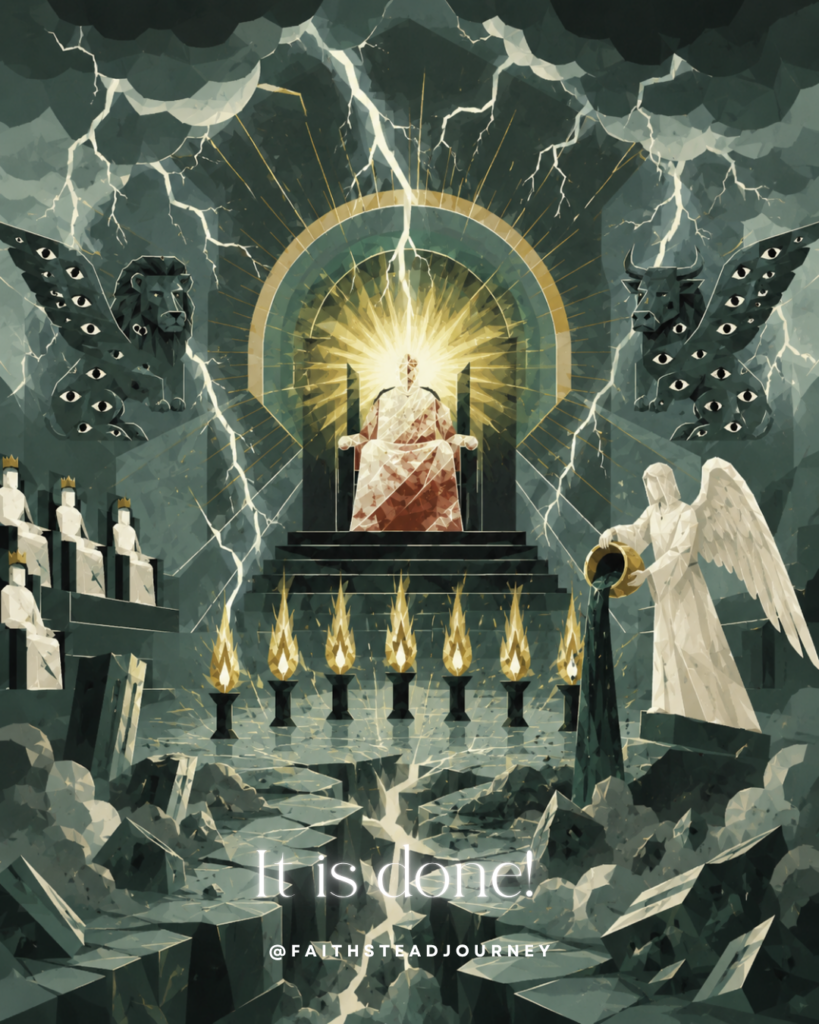
The seventh bowl brings God’s judgments to their climax. As the angel pours out the final bowl, a loud voice from the throne declares:
“It is done!” – Revelation 16:17
These words immediately bring us back to another declaration made nearly two thousand years earlier, when Jesus cried from the cross:
“It is finished.” – John 19:30
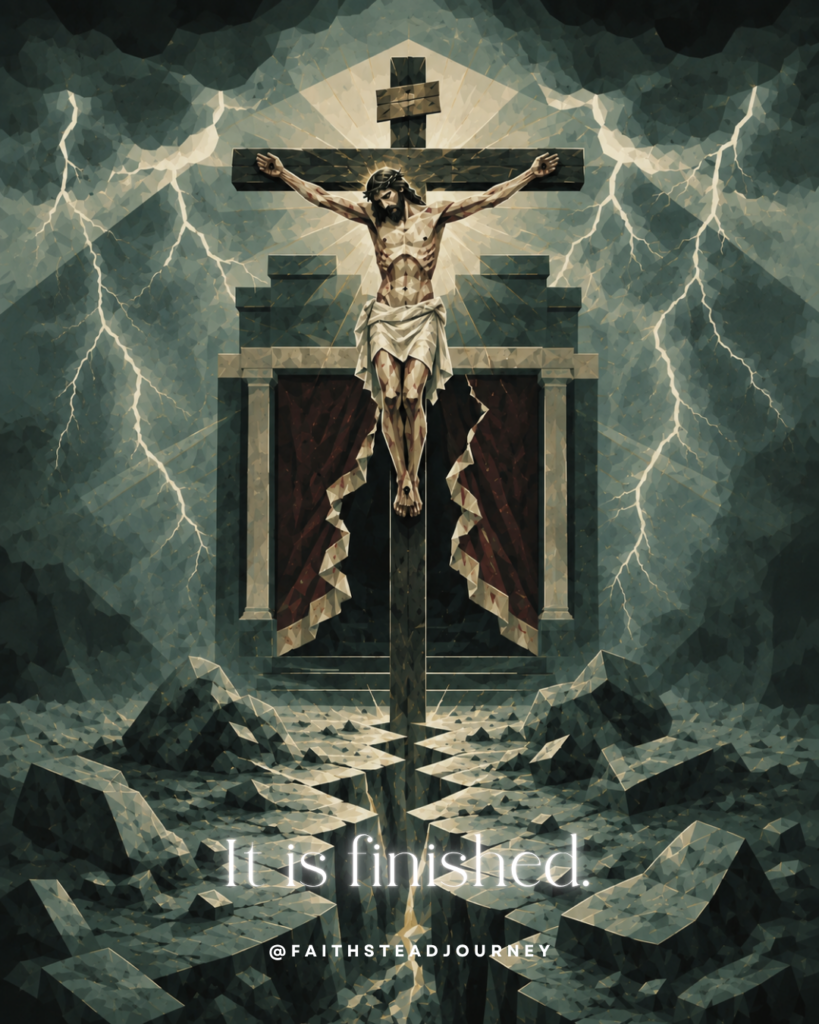
These two statements are deeply connected. At the cross, Jesus declared that the work of redemption was complete. The wrath that sinners deserved had been fully satisfied in Him. At the seventh bowl, the voice from heaven declares that God’s righteous judgment has reached its appointed completion. The first announcement comes from the suffering Savior; the second comes from the throne of the sovereign Judge. Together they reveal that God’s justice will be fully accomplished.
Both moments are also accompanied by earthquakes. When Jesus died, “the earth shook, the rocks split” and the curtain of the temple was torn in two (Matthew 27:51), revealing that through Christ’s sacrifice the way into God’s presence had been opened. At the seventh bowl, another great earthquake shakes creation and the great city is split apart (Revelation 16:18–19), revealing the final collapse of all that stands opposed to God.
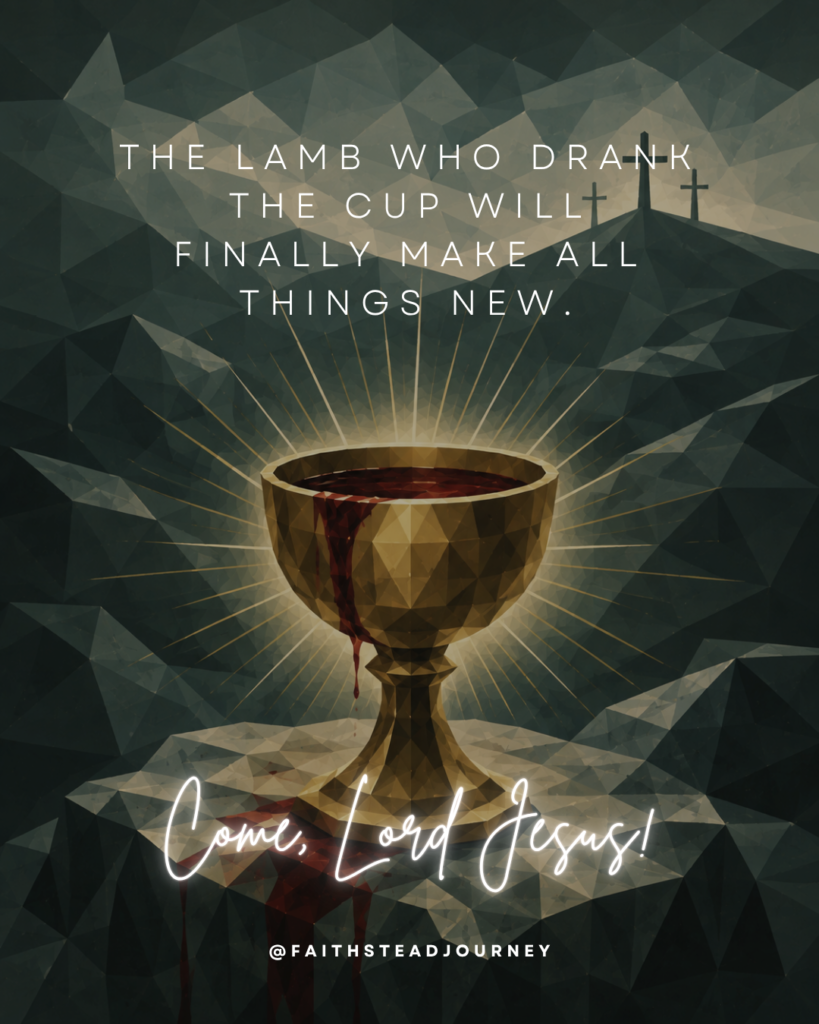
The connection between these two moments is found in the image of the cup. In Scripture, the cup often represents God’s righteous wrath against sin. In the garden of Gethsemane, Jesus prayed:
“Father, if you are willing, take this cup from me. Nevertheless, not my will, but yours, be done.” – Luke 22:42
Jesus was not only anticipating the physical suffering of the cross; He was preparing to drink the cup of God’s judgment that we deserved. The holiness and justice of God required that sin be judged, but because of God’s mercy, Jesus took that judgment upon Himself.
This is the great exchange of the gospel: Jesus drank the cup of wrath so that His people could receive the cup of blessing. The One who deserved no judgment received the judgment of God; those who deserved judgment receive forgiveness, adoption, and life.
But Revelation 16 reveals the tragedy of those who reject the Lamb. By refusing Christ, they refuse the One who came to drink their cup for them. Instead, they remain under God’s righteous judgment and must drink the cup themselves.
This is what makes the Lord’s Supper so precious. When Jesus gave His disciples the cup, He said:
“This cup is the new covenant in my blood. Do this in remembrance of me.” – Luke 22:20
What are we remembering?
We remember that the cup we hold is not the cup we deserve. We remember the cup Jesus asked the Father to remove, yet willingly drank on our behalf. We remember that God’s wrath has already fallen on Christ, so that we might receive mercy. We remember that the cup of communion is a cup of blessing because the Lamb first drank the cup of judgment.
Every time we take the Lord’s Supper, we proclaim both the seriousness of sin and the greatness of grace. We remember that “It is finished” because Christ has paid the price, and we look forward to the day when heaven declares, “It is done,” because God’s kingdom has come in fullness.
I’ve compiled all of my Revelation Reloaded reflections into one PDF so you can read through them in one place, revisit them as you study, or keep them alongside your Bible as you journey through Revelation for yourself.