Have you heard of the Shroud of Turin? It is a powerful testament to the death, burial, and resurrection of our Lord and Savior, Jesus Christ.
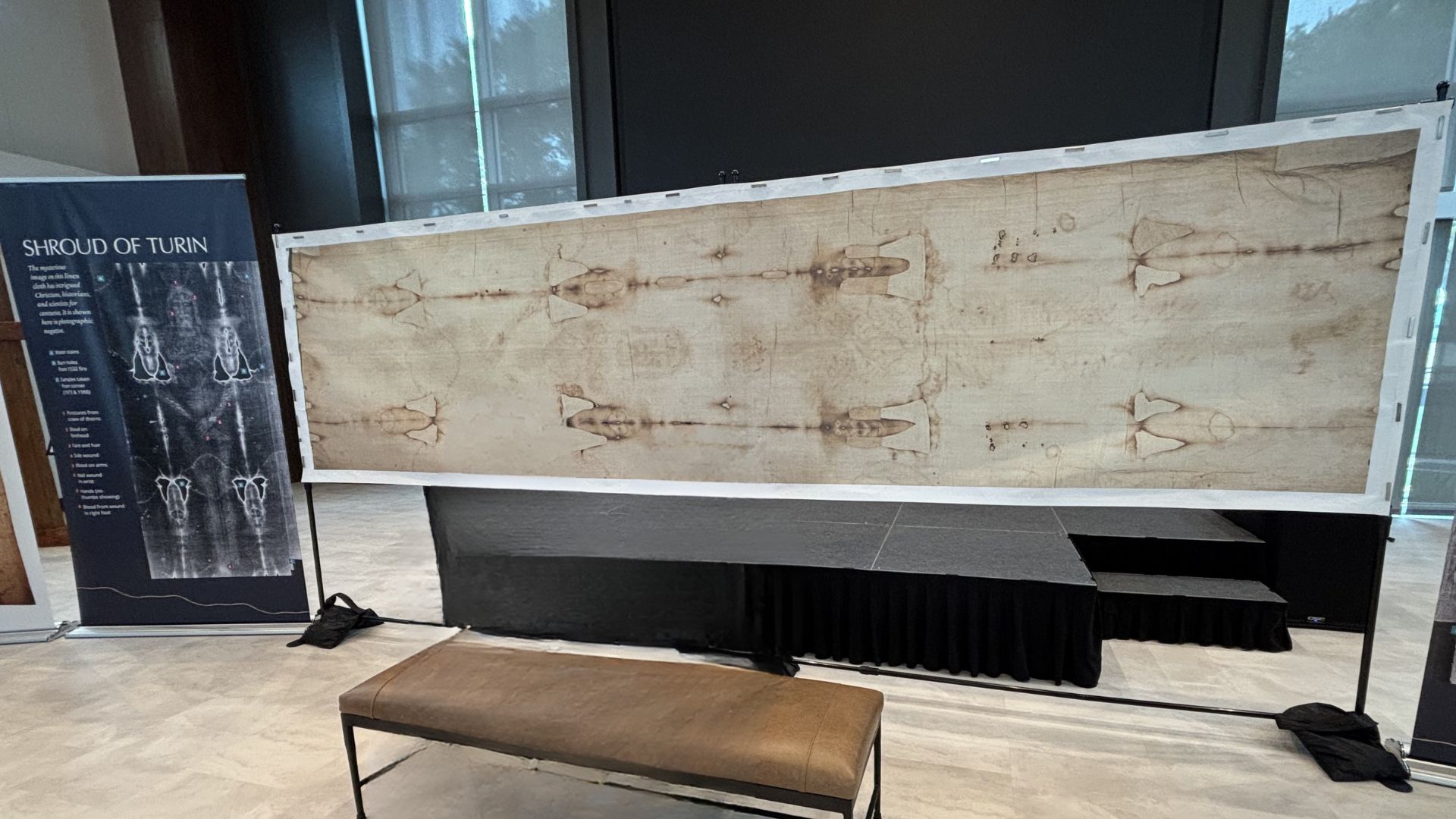
The Shroud of Turin is an ancient linen burial cloth—over 14 feet long and 3½ feet wide. It’s considered one of the most scrutinized artifacts in the world, bearing the mysterious image of a man whose wounds closely align with the Gospel accounts of Jesus’ suffering and crucifixion.

I recently got to visit a mini pop-up Shroud of Turin Exhibit in Katy, TX. There are many interesting facts to learn about the shroud, but what struck me most wasn’t the shroud itself—it was the Person it points to.

This is a flagrum, which is a short whip with barbells on the end, and what was used to flog Jesus. Based on the shroud, scientist estimate that there were at least 700 wounds on His body. Any normal man would have died from the beating, but Jesus was determined to accomplish His Father’s will to get to the cross so he endured it.
Notice how short these whips are and you can imagine that while the guards where flogging Jesus and shredding up his body, his blood was splattering everywhere on to the guards. Peter tells us that due to Jesus Christ’s obedience we are sprinkled clean by His blood. We were once enemies, but Jesus responds by sprinkling His blood over us.

Also 50 wounds were found on the head alone. That means that the crown of thorns isn’t the typical wreath we think of but a helmet of thistles. From Genesis we know that thorns came because of the curse that fell on humanity. So thorns became a sign of judgment and at the cross we see that judgment literally became Jesus’ crown and He willingly carried our curse on his head.

The shroud also appears to depict Jesus’ body in an unnatural, stiff position—consistent with rigor mortis, the post-death stiffening of muscles that typically lasts around 40–42 hours. Since roughly 36–40 hours passed between Jesus’ death and resurrection, this would suggest His body had not yet begun to decay. This aligns beautifully with Psalm 16:10: “You will not let your Holy One see decay.”

The shroud also shows four distinct piercings, consistent with crucifixion. The nails used by the Romans were often bent from multiple use and the soldiers would further torment victims by shifting the nails while they hung. Can you imagine the agony? In Colossians Paul says that Jesus took all our debts and nailed them to the cross. Jesus was nailed in our place. Wow!

If you’ve ever wondered whether or not God really loves you, come and see what Jesus bore on our behalf. It is easy for us to become desensitized to the cross but as Dr. Jeremiah Johnston puts it: The shroud is an itemized receipt of how much Jesus loves you.

And what absolutely blew my mind away was how this shroud documents the split second when Jesus resurrects to new life. Scientists hypothesize that the image on the cloth was made when a very sudden and intense bright light was emitted from the body at the resurrection, creating the first selfie imprint on the linen.

Another fascinating detail—C. S. Lewis actually kept an image of the man of the Shroud of Turin in his bedroom at The Kilns. It served as a quiet reminder that our God is not distant or abstract—He has a face.
Lewis even wrote a letter to the Anglican nun who gifted it to him:
“Thank you so much for the head of Our Lord from the shroud. It has grown upon me wonderfully. I don’t commit myself to its genuineness… But the great value is to make one realise that He was a man, and once even a dead man. There is so much difference between a doctrine and a realisation.”
And that’s the point, isn’t it?
Jesus isn’t just an idea or a doctrine to study—He is a real man who walked this earth, suffered, and died on a real cross… and He truly rose again.
And when you truly surrender your life to Him, it’s not just information—it’s transformation.
If there’s ever a Shroud of Turin Exhibit in your area, don’t miss it! I’m so grateful I got to experience the risen Christ in a whole new way!